






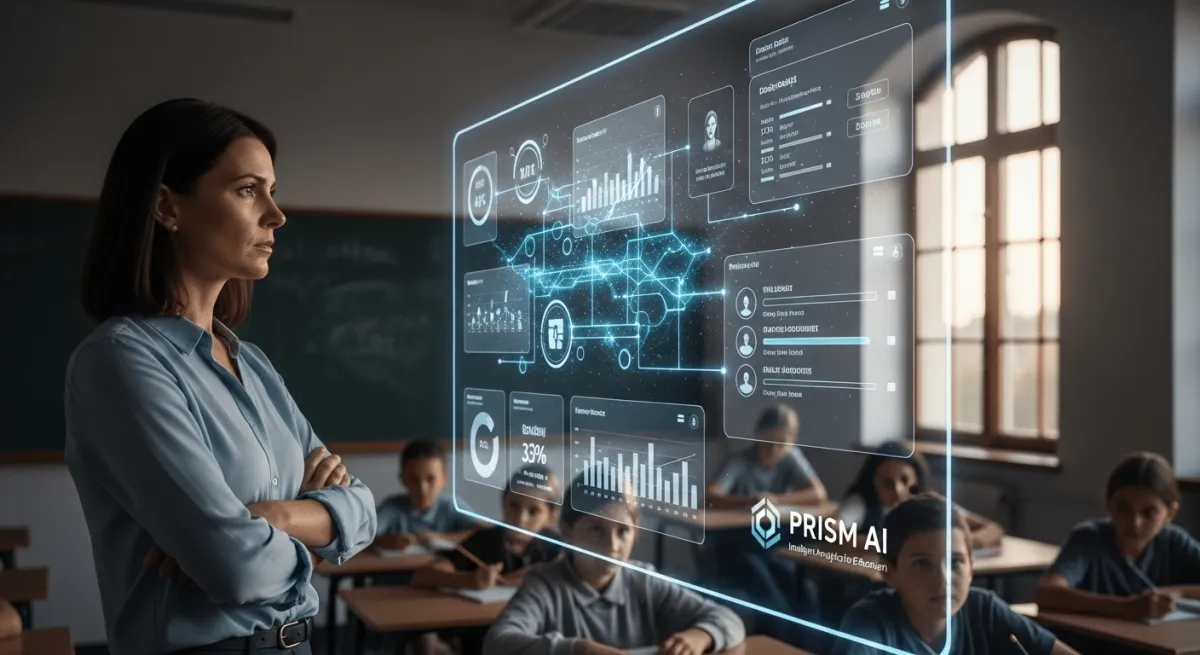
The arrival of artificial intelligence in education has changed the meaning of the classroom. A student can now ask a machine to explain a difficult concept, summarise a book, solve a mathematical problem, translate a passage or even write an essay within seconds. Information, once carefully gathered from libraries, teachers and textbooks, is now available at the touch of a screen. But while AI can make learning faster, it cannot make education meaningful on its own.
The central question before us is not whether artificial intelligence should enter the classroom. It already has. The more important question is what will happen to the relationship between teachers and students when a machine becomes capable of answering almost every academic question.
For generations, education has rested on a human relationship. A teacher does not merely deliver facts. A teacher observes hesitation in a student’s eyes, notices a sudden silence, recognises a loss of confidence and sometimes understands a problem that the student has not expressed in words. This human attentiveness cannot be replicated by an algorithm, however advanced it may become.
A machine can provide an answer. A teacher helps a student understand why the answer matters.
This distinction is becoming increasingly important. AI tools can produce fluent essays, generate presentations and complete assignments. But education is not simply the production of correct sentences or impressive answers. It is the development of judgment, curiosity, discipline, empathy and responsibility. If students begin to depend on AI for every intellectual task, they may acquire information without developing the ability to think independently.
The danger is not technology itself. The danger lies in allowing convenience to replace effort. Teachers, therefore, must not view AI only as a threat to their authority. Nor should they treat it as a shortcut that can replace teaching. AI should be used as an aid, not as a substitute for the teacher or the student’s own intellectual labour. It can help teachers prepare lessons, identify learning gaps, create examples and offer different explanations for difficult subjects. It can help students practise, revise and explore beyond the limits of the textbook. But its use must remain guided by human judgment.
The teacher’s role in the AI age is not diminished; it is made more demanding. Earlier, a teacher’s responsibility was largely to provide knowledge and explain concepts. Today, teachers must also teach students how to evaluate information, recognise bias, protect privacy, question machine-generated answers and use technology ethically. They must help students distinguish between assistance and dependence, between learning and copying, and between originality and imitation.
This requires a new kind of digital literacy. A student should know that an AI-generated response may sound confident while being factually wrong. They should understand that technology can reflect the biases present in the data on which it has been trained. They should also learn that feeding personal information, private conversations or sensitive academic records into unknown platforms can create serious risks.
The classroom must become a place where such questions are discussed openly. There is also a moral dimension to the issue. The relationship between a teacher and a student is built on trust. When a student submits work entirely produced by AI as their own, that trust is weakened. The concern is not merely about cheating in an examination. It is about the gradual weakening of honesty as a value. Education loses its purpose when marks become more important than learning and appearance becomes more important than effort.
At the same time, institutions must be careful not to respond with fear alone. A blanket ban on AI may appear decisive, but it will not prepare students for the world they will enter. Artificial intelligence is already shaping workplaces, public services, research and communication. Students must learn to use it responsibly rather than remain unaware of its possibilities and dangers.
Schools and colleges should formulate clear and practical policies. Students should be told when AI assistance is permitted, how it must be acknowledged and which tasks require independent work. Assessments should increasingly test reasoning, discussion, creativity and personal understanding rather than only the reproduction of memorised content. Oral presentations, classroom debates, project work and reflective writing can help teachers determine whether a student has genuinely understood a subject.
The teacher-student relationship must also become more conversational. In a world where information is abundant, the teacher’s greatest contribution may be the ability to ask the right questions. A good teacher encourages a student to examine assumptions, defend an argument, listen to an opposing view and connect knowledge with lived experience. These are not mechanical processes. They are part of the formation of a thoughtful human being.
For students, AI should be treated as a questioning partner, not an invisible author. They can ask it to explain a concept in simpler language, suggest alternative viewpoints or identify weaknesses in an argument. But the final judgment, interpretation and responsibility must remain their own. A student who uses AI to avoid thinking may complete an assignment, but a student who uses it to deepen thinking may genuinely learn.
In this transformation, emotional connection will matter even more. Young people are not only seeking information; they are also dealing with anxiety, competition, loneliness and uncertainty about the future. A digital tool may respond instantly, but it cannot replace the encouragement of a teacher who believes in a student’s potential. It cannot take responsibility for a vulnerable child, mediate a conflict or inspire courage during failure.
The future classroom should not be a battle between teachers and machines. It should be a space where technology supports human teaching and human values direct technology. The teacher must remain the mentor, the student the learner, and AI the instrument.
Education will succeed in the age of artificial intelligence only when it remembers that learning is not the same as receiving information. It is a relationship through which knowledge becomes wisdom, discipline becomes character, and curiosity becomes purpose.
The machine may know more answers. But the teacher must continue to show students how to live responsibly with them.
(The Author is a lecturer in HED and a columnist)


