



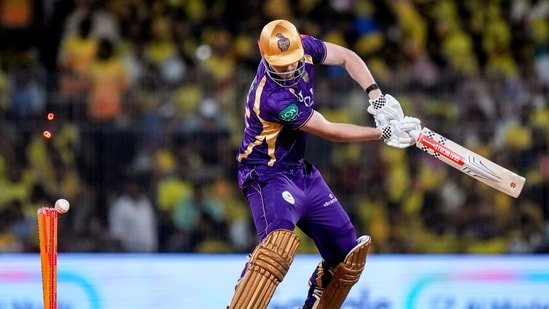
Cameron Green’s balance sheet against CSK was not just poor. It was the kind of night that turns a season ledger into a warning sign. Out first ball, no wicket, no meaningful return, and by the end of KKR’s 32-run defeat, the financial hole around him had grown large enough to feel familiar in IPL terms.
Because this is no longer only about Green’s original ₹25.20 crore auction fee. After five matches, KKR’s cumulative loss on him in our model stands at ₹8.01 crore. That is the exact price bracket where franchises buy a serious first-choice IPL cricketer. It is worth the price of Tilak Varma’s IPL contract. It is also the cost of Mukesh Kumar or Harshal Patel. That is what makes the Green story sting.
A game that pushed the deficit into a new bracket
The CSK match gave this story its sharpest edge yet. Green made 0, took 0 wickets, conceded 30 runs, and returned ₹0 in match worth in our method. With his per-match cost in this system fixed at ₹180 lakh, that meant another full negative hit.
Before this game, Green had at least one meaningful evening to point to. Against LSG, he produced his best single-match return of the season at ₹64.87 lakh. But that remains the exception, not the pattern. Across five matches, his total match worth generated is still only ₹99.14 lakh. Against a cumulative investment of ₹9 crore so far, that leaves KKR with a net deficit of ₹8.0086 crore.
That number is where this story really begins. Because ₹8.01 crore is not an abstract red-ink figure anymore. It is the auction value of Tilak Varma. It is also what teams committed to Mukesh Kumar and Harshal Patel. KKR’s Green ledger has now drifted into the same financial neighbourhood as an entire frontline player.
The Tilak Varma comparison
Tilak Varma is not just a random name from the auction list. He represents a premium category of player spending that teams usually make with very clear intent. At ₹8 crore, that is the range where a franchise expects role certainty, recurring contribution and a sense of season-long utility.
That is why the Green comparison bites. KKR’s loss on one player has already crossed the amount another team spent to secure Tilak Varma outright. In other words, the downside already attached to Green is now big enough to resemble the full cost of a separate high-value acquisition.
There is another layer to this. Green is not carrying a low-risk profile in the model. With a per-match charge of ₹1.8 crore, each appearance comes with immediate pressure. A modest outing does not help much. A poor outing hurts badly. A zero-return game, like the one against CSK, becomes a financial crater.
What Green’s five-match sheet actually says
The season line is harsh. In five matches, Cameron Green has generated a total match worth of ₹ 99.14 lakh. His average normalised impact is down to 14.12 by our model. His best game remains that LSG outing. Everything else has been either underwhelming or outright damaging to balance sheets.
The individual returns tell the story well enough. He brought back ₹32.41 lakh in one game, ₹1.86 lakh in another, ₹0 in a third, ₹64.87 lakh against LSG, and now ₹0 again against CSK. That is not the spread of a player stabilising his investment. That is the spread of a volatile asset with one modest spike and too many flat lines.
The CSK match worsened that problem because it stripped away even the excuse of partial compensation. There was no batting return. No bowling return of note. No match value at all. KKR paid the full appearance cost and got nothing back in monetary terms.
Why this matters beyond one bad game
A player bought at Green’s number does not need to justify his full fee every night. But he cannot keep slipping into games where the downside overwhelms the upside. Our model prices contribution in a way that punishes low-return appearances against a heavy auction burden. For Green, that burden is now beginning to define the season more than the actual flashes of impact.
That is why the Tilak Varma angle is more than a headline trick. It gives scale to the damage. Fans can understand ₹8 crore. Teams understand what that bracket can buy. Once the loss on Green reaches that level, the discussion changes. It is no longer about patience alone. It becomes about opportunity cost, squad value and whether the investment is giving KKR enough to justify the drag.
Right now, the answer from the numbers is brutally simple. KKR have invested ₹9 crore worth of match-share into Cameron Green so far. The return has been ₹99.14 lakh. The hole is ₹8.01 crore. That is not just a bad run. That is the price of Tilak Varma, sitting on the wrong side of the ledger.
How Cameron Green’s tournament worth is calculated
Our method begins with a player’s auction or retention price and converts it into a per-match cost. For Green, the base price is ₹25.20 crore. The model spreads that across an expected 14 league matches, which gives him a fixed per-match cost of ₹180 lakh. Every appearance is then judged against that charge.
From there, each match contribution is turned into a normalised monetary impact. That score is built from batting, bowling, and fielding inputs and can also be adjusted by manual rating, captaincy bonus, or synergy bonus, where applicable. Once the final normalized impact is ready, it is converted into a rupee value called match worth. That tells us what the player returned in that specific game within this system.
The key balance-sheet number comes next. Rolling profit or loss is simply the player’s match worth minus his per-match cost for that appearance. So if Green returns ₹64.87 lakh in a match, but his cost for that game is ₹180 lakh, the model records a negative result for that appearance. If he returns ₹0, as he did against CSK, the full ₹180 lakh is treated as a loss for that match.
Add those match-by-match outcomes together, and you get the tournament balance sheet so far. That is how Green’s season ends up at ₹99.14 lakh in total returns against ₹9 crore invested, leaving KKR with an overall deficit of ₹8.01 crore after five matches.


