






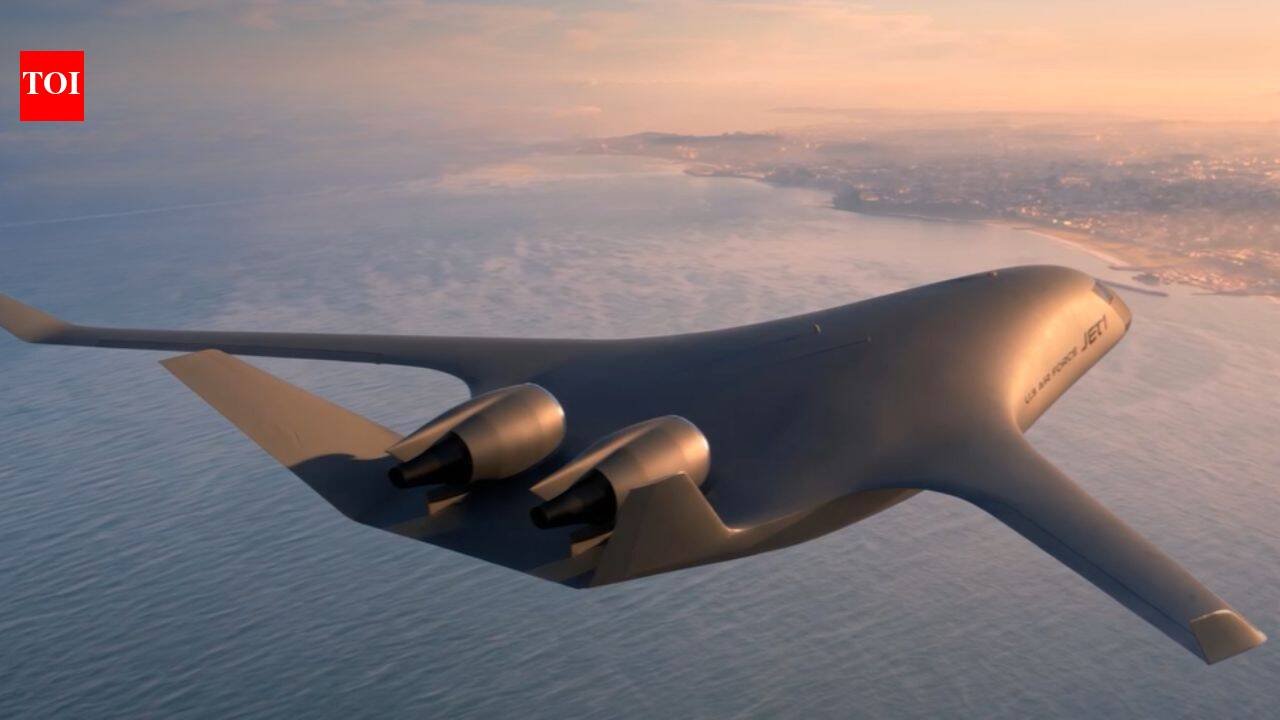
A California-based startup, JetZero, is all set to move closer to a real-world test of a ‘manta ray’ aircraft that could change the future of the airline industry forever. According to the startup, its planned Z4 will carry about 250 passengers, fly roughly 5,750 miles and use 30% to 50% less fuel than the aircraft in service today. The company presented the project during the Farnborough International Airshow, held in the United Kingdom from July 20 to July 24, 2026. Japan Airlines has now joined the program to provide operational input.
A ‘manta ray’ shaped aircraft
The company aims to have a full-scale prototype airborne by 2027 and hopes to launch commercial operations in the early 2030s. In July, JetZero announced a $3 billion deal with the U.S. government to finance a factory in North Carolina aimed at accelerating the development and future production of the aircraft.The major innovation of the aircraft lies in its very shape. Most commercial jets use a “tube and wing” layout, with passengers inside a cylindrical fuselage while two separate wings produce most of the lift that keeps the aircraft in the air. The Z4 uses a blended-wing-body configuration. Its wide, flattened centre section flows gradually into the wings, allowing much more of the structure to generate lift and creating a smoother path for air around the aircraft. Less aerodynamic drag means the engines need less energy to push the plane forward.
The fuel claim that has everyone hooked
Jet fuel is a major operating expense, and the reduction of 50% would affect both environmental performance and the cost of flying each seat. For the most part, burning less conventional aviation fuel also means producing less carbon dioxide per trip.Still, the number is a company target, not a result from a certified passenger aircraft. Even if the Z4 reaches it, the plane would not be emission-free, and the final savings would depend on route length, payload, weather, engine choice, and how airlines configure and operate it.The project envisions a maximum range of approximately 5,000 nautical miles, roughly equivalent to 9,200 kilometres. As a point of reference, this distance is sufficient to cover the route between São Paulo and Madrid, which is estimated at about 8,400 kilometres.About 250 passengers would be distributed across six sections of the cabin, with each seat having access to its own luggage compartment. However, traditional side windows are not part of the design. Instead, screens connected to high-definition cameras will display external images during flight, while two skylights near the front rows will allow natural light to enter. The proposed capacity also fills an awkward space in today’s market. With about 250 seats, the aircraft would sit between the largest single-aisle jets and the bigger twin-aisle models used on many long-haul routes. Its projected range could cover a large share of medium- and long-distance services without forcing airlines into a much larger aircraft.
A long-existing concept
The basic idea has been studied for decades. A Boeing, NASA, and U.S. Air Force team flew the remotely piloted X-48B and X-48C demonstrators more than 100 times, examining low-speed stability, takeoffs, landings, and flight-control behaviour. The tests showed that an unusual, tailless aircraft could be controlled through demanding parts of a flight.Airbus followed another route with MAVERIC, a small remote-controlled demonstrator that first flew in June 2019. The manufacturer estimated that its blended-wing-body configuration could reduce fuel consumption by as much as 20% compared with a current single-aisle aircraft using the same engine.Those projects helped engineers understand the shape, but neither became a commercial passenger jet. JetZero is trying to cross that gap. That is the big difference. But before passengers can board a Z4, the company must prove that the architecture works at full scale. Scaled Composites, a Northrop Grumman subsidiary, is building the Jet1 demonstrator which is scheduled to make its first flight in 2027.The U.S. Department of the Air Force backs the project, selecting the developer for a $235 million blended-wing-body prototype effort. The military sees potential for lower fuel demand, longer range, and more efficient cargo movement, while the same testing could provide useful evidence for a future civilian aircraft.The Z4 has already attracted the attention of some of the largest airlines in the United States. JetZero has agreements with industry companies, and United Airlines plans to purchase up to 200 units of the aircraft. Delta and Alaska Airlines are also among the companies supporting the development of the new platform.
Japan Airlines on board
The developer says it is designing the Z4 to use existing airport infrastructure without specialised or costly changes, a crucial point for airlines that cannot rebuild terminals, taxi routes, and ground equipment around one new model.Japan Airlines will contribute experience in flight operations, cabin service, maintenance, and ground handling. The two companies also plan to study gate management and a future maintenance, repair, and overhaul system that could support operators after entry into service. Takao Suzuki, the airline’s executive officer for corporate strategy, said the collaboration supports its commitment to “sustainable innovation and net-zero emissions by 2050.” JetZero chief executive and co-founder Tom O’Leary said the goal of bringing the aircraft to market in the early 2030s fits the carrier’s longer-term plans.


