



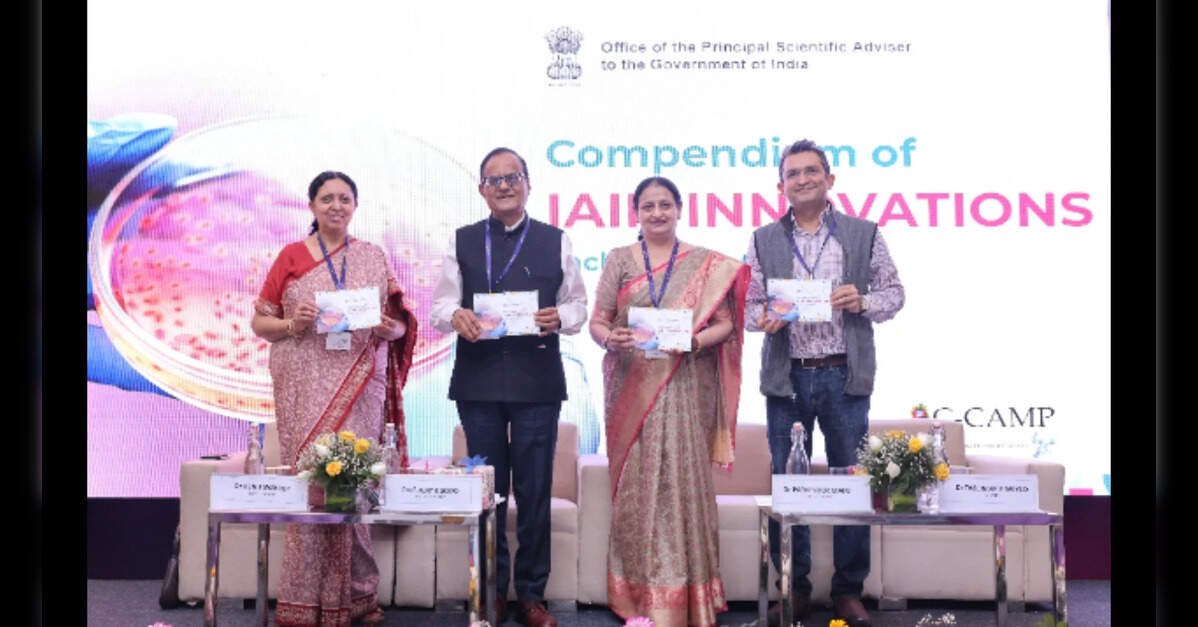
New Delhi: Centre for Cellular and Molecular Platforms (C-CAMP), under the aegis of the India AMR Innovation Hub (IAIH), hosted the second India Antimicrobial Resistance (AMR) Innovation Workshop in the national capital with support from the Office of the Principal Scientific Adviser to the Government of India.
The workshop brought together over 100 stakeholders from across academia, industry, clinical research, government, philanthropy and global public health agencies, marking one of the largest AMR-focused innovation dialogues in the Asia-Pacific region.
The day-long deliberations centred on breaking silos, strengthening cross-sectoral collaboration and consolidating efforts to combat the growing global threat of antimicrobial resistance. The event featured the launch of breakthrough innovations supported by C-CAMP under the IAIH umbrella by Principal Scientific Adviser Prof. Ajay Kumar Sood, along with a technology showcase of solutions spanning air sterilisation systems, rapid genomics-based diagnostics and surveillance platforms, treatment technologies for biopharmaceutical wastewater effluents, and antibiotic-free aquaculture models.
A compendium of 60 AMR solutions supported under IAIH was also released by Prof. Sood in the presence of Dr. Parvinder Maini, Scientific Secretary, OPSA; Dr. Renu Swarup, former Secretary, Department of Biotechnology and Vice Chair for International Centre for Antimicrobial Resistance Solutions (ICARS); and senior representatives from national and international organisations.
The compendium features innovations across preventatives, therapeutics, diagnostics, detection, screening, monitoring and surveillance tools, many of which are at advanced stages of readiness or adoption. These technologies address cross-sectoral challenges and advance the One Health approach integrating human health, animal health, food safety and environmental health.
The workshop also unveiled the second cohort of seven startups selected under the C-CAMP Programme on AMR in the Environment, supported by the UK Department of Health and Social Care’s Global AMR Innovation Fund (GAMRIF), as well as seven winners of the C-CAMP One Health AMR Challenge 2025 supported by Denmark-based ICARS. With the addition of the second cohort, the GAMRIF-supported programme now comprises 16 startups.
The new cohort includes Ampligene India Pvt Ltd., BioNEST-BHU, GenePath India Pvt Ltd., IIT Madras, Meril Diagnostics Pvt Ltd., Module Diagnostics Pvt Ltd and CSIR–National Chemical Laboratory. These startups will receive funding and end-to-end ecosystem support, including field testing and validation. Their technologies aim to detect antimicrobial-resistant microbes and antibiotic residues in environmental samples, prevent the spread of resistance and treat contaminated samples at source.
IAIH, conceptualised and anchored by C-CAMP and chaired by the Principal Scientific Adviser, has been positioned as the innovation arm of the National Action Plan (NAP) 2.0 on AMR announced by the Ministry of Health and Family Welfare on November 18, 2025, in the presence of Union Health Minister J.P. Nadda. The hub aims to build a pipeline of 10–15 fully mature, Technology Readiness Level (TRL) 9 and above solutions over the next five years for deployment in India and other low- and middle-income countries.
C-CAMP also launched the first-of-its-kind IAIH Grand Challenges to identify and incentivise solutions to critical and underfunded AMR problems — ranging from environmental bioremediation of antibiotic waste to affordable rapid diagnostics for primary health centres. In addition, it announced the IAIH Impact Fund, envisioned as a unified funding mechanism across partners to support biotech startups from TRL-4 onwards and improve their commercial and public health impact.
Welcoming participants, Dr. Taslimarif Saiyed, Director-CEO, C-CAMP, said the second edition of the workshop seeks to align stakeholders on implementing and leveraging India’s ambitious NAP 2.0 roadmap against AMR through collaborative action and convergence of mandates.
Prof. Ajay Sood said India faces uniquely high AMR stakes due to its fragmented healthcare landscape, geographic scale, demographic diversity and position as the “pharmacy of the world”, underscoring the need for a coordinated, multi-sectoral response across the animal-human-food-environment interface.
Dr. Parvinder Maini said IAIH serves as a convergence platform linking biotech innovation with policy, implementation and surveillance mechanisms, adding that the Office of the PSA remains committed to supporting scientific breakthroughs in AMR.
Dr. Renu Swarup emphasised that addressing AMR requires scientific depth, translational capability and systems thinking under a One Health operational framework, noting that IAIH provides the architecture to move innovations from discovery to deployment.
The workshop featured four panel discussions covering top AMR challenges and innovation priorities; One Health interventions across environment and food systems; coordinated innovation and funding architecture; and pathways for deployment and scale of AMR technologies.>


