







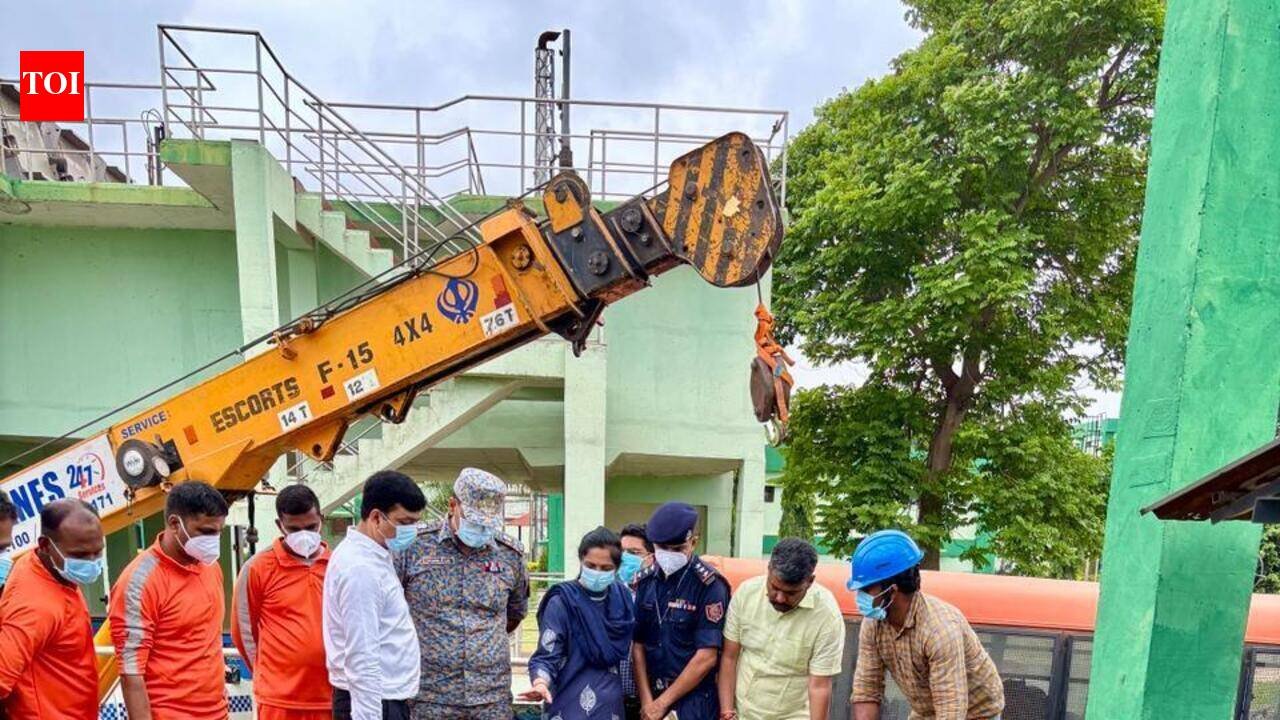
Bengaluru: Even as rescue teams continued their search for two workers who went missing inside a BWSSB sewage treatment plant (STP), anti-manual scavenging activists Friday alleged that the men were illegally employed and made to undertake hazardous work without adequate safeguards. The water authority, however, denied that the incident amounted to manual scavenging and maintained that the workers had entered the facility without authorisation.The incident has reignited concerns over worker safety and accountability in Bengaluru’s sanitation sector, with labour unions and anti-manual scavenging campaigners alleging that hazardous jobs continue to be performed by workers who remain outside formal employment structures.S Balan, state president of the Indian Federation of Trade Unions (IFTU), alleged that the two workers were neither regular BWSSB employees nor part of the utility’s contractual workforce. According to him, BWSSB engages more than 4,000 contractual sanitation workers, but only around 60 are on its payroll. “The workers who went missing are not even part of the 4,000. They were hired by the contractor managing the STP. In most cases, the contractor is only a name lender; the workers are arranged by BWSSB executive engineers,” Balan alleged.Claiming that many sanitation workers are paid below minimum wages, Balan demanded action against officials responsible for assigning hazardous work. “The engineers in charge must be prosecuted for culpable homicide not amounting to murder because they knew the work was lethally dangerous,” he said.Ramon Magsaysay Award winner and Safai Karmachari Andolan national convener Bezwada Wilson said the incident raised troubling questions about safety practices at facilities specifically designed to scientifically process sewage and wastewater. “The very purpose of an STP is to process wastewater in a scientific manner. If there are no safety measures even in such places, it is a crime on the part of BWSSB,” Wilson told TOI.Wilson said the organisation documented 121 sanitation-worker deaths across India in 2025 and another 95 deaths during the first six months of 2026. The actual figure could be higher because many cases go unreported, he opined.“We don’t know the unreported cases. While 95 safai karmacharis have died in six months, there has been no response, no action, and no statement. This is because those who die belong to the most marginalised communities,” he said, adding that the Andolan would soon launch a nationwide campaign on the issue.‘Was a gate repair job’BWSSB chairperson N Manjula, however, rejected suggestions that the incident was a case of manual scavenging. She said preliminary information indicated that the workers entered the facility while attempting to repair a gate and were not engaged in cleaning sewage manually.“This is not manual scavenging. The STP has been running for seven years without anyone going inside the tank,” she said. Manjula said the plant had not been cleaned for at least two years, resulting in the accumulation of nearly a metre of silt and plastic waste. She also maintained that the workers had neither obtained authorisation to enter the tank nor informed BWSSB engineers.“I’ve been told they were trying to fix a gate. The gate should have been closed to stop inflow of water,” she said.Rescue operations continued through Friday evening, with National Disaster Response Force (NDRF) teams repeatedly entering the sewage-pumping wet well in an attempt to locate the missing workers. According to BWSSB officials, the oxygen cylinders carried by NDRF personnel provide roughly 15 minutes of breathing time, forcing teams to make repeated entry and exit.Officials added that the operation was being hampered by the dimensions of the structure — a 40ft-deep tank with a diameter of around 60ft — and efforts were on to deploy a larger crane to aid the search.—–BOXBWSSB Orders Probe■ BWSSB chairperson N Manjula has ordered a probe into the incident. A report has been sought by noon on Saturday■ A three-member inquiry committee has been constituted comprising chief engineer KN Rajiv, additional chief engineer KS Renukumar, and deputy chief engineer DS Vinutha■ The panel will investigate the circumstances that led to the incident inside the sewage-pumping wet well■ BWSSB has also indicated that it will review mechanisms to ensure stricter compliance with SOPs at its facilities


