



As the 80th anniversary of Independence Day dawns, the country will simply go into an overdrive with customary grandeur. The Tricolour will flutter atop important buildings; schoolchildren will sing patriotic songs, and speeches will extol the sacrifices that won us freedom from our colonial masters.
A nation- state is defined by two of its very distinct facets—its people who populate its entire length and breadth and off course the national boundaries/borders. Both of these entities find ample space and discourse in its constitution and are complementary to each other. Not one of them individually can define the concept of a nation-state on its own steam.
No wonder eighty years back, when Cyril Radcliffe the British lawyer cum boundary commission chairman set out his task of defining the national boundaries of India and Pakistan in a mere forty five days span , even he wouldn’t have realized the importance of carving out such a ‘cartographic lineation’.
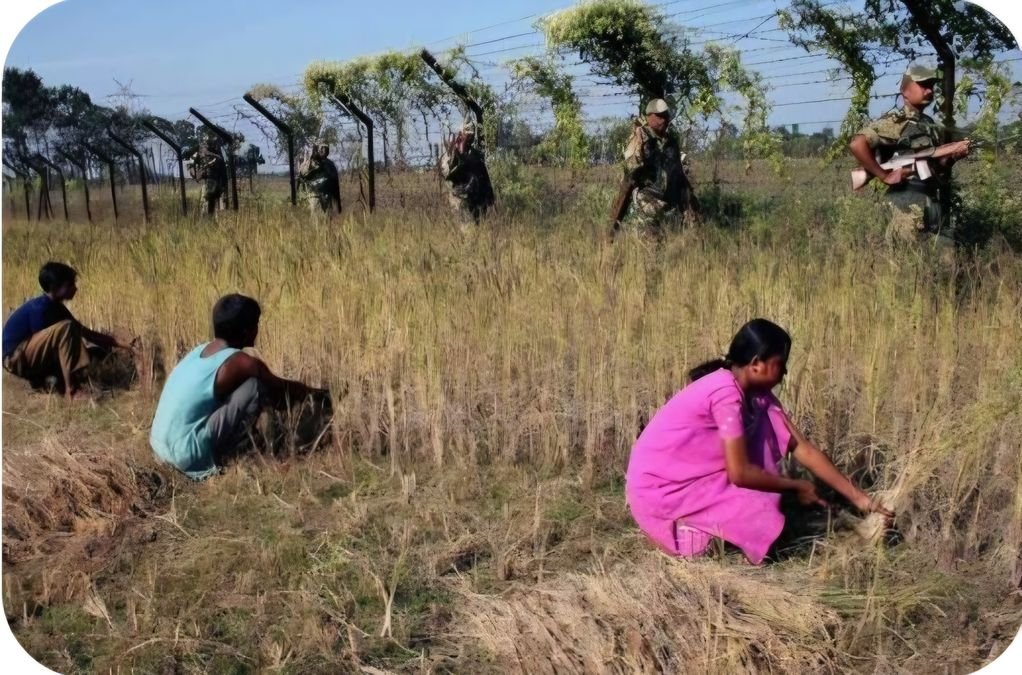
Since this lineation was followed by one of the biggest human displacements with bloody repercussions in modern times across the Radcliffe line, hence the uniqueness of this partition.The borders of a country are not merely ‘cartographic labyrinthine’ but a place where the republic is tested every single day. It is where the idea of India ceases to be an abstraction and becomes a lived reality. Ironically, while the border defines India’s geography, the ‘border citizen’ often remains invisible in India’s policymaking.
For close to seventy nine years, India has viewed its national borders primarily through the prism of military strategy, investing in troops, weapons, surveillance and other infra to protect its territorial integrity. These investments are indispensible no doubt, but they also reveal a deeper flaw in our national thinking right from 1947.
We have treated borders as military spaces to be defended rather than living spaces to be nurtured. This distinction matters, and hence my endeavour to pen down this write up on India’s 80th Independence day to put under the scanner such a distinction which may not portend well for our country if left untreated. A nation-state is not merely secured by its armed forces guarding its borders. It is secured when citizens choose to live there with dignity, confidence and hope.
Every inhabited village on the border is a declaration of national sovereignty. Every family that refuses to abandon its ancestral home despite enemy shelling, infiltration or isolation is performing an act of national service that rarely finds mention from the ramparts of Red fort of India. Nowhere is this reality more visible than in Jammu & Kashmir.
Border residents have lived through wars since 1947, terrorist violence, repeated ceasefire violations and prolonged uncertainty. Children have grown up distinguishing mortar fire from festival fireworks, farmers have cultivated fields under the shadow of sniper fire and many more such vagaries as thrown up by our inimical western neighbour at us. These are not isolated tragedies. But represent a way of life that few Indians living hundreds of Kilometers away can fully comprehend.
Out of a stated fifteen thousand kilometers of total land boundary of India touching seven neighbouring nations, how much of border is actually under fire of ours? I may dare say only that which abuts our western neighbour in the UT of J&K and now under an uneasy calm punctuated by repeated ceasefire violations. Isn’t it suitable time on the anvil of 80th Independence Day of India, that these hapless people are not left to the mercy of geo-political machinations of this sub-continent which are played with utter disregard to their wellbeing?
Be that as it may, yet public policy frequently views border districts through the lens of relief rather than resilience. Compensation is announced after damage, roads are sanctioned after strategic necessity arises. Same is the case with a plethora of welfare schemes involving schools, hospitals and employment opportunities.
In the after math of mayhem unleashed by Pakistan last year during ‘Op Sindoor’ on our border villages abutting both the IB and the LC, stories of continued neglect, administrative cum bureaucratic apathy emanate from media circles regarding laggardly pace of redevelopment of damaged infra. Leave alone relief, resilience is a far cry for us to come on top of the things as they stand today.
The contrast with China is instructive. Both India & China threw out the yolk of slavery in the late 1940s. With a gap of only two years in between i.e. 1947 and 1949 respectively, China has pursued an integrated border strategy in which civilian settlements, economic development and military preparedness reinforce each other thereby surpassing India both in thought and action.
Many of the readers of my article may argue that being a totalitarian cum communist nation, for China the concept of a nation-state supersedes its denizens. This is passé, simple and straight. For the sake of argument even if I do take this concept as viable, then may I ask why India has woken up lately to emulate the same concept in the format of VVP (Vibrant village programme now?
The villages of China all along the LAC in our context present themselves the ‘Chinese instrument of national security, signaling that the writ of mandarins of power in Beijing runs not only in their national capital but right till the last village of theirs. Though India as stated above has lately started in the right earnest to rectify decades of its inertia in such matters, by kicking starting programmes like the VVP it is too late and too less. The intent though commendable, the scheme doesn’t inspire that much confidence.
As late as few weeks back the PM in one of his discourses with the youth of India under the aegis of DIYLD (Developed India young leader’s dialogue) presented an idea before them of visiting border villages, stay and connect with them instead of using the virtual media to do so.
This suggestion by our honourable PM throws an interesting question instead—‘Is merely encouraging the youth of India to visit these border villages enough? Can these cosmetics change the dismal situation as found present in these frontier areas? I shall not dwell much upon this topic, since it is being tackled by me in a separate article from Rising Kashmir paper.
Border citizens per se ought to be placed head and shoulders above the rest of populace of our country. Their defining attributes being derived from their very stay in the border areas and acting as the sentinels of a democratic dispensation in a region surrounded by theocratic countries.
As India enters its eightieth year of independence, perhaps the time is ripe enough to redefine the citizenry of our border areas who away from the din of the mainstream living of India are silently carving out an existence for themselves based on true values of nationalism.
The strength of a nation cannot be measured in terms of its military or economic might. But from the confidence of its citizens living at its farthest edge. If the border defines India’s territorial identity, then the ‘border citizens’ defines its moral identity. How India treats those who stand at its frontiers reveals what kind of republic it truly is.
(The writer is a retired army officer and a regular scribe of Rising Kashmir. He can be approached on his email: [email protected])


