


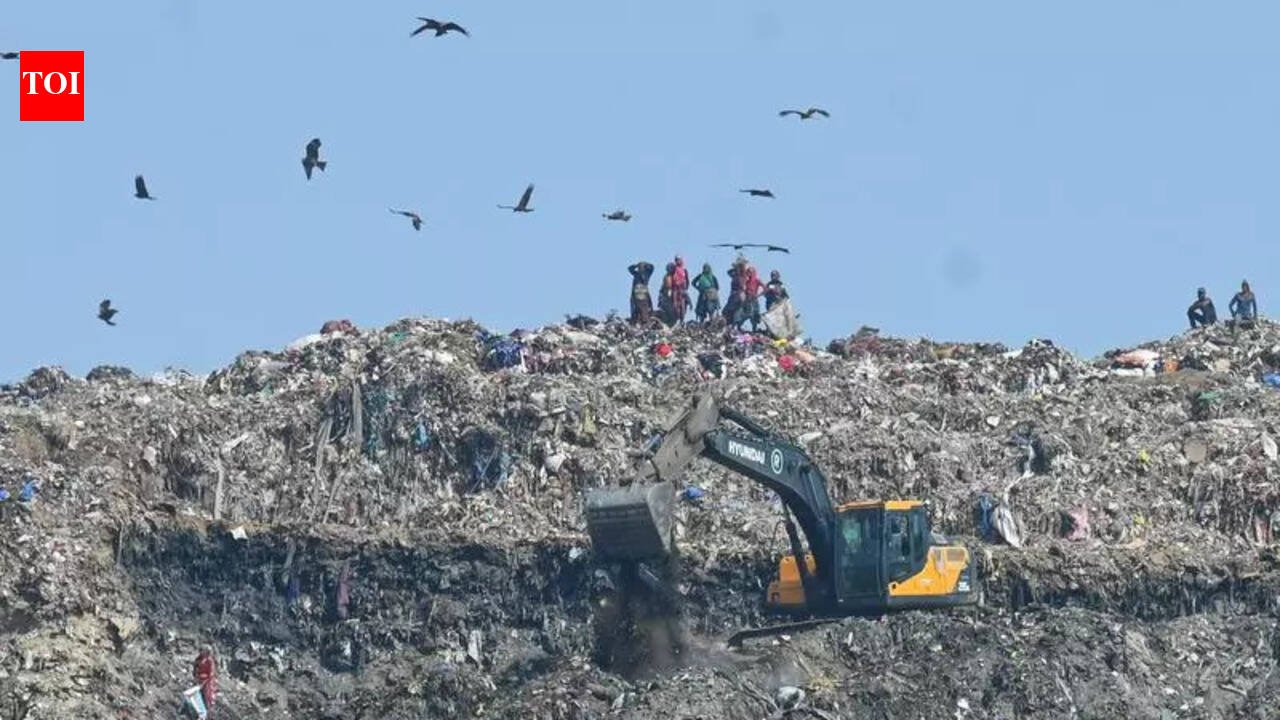
New Delhi: The process of setting up four new facilities to treat fresh municipal solid waste is likely to begin next month, with the Municipal Corporation of Delhi (MCD) receiving 25%—or about Rs 90 crore—of the viability gap funding from the Centre under Swachh Bharat Mission (SBM) 2.0.The initiative, aimed at stopping the dumping of fresh waste at landfills, will enable the processing of around 5,100 metric tonnes of waste per day. The facilities are proposed to be established at four locations, including reclaimed sites at two landfills. MCD plans to award the project by March 31 and has set June 15 as the target for making all units operational.
One of the facilities will come up on a reclaimed 12-acre plot at the Bhalswa landfill, with a capacity to process 1,800 tonnes of fresh waste daily. At Singhola, MCD will use its 6.6-acre silt disposal site to set up a unit that can treat 700 tonnes per day. Another 1,400-tonne-per-day facility will be built on 10 acres of reclaimed land at the Okhla landfill. A fourth facility is proposed at Bawana, where 10 acres have been carved out of the 35-acre parcel previously allotted for an upcoming waste-to-energy (WTE) plant; this facility will process 1,200 tonnes per day. “The project is expected to significantly boost Delhi’s waste-processing capacity and ensure scientific, end-to-end treatment of fresh municipal waste. It will also support the time-bound flattening of landfills as fresh dumping can be stopped,” an MCD official said. Officials explained that while the city is steadily biomining legacy waste, the accumulated waste is largely dry and contains nearly 60% inert material, which can be processed using existing trommel machines. “However, the daily waste coming from households is mostly wet and mixed. It cannot be proces-sed through the current trommels used for legacy waste and is also unsuitable for direct feeding into WTE plants,” the official added. To address this gap, MCD plans to install high-capac-ity trommel machines specifically designed to handle wet waste. At the new facilities, incoming waste will first be manually segregated before undergoing mechanical processing. Recyclables such as plastic and cloth will be separated, while the organic component will be dried and converted to manure within 30–40 days, officials said. “Unlike the existing trommels used for legacy waste—with pore sizes of around 6 mm—the new units will have larger-sieve trommels to allow more efficient handling of wet waste,” the official added. Delhi generates around 11,500 tonnes of municipal solid waste daily. Of this, about 6,650 tonnes are processed at the city’s four WTE plants: 1,800 tonnes at Narela–Bawana; 1,550 tonnes at Okhla; 2,000 tonnes at Tehkhand and 1,300 tonnes at Ghazipur. Though several decentralised waste facilities are operational, a processing gap of roughly 4,700 tonnes per day persists, leading to continued dumping at Bhalswa and Ghazipur landfills.


