






Mir Latif Hussain, JMI graduate, says calligraphy, painting are his way of fulfilling responsibility during sacred month
Budgam, Jun 26: Every person has a different responsibility during Muharram. For Budgam’s multidisciplinary artist Mir Latif Hussain, that responsibility lies in calligraphy and painting.
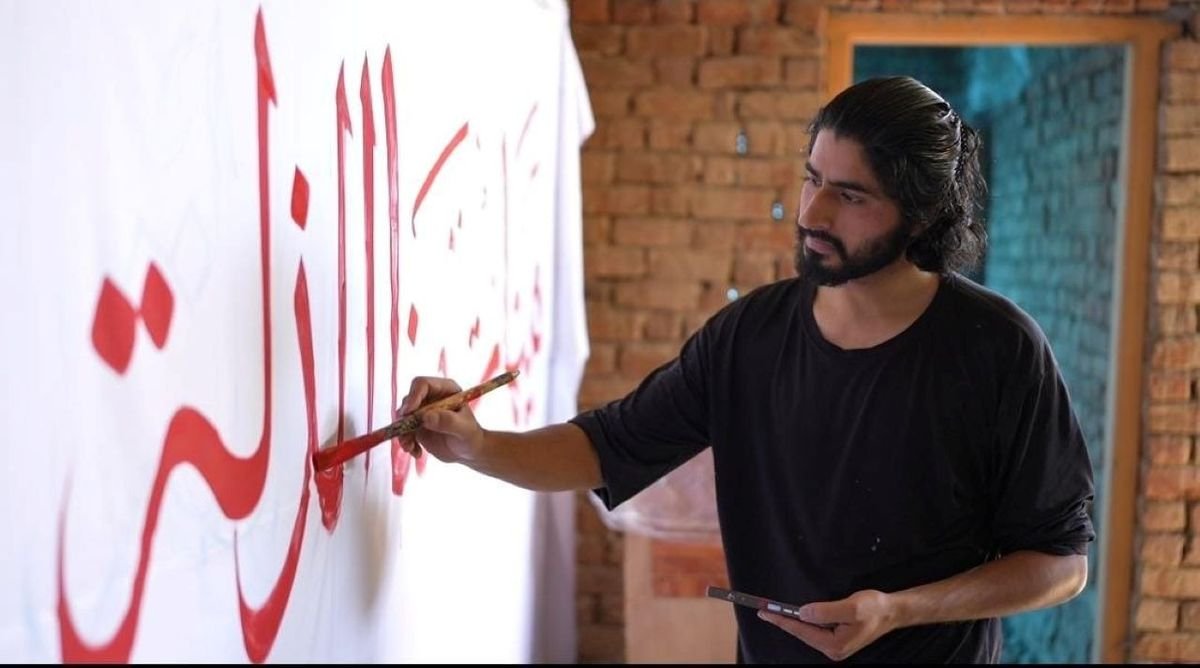
As the month of Muharram begins, Hussain spends his days preparing posters, paintings and banners for mourners and processions, using his art to express remembrance and devotion.
“I see that with time, a person’s responsibility increases. Since it is Muharram, I do calligraphy and make paintings related to Muharram. Every person has a different responsibility and, as an artist, I try to fulfil mine in this way,” Hussain told Rising Kashmir.
The artist from Wahabpora recently completed a large painting measuring 16 by 17 feet at Imam Bara Bemina, a work that has drawn attention on social media.
“Recently, I made a large painting measuring 16 by 17 feet at Imam Bara Bemina. It has become quite famous,” he said.
One of Hussain’s recent paintings is titled Mithli La Yubayi’u Mithlahu, an Arabic phrase attributed to Imam Hussain (AS) and commonly translated as, “A person like me cannot pledge allegiance to a person like him.”
Explaining the idea behind the work, Hussain referred to the popular Urdu verse, “They got Hussain’s head, but never his allegiance,” saying it inspired the painting.
“I made this painting on that title. Imam Hussain had said this to Yazid, and this painting is based on that,” he said.
A graduate in Fine Arts from the University of Kashmir and a Master’s in Painting from Jamia Millia Islamia, New Delhi, Hussain said his journey in art formally began in 2016,though he had been drawing since childhood.
“Before that, I worked on my own without guidance. I joined Fine Arts in 2016 and completed my bachelor’s degree. After that, I got admission to Jamia Millia University and completed my Master’s there,” he said.
His participation in exhibitions and interactions with artists from outside Kashmir, he said, broadened his understanding of art and practice.
“I received a national award at the Kochi Biennale and another from Ranchi University in 2018. By participating in different universities and exhibitions, I learned a lot because artists outside Kashmir work very hard,” he said.
Hussain also sees technology as a support for artists seeking references and developing ideas.
“I think AI is good for artistry because artists can take help from it. Earlier, there was no such technology, and artists could only use Google for references. Now, artists can get many references and develop their ideas,” he said.


