



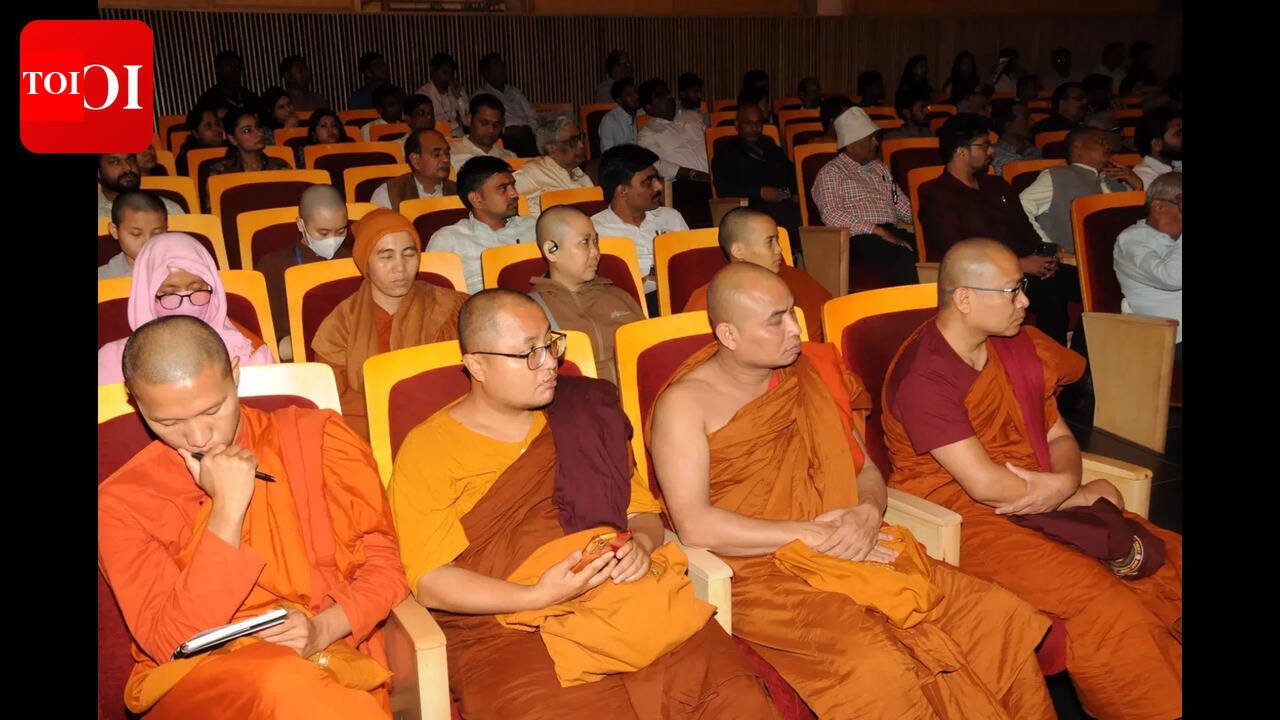
Patna: Eminent national and state experts at the inaugural plenary session of a two-day conclave that began at Bihar Museum in Patna on Saturday deliberated on the theme ‘Buddhist heritage, culture and sustainability’. Speakers said Buddhism was “not a rigid doctrine” and constituted a great Indian heritage that has given international recognition not only to India but also to Bihar, the seat of its origin, growth and global spread.Leading the discussion, former India foreign secretary and president of India International Centre (IIC) Shyam Sharan described Buddhism as a major Indian heritage, saying that “it was remarkable of it that it was not a rigid doctrine” and therefore spread to China, Tibet, Japan, countries of South East Asia, Nepal and Bhutan.“Budhism did not impose any rigid doctrine, but provided sparks that led to the emergence of multi-cultural heritage,” Sharan said, adding that each country produced “its own kind of Buddhist textual heritage”, which later spread globally and was preserved in the form of scriptures and manuscripts.He said manuscripts from ancient centres of Buddhist learning such as Nalanda and other places were later taken to their countries by colonial powers and preserved in various universities. He added that the IIC has already collected and digitised 4,000 such manuscripts.The conclave was organised by the civil society group Deshkal Society as part of the eighth edition of its Bodh Gaya Global Dialogues, with Bihar Museum and the Indian Council of World Affairs (ICWA) as supporting partners.Besides Sharan, speakers included former diplomat and National Human Rights Commission (NHRC) member D M Mulay, Bihar Museum director general Anjani Kumar Singh, senior columnist Harish Khare, author Arvind Mohan, former minister and senior JD(U) functionary Neeraj Kumar, and ICWA representative Subodh Chandra Bharti.Singh said while he was abroad conceptualising the format of Bihar Museum according to global standards, he realised that people in the West were aware of Nalanda and Bodh Gaya but not about Patna and Bihar with which the two are associated. “Therefore, the Buddhist heritage of Bihar and Patna is an important aspect that gives global identity not only to them, but also to India,” he said.Mulay presented a short text imagining Buddha narrating his thoughts in the context of present-day global conflicts. When asked by his disciple about the path to be chosen today, Buddha replied, “Be your own path, so that others follow you… Technology, politics and economics should be aligned with wisdom and justice.”JD(U) functionary Neeraj Kumar highlighted the works carried out by chief minister Nitish Kumar to strengthen Bihar’s Buddhist heritage and promote spiritual tourism, which has been attracting visitors in large numbers. Deshkal Society founder Sanjay Kumar welcomed the guests while Dr Shruti from Haryana conducted the proceedings.


