



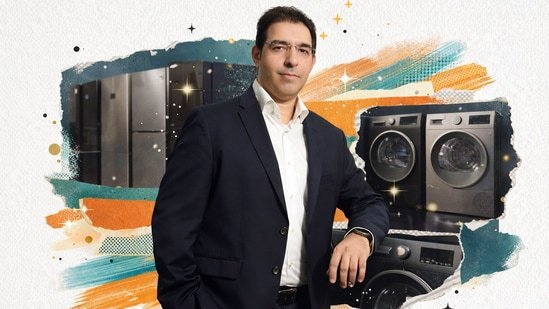
As India’s premium appliance market evolves, BSH Home Appliances India, the company behind Bosch, Siemens and Gaggenau, is sharpening its focus on localisation, consumer education, and category creation. In a conversation with Hindustan Times, Saif Khan, CEO and MD, BSH Home Appliances India, spoke about the company’s regional efforts, addressing misconceptions around its popular categories, and why India-specific innovation is central to the company’s strategy.
The regional touch
To widen reach, BSH has been investing in regional marketing strategies. “Apart from social media influencers, we are doing it regionally in regional languages so that every consumer gets to understand our portfolio and what benefits it brings,” Khan explained.
BSH makes it clear that because of India’s diversity, a one-size-fits-all approach does not work, and this why what might work as marketing in the north might be different from what is needed in the south, he added, noting that campaigns are increasingly tailored to local preferences.
ALSO READ: Can a robot replace househelp? I tested the Dreame D20 Ultra—Here’s what happened
Breaking myths around dishwashers
Dishwashers, once considered niche in India, are now seeing strong growth. However, misconceptions persist, particularly around water usage. BSH has been working on this for years. “Our journey of educating buyers for dishwashers started five six years back. Since then, there has been awareness that it is not just for washing kadhai or getting stains out. It is a very critical appliance from a hygiene and water sustainability perspective,” Khan said.
To demonstrate this, the company has set up live units in stores. “Consumers actually look at a working dishwasher, and that’s when we explain that water efficiency and hygiene efficiency are much better than hand washing,” he noted.
He added that dishwashers can achieve temperatures of up to 70 degree celcius, something not possible with manual washing, and include India-specific features like a kadhai function.
In water-scarce regions such as parts of Rajasthan and north India, awareness is improving.
“Consumers understand that dishwashers save considerably more water than traditional washing,” Khan said.
Changing habits in a maid-dependent economy
One of the biggest behavioural challenges in India is the reliance on domestic help, and how consumers are bit hesitant to let thier house helps use expensive appliances like dishwashers.
BSH has tried to address this through trial-led adoption.
“We introduced initiatives with a 30-day trial so that consumers can use the dishwasher at home and even their house help can get comfortable with it. The success ratio is 99%. We have almost never seen a dishwasher coming back after a trial,” Khan claimed.
He added that familiarising domestic workers with appliances is a key part of adoption. “We brought house helps into the process so they get accustomed to using it,” he said.
Localisation push: 90% by 2030
Local manufacturing and R&D are central to BSH India’s roadmap. “Currently, our localisation is at about 65 to 70%. The goal is to take it to 90% by 2030,” Khan revealed.
New product launches are already reflecting this shift, the company notes. “We have moved towards a more local ecosystem, and the acceleration is also helped by exchange rate challenges,” he said, adding that washing machines are seeing significantly higher localisation compared to before.
Building health-focused appliance categories and education
BSH is also betting on the growing demand for healthier lifestyles.
“We have started a category creation exercise for steam ovens. In one appliance, you can steam, fry, and do multiple cooking methods,” Khan said.
He pointed to rising consumer awareness. “The consciousness in India is increasing when it comes to healthy cooking, and more consumers are asking for healthier options.”
Products such as ovens that use minimal oil aim to replicate traditional taste while reducing fat intake. “You still get the same crispiness and taste,” he said.
The company is also pushing newer categories like dryers, where misconceptions remain. “There is a belief that dryers shrink clothes. We are educating consumers that you can even put delicates in a dryer,” Khan noted.
In-store demonstrations, including showcasing delicate drying with a balloon inside a drum, are being used to build trust.
ALSO READ: I switched to smartwatches with breathable nylon straps and workouts feel much better now
Premium perception vs local relevance
European brands often carry a premium tag in India, alongside perceptions that Japanese and Korean brands are more reliable.
But Khan believes differentiation lies in localisation. “The difference for us as a European brand is the deep investments we are putting into local consumer insights and R&D design,” he said.
He added, “It’s not that we are just taking products out of European factories and putting them here. Even for categories like dishwashers, where penetration is 80 to 85% globally, products are customised for the Indian consumer.”


