



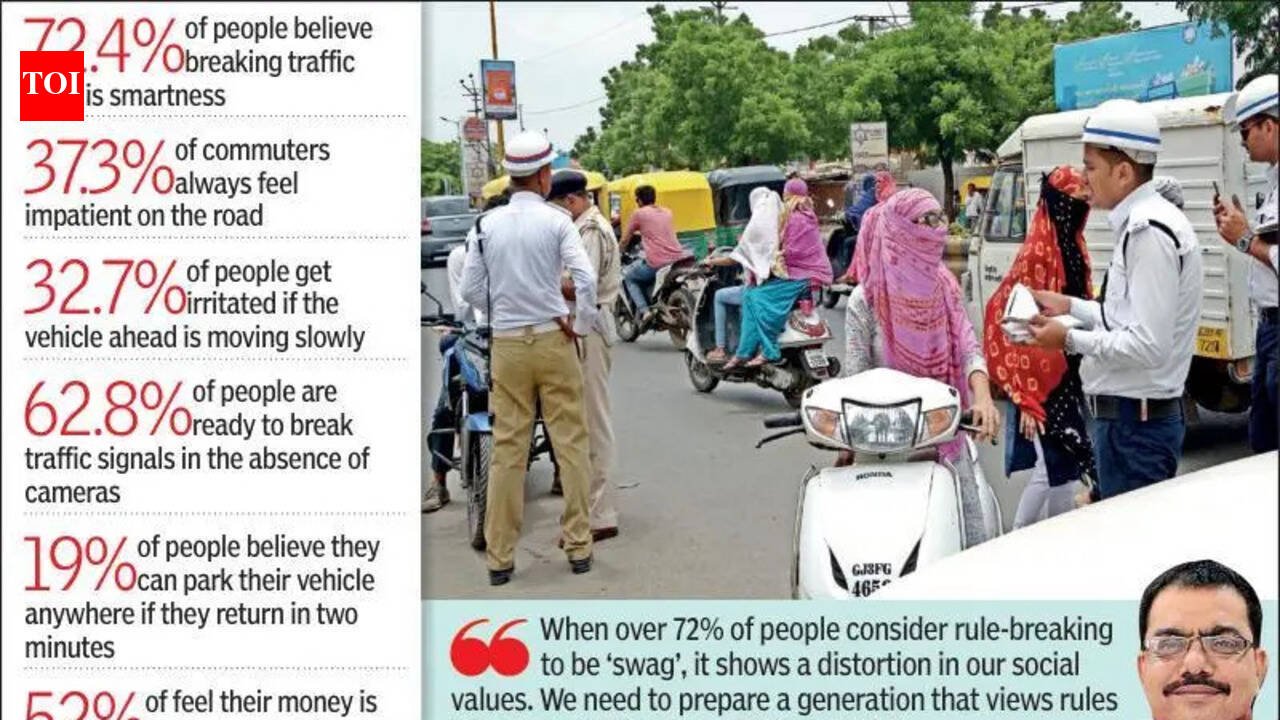
A psychological survey conducted by Saurashtra University has revealed troubling insights into driving behaviour, suggesting that traffic problems here stem more from mindset than infrastructure. Based on responses from 1,456 participants in Rajkot, the study found that 72.4% believe breaking traffic rules is now seen as a sign of “smartness” or “swag”.The study was conducted by researchers under the guidance of Professor Yogesh Jogasan and Dhara R Doshi of the psychology department. It points to a deep lack of self-control and a worrying acceptance of rule-breaking as a status symbol on the roads.Swag Over Safety The most alarming finding is a widespread social distortion in which traffic violations are viewed as ‘smartness’ or ‘swag’. As many as 72.4% of respondents agreed that violating traffic rules has become a sign of ‘swag’ or ‘smartness’.Anger and Impatience Fuel Accidents The survey points to high levels of emotional instability among drivers. While 37.3% admitted to feeling impatient while driving, 32.7% said they get angry immediately if the vehicle ahead is slightly slow. Doshi stressed that such impatience lies at the root of road rage and risky driving. The study also found that 33.7% of drivers indulge in competitive overtaking, revealing a disturbing ego-driven mindset on the roads. External Fear, Not Internal Discipline The lack of internal discipline among commuters is stark. According to the study, 62.8% said they would consider breaking a traffic signal if they knew there were no cameras on the road. This shows that fear of external threats such as police checks and cameras, rather than self-discipline or concern for safety, drives compliance. The survey also highlighted social arrogance, with 60% of respondents believing that drivers of big or expensive vehicles give less importance to those on smaller vehicles. Researchers termed this the “arrogance of power”, where social status is projected onto road behaviour. Call For Change In MentalityWhen asked what is more necessary for road discipline, 68.4% favoured a change in people’s mentality, while 31.6% supported stricter laws. The researchers proposed psychological solutions such as sensitivity training before issuing licences and restoring social values by teaching traffic discipline as part of culture and citizenship in schools. According to the surveyors, the message is clear: fines and cameras alone will not solve India’s traffic chaos. As the report concludes, “This survey proves that if we bring a slight change in our mentality and maintain patience, 90% of road accidents and traffic jam problems can be avoided. Driving is not just a mechanical process but a reflection of your civility and culture.” The surveyors further noted that during traffic jams, red signals or closed railway crossings, the situation is in nobody’s hands. Blowing the horn at such times, psychologists said, is a symptom of negative mentality. The survey was conducted by students of the psychology department, including Jaya Jamod, Smit Ramani, Gautam Lagariya and Divya Jambusa, among drivers in Rajkot.


