He was only the most radical manifestation of declining trust in voting systems around the world. His son, Flávio, a senator, is running for president in elections in October. In March, at the Conservative Political Action Conference, a right-wing gathering held this year in Dallas, Flávio claimed that he would win the elections if they were “free and fair”, suggesting that any other outcome would show they were not. Many of the other Trump-supporting attendees have also stoked false rumours about dodgy voting machines. Though Flávio’s campaign has faltered recently after leaked messages linked him to a corrupt banker, the Bolsonaro effect lingers: a sizeable share of Brazil’s right has taken up the discourse against voting machines, particularly on social media. Candidates disputed the result of general elections in 2014, 2018 and 2022. If this year’s outcome is tight, the loser may once again cry foul.
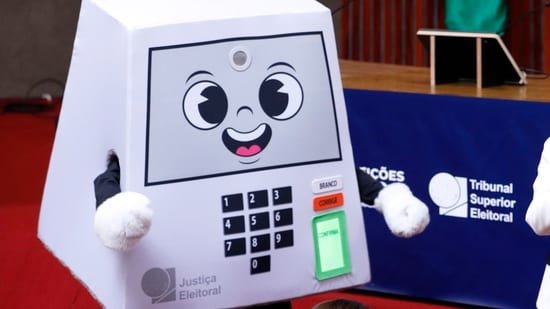
Distrust in the electoral system has been driven by polarisation and online misinformation, not by proven fraud. But its technical nature does make it easier for false information about the system to spread. When voters enter a polling booth, the machine identifies them by their fingerprints. They then enter the two-digit ID of their chosen candidate, and confirm their choice. Votes are not recorded in chronological order, but at random, in order to preserve ballot secrecy. When polls close, at 5pm, a tally is printed out and hung up in the polling station for the public to see, the only paper record of the vote.
A polling officer then removes the memory sticks attached to each machine, and sends an encrypted electronic record of the tally to the TSE headquarters over a virtual private network. The software that does this was written by the TSE itself, and uses similar security protocols to bank transactions. Each machine has a unique digital signature which it uses to sign the electronic record that is transmitted to the TSE. If the signature on a batch of votes does not match the TSE’s records, it will be barred from entering the network. The machines deliberately lack the hardware needed to connect to the internet or bluetooth themselves. The memory sticks also carry a signature, and the machines will reject any which do not match.
“Even if you have one or a few bad-faith actors in the TSE, there are too many layers of security for them to be able to affect the system as a whole, or the vote count,” says Carlos Alberto da Silva, a professor of cryptography at the Federal University of Mato Grosso do Sul. “Over the course of three decades, there has never been any evidence of electoral fraud in the Brazilian voting system,” says Cármen Lúcia, until recently the TSE’s president. “That fact speaks for itself.”
Brazilians know the outcome of their election within four hours of the polls closing. Voters can verify the result by seeing whether the tallies in the polling stations match the electronic voter logs, which are published on the TSE’s website. The independent federal audit office also collects a large sample of paper tallies and compares them with the electronic tally. The winner is then certified.
Brazil chose to go electronic to combat widespread electoral fraud. Many illiterate voters used to have their paper ballots pre-filled by politicians’ henchmen. Voter rolls frequently included dead or non-existent people. Matters came to a head in 1994, during a blatantly marred election in Rio de Janeiro. Hundreds of ballots were written in the same handwriting. After that election, the TSE convened a group of engineers and legal scholars to come up with a solution. By 2000 voting was entirely electronic.
To boost trust in the system, the TSE organises hackathons at its headquarters in the run-up to the election. Any citizen over 18 can attend, with expenses covered. Participants have access to voting machines’ hardware and software, and can attempt to compromise them. If a vulnerability is found the TSE fixes it and invites participants back to repeat their attacks. It also allows the source code for the voting machines to be inspected by universities, the army, the federal police, civil-society organisations—such as Brazil’s bar association—and political parties.
Marcos Roberto dos Santos, a cyber-security professor at Atitus, a private educational institute in Rio Grande do Sul, has participated in the public security tests four times. “If you have doubts or problems with the system, that’s in your right,” he says. “Then go test it for yourself.” Mr Bolsonaro’s attempts to discredit the system in 2022 reveal self-interest more than security concerns. After his loss, his party sued to have the results of the run-off annulled—but not those of the first round, in which it took the most seats in Congress.
An almighty electoral court
Yet openness and advanced cryptography have their limits. Trust in Brazil’s courts is falling. In most countries, administrative authorities organise elections, while courts try violations of electoral law separately. The TSE’s staff organise the general election, source voting machines, write the software, certify the results, adjudicate disputes and fight misinformation. Its membership overlaps with that of the Supreme Court, which is regarded with suspicion by many Brazilians. Alexandre de Moraes, a pugilistic Supreme Court justice, oversaw Mr Bolsonaro’s coup trial. During his tenure on the TSE it imposed fines on those who discredited voting machines and banned Mr Bolsonaro from holding public office.
The TSE “holds too many roles that could create conflicts of interest”, says Diego Aranha, a Brazilian cyber-security expert at Aarhus University in Denmark. The country has become so polarised that “any well-intentioned critic of the system becomes lumped together with bolsonarismo, even if the criticism is technical.”
Those well-intentioned critics argue that combining the machines with individual paper receipts, not just the polling-station tally, would improve the system’s auditability. This is similar to what India does. Brazil’s Congress has repeatedly called for printouts to complement the electronic record, but the TSE has ruled against this. In 2002 it conducted a pilot where printers were attached to machines. But the printers frequently jammed, requiring human intervention to fix. The TSE argued that such malfunctions could delay the count. It also claimed that individual records could compromise the secrecy of the ballot, since gangs or local bigwigs could then ask voters for proof of their vote. “In the Brazilian experience, the individual paper receipt has opened the door to coercion and control over voters, which undermines the legitimacy of the process,” says Ms Lúcia.
On May 12th Kassio Nunes Marques, a Bolsonaro appointee to the Supreme Court, took charge of the TSE. Of the two other Supreme Court justices on the bench, one is also a Bolsonaro appointee and the other has become closer to Flávio in recent years. Where Mr Moraes was accused of overreach, Mr Nunes Marques has said that the TSE will interfere as little as possible this time around. That may assuage the bolsonaristas—for now.