



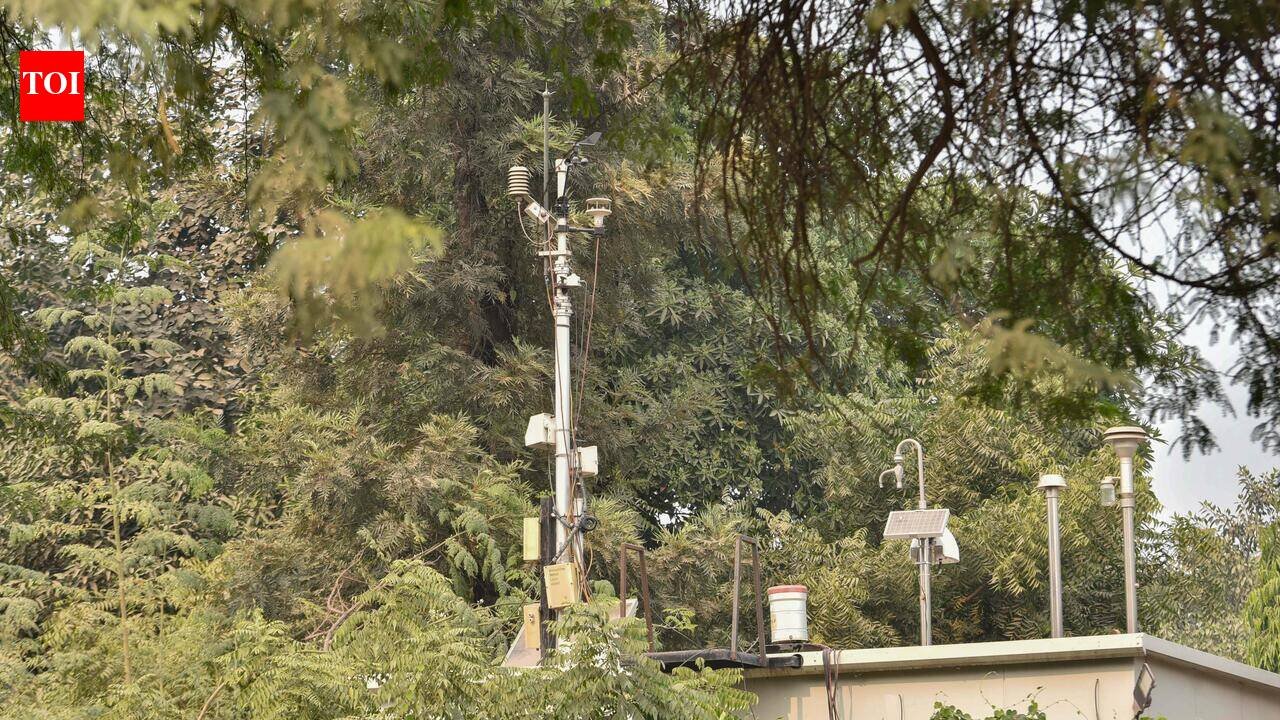
Gurgaon: Haryana is racing to meet a series of pollution-control targets ahead of the winter season, but a review presentation prepared by Haryana State Pollution Control Board (HSPCB) shows several critical gaps remain, particularly in the city, across public transport, road redevelopment, air quality monitoring, waste management and electric vehicle infrastructure.The presentation, prepared for a high-level review of air pollution mitigation measures in NCR districts of Haryana, assesses progress on directions issued by Commission for Air Quality Management (CAQM) across transport, industries, municipal solid waste, construction and demolition (C&D) waste, road infrastructure and paddy straw management.According to data, the biggest gap remains in Haryana’s air quality monitoring network. Against a prescribed requirement of 45 Continuous Ambient Air Quality Monitoring Stations (CAAQMS), only 22 were operational as of June 30 — a shortfall of 23 stations. The state expects purchase orders for the remaining stations by July-end and aims to complete installation by Sept 30.The report was reviewed on Friday at a meeting chaired by chief minister Nayab Singh Saini and Union environment minister Bhupender Yadav.Yadav called for stronger coordination between the Centre and the state, directing focused action on polluting industries, scientific management of construction and demolition waste, disposal of municipal solid waste, prevention of biomass burning, and effective stubble management.Saini announced that Haryana will bring a new EV policy to the cabinet at its next meeting. The CM also ordered a detailed survey of congestion hotspots across Gurgaon, Faridabad, Sonipat and Bahadurgarh, with a comprehensive action plan to follow.Public transport electrification has progressed slowly and across seven NCR cities, only 70 electric buses are operational against an annual target of 875. Haryana will roll out its “No PUC, No Fuel” policy across NCR districts from Oct 1, under which vehicles without a valid Pollution Under Control certificate will be denied fuel. To enable this, all 2,780 fuel stations in NCR Haryana are to be fitted with Automatic Number Plate Recognition (ANPR) cameras by Sept 30, starting with 775 stations in Gurgaon, Faridabad, Jhajjar and Sonipat during July, with the rest covered over the following two months.Gurgaon continues to lag on EV charging infrastructure. Against a target of 84 charging stations this year, only 40 had been installed by June-end — a shortfall of 44. Across Haryana’s NCR cities as a whole, only 88 charging stations had been established against a target of 199.Road redevelopment, considered critical for reducing dust emissions, tells a similar story. The city had planned to redevelop 494.92 km of roads this year, but only 228 km had been completed by June-end. Statewide, just 554 km had been redeveloped against a target of 1,164 km, with most of the remaining work expected in the second half of the year once administrative approvals and work orders are issued.Traffic congestion, another driver of vehicular emissions, remains a concern too. The city has identified nine congestion hotspots requiring intervention, but mitigation measures had been completed at only four by June-end — with similar gaps in Faridabad, Karnal and Panipat.The city has only four secondary collection centres against a requirement of 20 for C&D waste, with the remaining ones proposed by Dec 2026. The city generates around 1,500 tonnes of C&D waste daily and is currently processing the entire quantity, though MCG plans an additional 400-tonne-per-day plant.Municipal solid waste is a bigger concern. The city generates about 1,200 tonnes daily, but no processing facility is currently operational, leaving all of it untreated. The city also recorded 399 incidents of municipal waste and biomass burning last winter — the highest among the cities in the review. New processing facilities are expected to come online later this year.Legacy waste remediation is behind schedule as well. Against a 2026 target of clearing 15 lakh metric tonnes of old waste, only 2.15 lakh metric tonnes had been processed by June-end, leaving 12.85 lakh metric tonnes still to be cleared. The exercise is now targeted for completion by March 2027.The state is also tackling its end-of-life vehicle backlog. Haryana has identified nearly 8.9 lakh BS-III and older vehicles, of which 2.23 lakh are estimated to still be on the roads. Between Jan and June, enforcement agencies seized 4,722 such vehicles, scrapped 2,134, and issued 6,710 no-objection certificates for their transfer outside NCR — alongside SMS alerts to owners and joint enforcement drives with police and transport officials.Most industries required to install Online Continuous Emission Monitoring Systems (OCEMS) have been connected to the Central Pollution Control Board server, but 17 are yet to comply, and another 956 industries still need air pollution control devices installed. In non-conforming industrial areas, authorities inspected 329 industries and ordered closure of 131 units in the first half of the year, with inspections of all remaining units targeted for completion by July 31.Ahead of the paddy harvesting season, Haryana has expanded its biomass utilisation network to 955 paddy straw utilisation units, up from 908 last year. The state aims to utilise 2.71 million metric tonnes of paddy straw through pellet plants, biomass power projects, thermal power plants, brick kilns and bio-CNG facilities — of which about 1.35 million metric tonnes, nearly half the annual target, had already been utilised by June-end.


