


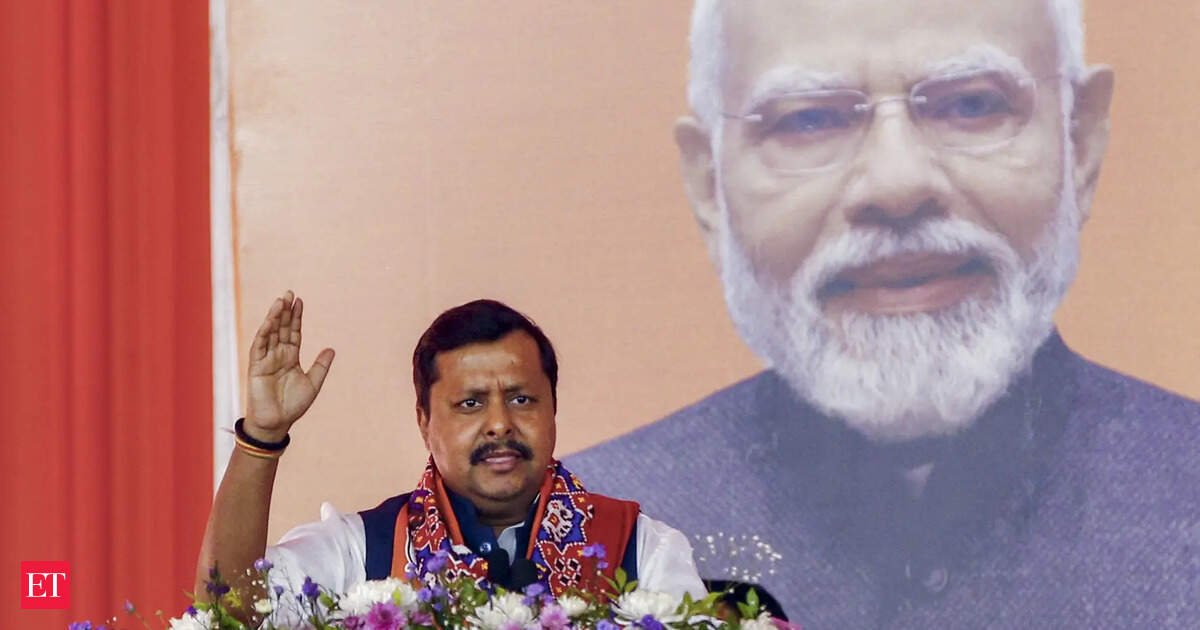
BJP president Nitin Nabin, who concluded a three-day visit to Punjab on Monday, in a closed-door strategy meeting asked party leaders to avoid public comments on a possible alliance with SAD, according to people familiar with discussions.
At a media conclave during the visit, Nabin stressed that BJP was preparing to contest all 117 assembly seats, but added that what happens in future can’t be said, remarks interpreted by many in the state unit as keeping the option of a rapprochement alive.
Party leaders said the issue reflects the differing priorities of BJP’s central leadership and its Punjab unit. While the brass is focused on expanding the party independently and testing its strength across all 117 seats, several senior leaders in Punjab are convinced that an alliance with SAD remains the most viable route to broaden BJP’s reach beyond urban pockets and make deeper inroads into rural and semi-urban areas.
“A BJP-Akali Dal alliance would be in the interest of both parties, Punjab and even the nation,” a senior BJP leader told ET. Another senior leader argued that a moderate Akali Dal would help ensure stability in the state and act as a bulwark against radical forces. “A liberal Akali Dal is better for Punjab than allowing space for elements like Amritpal Singh,” he said.
The principal hurdle, however, is seat-sharing and the valuation of the two parties. While BJP wants to be treated as an equal partner, if not more, SAD views itself as Punjab’s principal regional force and the traditional panthic representative of the Sikhs.
A SAD leader acknowledged that ties with BJP had undergone turbulence and insisted the party would not accept an arrangement that diminished its standing. “We were among the first to support Atal Bihari Vajpayee’s government in 1996. You cannot bring us down so much in seat terms in our home state that people feel we compromised and lost credibility. The worst is behind us and we are now on an upward trajectory,” the leader said.BJP and SAD, whose alliance spanned more than two decades and survived several political storms, parted ways in 2020 after Union minister Harsimrat Kaur Badal resigned from the Modi government over the three farm laws. The Centre later repealed the laws following widespread protests.
With AAP in power, Congress seeking a revival and radical voices trying to occupy political space, leaders in both camps acknowledge that the social and electoral arithmetic that underpinned one of the longest alliances has not entirely disappeared.
