






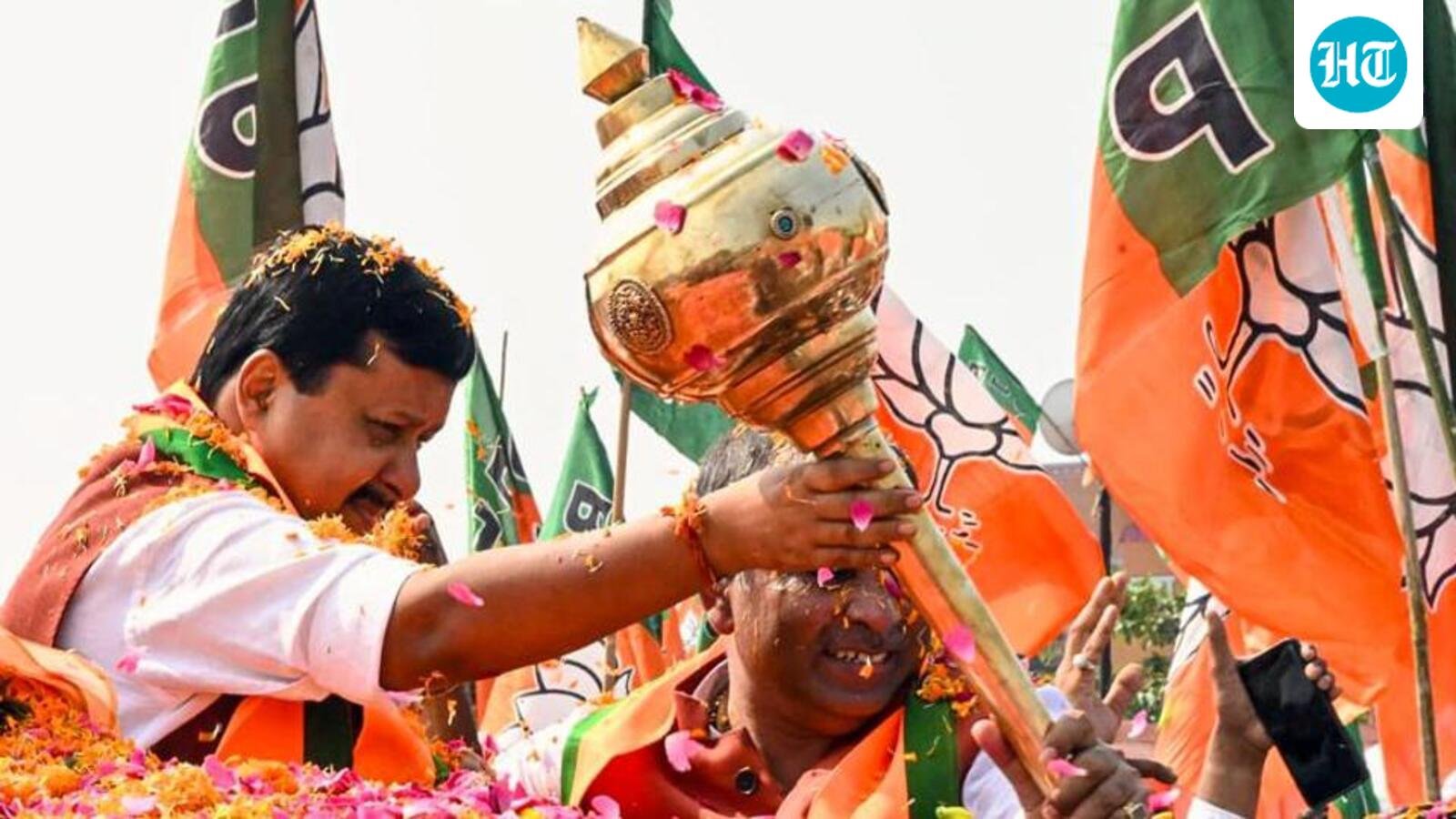
BJP national president Nitin Nabin on Tuesday said the party would return to power in Uttar Pradesh with a “massive majority” in the 2027 assembly elections, asserting that the enthusiasm among party workers indicated its strong preparedness.

He also stressed the need to bring together all sections of society, as he held meetings with party leaders and office-bearers from western Uttar Pradesh and reached out to the Dalit community by visiting a Ravidas temple and having lunch at the home of a Scheduled Caste party worker in Saharanpur.
“We have to move forward by completely bringing together all sections of society. Uttar Pradesh is witnessing continuous development,” Nabin said while speaking to reporters after the meetings.
He said his interactions with workers across Saharanpur and western Uttar Pradesh had given him an opportunity to assess their enthusiasm and energy.
“The enthusiasm and energy of the workers are clearly indicating that in 2027, the Bharatiya Janata Party will once again form a government with a massive majority,” he said.
Nabin also said the presence of people on the streets during his visit reflected what he described as public enthusiasm for Prime Minister Narendra Modi, chief minister Yogi Adityanath, state BJP president Pankaj Chaudhary and the party’s MPs and MLAs. “We will accomplish the mission for 2027,” he said.
The BJP chief also highlighted the state government’s development narrative, saying Uttar Pradesh had moved beyond its earlier association with crime and mafia and was now emerging as a hub for young people, semiconductors and artificial intelligence.
“The state that was once known for mafia is today making its mark in the world for its youth, semiconductors and AI,” Nabin said, citing expressways and the manufacture of missiles such as BrahMos as symbols of the “new Uttar Pradesh”.
He said the state was moving towards becoming an “Uttam Pradesh” while preserving and promoting its heritage.
Nabin’s remarks came after two meetings at a resort on Ambala Road with former and current public representatives and party office-bearers from western Uttar Pradesh. The meetings, which lasted around two-and-a-half hours in all, focused on organisational preparedness and the BJP’s roadmap for the 2027 elections.
The first meeting, which lasted around two hours, involved former public representatives and former office-bearers and included discussions on their political experience, coordination and preparations for the elections. A second meeting, lasting around half an hour, was held with current public representatives and office-bearers.
The second meeting included discussions to assess the position of potential ticket aspirants. Some office-bearers also raised concerns about not receiving adequate recognition within the party and organisation. Media entry was restricted during both meetings.
Nabin asked party workers to work together to ensure victory and assured them that no one would be ignored. He said the party would provide due recognition to workers after forming the government.
After the meetings, Nabin visited the Sant Shiromani Guru Ravidas temple in Ojhpura, where he offered prayers. Members of the local community presented him with an idol of Sant Ravidas and a book.
The visit came as the country observes the year of the 650th birth anniversary of Sant Ravidas.
“Today, across the country, we are observing the year of the 650th birth anniversary of Sant Ravidas Ji. I was fortunate to get an opportunity to visit the temple of Sant Ravidas Ji in Saharanpur and seek his blessings,” Nabin said.
Nabin later visited the home of Ajab Singh, a Scheduled Caste party worker, where he had lunch with Pankaj Chaudhary. He stayed at Singh’s house for around 25 minutes and was served arhar dal, roti, pulao, dry potato curry, raita and ice cream before leaving for Delhi with his convoy.
Saharanpur has seven assembly constituencies — Behat, Nakur, Saharanpur Nagar, Saharanpur Dehat, Deoband, Rampur Maniharan and Gangoh. Rampur Maniharan is reserved for Scheduled Caste candidates. According to the 2011 Census, Muslims constitute around 43% of Saharanpur district’s population, while Scheduled Castes account for around 22%.


