



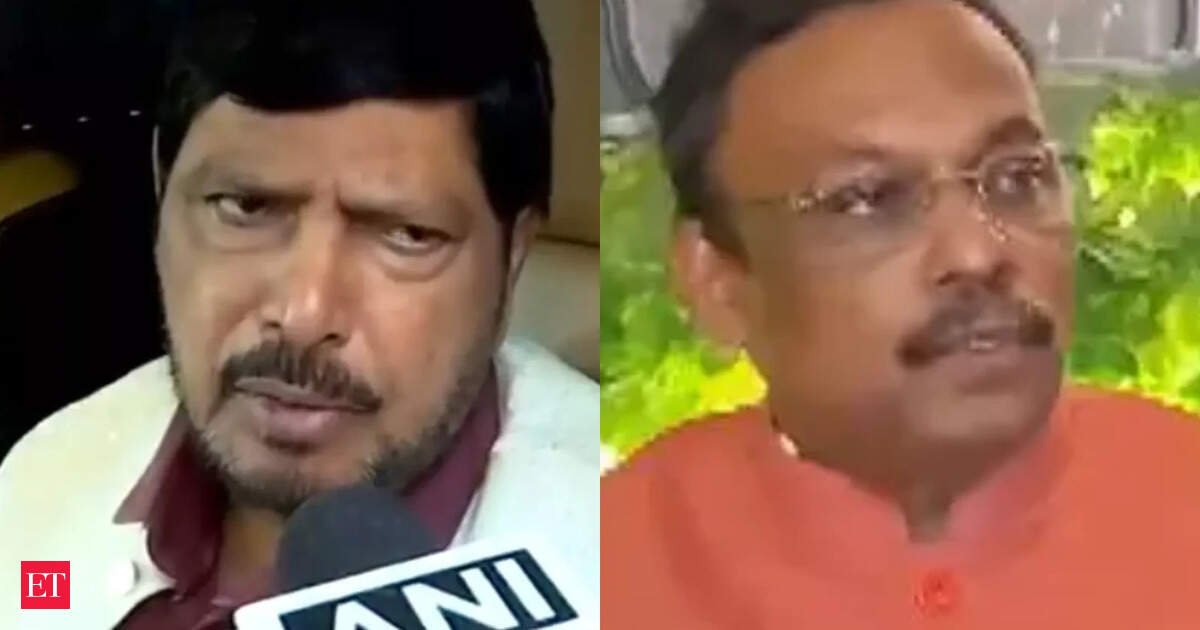
In addition to Athawale and Tawde, the party has fielded former Nagpur mayor Maya Chintaman Ivnate and former member of the legislative council Ramrao Wadkute for the biennial elections.
Seven Rajya Sabha seats from Maharashtra are due to fall vacant in April. With over 230 MLAs in the 288-member Assembly, the BJP-led Mahayuti alliance is positioned to ensure the election of all its four nominees.
The members retiring from Maharashtra this year include NCP (SP) chief Sharad Pawar, Athawale, who heads the Republican Party of India (A), Fauzia Khan of NCP (SP), Rajni Patil of the Congress, Priyanka Chaturvedi of Shiv Sena (UBT), and BJP leaders Dhananjay Patil and Bhagwat Karad.
Polling is scheduled for March 16 between 9 am and 4 pm, with counting set to begin at 5 pm the same day.
Earlier in the day, Athawale met Maharashtra Chief Minister Devendra Fadnavis at the official residence ‘Varsha’ in south Mumbai. The meeting was related to the Rajya Sabha elections, news agency PTI reported citing a source.
Wadkute, who hails from Hingoli district, said he had not anticipated being nominated by the BJP. He had joined the ruling party a few years ago. He said he had aligned with the BJP due to his faith in Prime Minister Narendra Modi and Devendra Fadnavis, adding that the party functions at the grassroots level and that he had focused solely on his work without expectations. He also said he had resigned as an MLC before completing his tenure and had not approached the party seeking a Rajya Sabha nomination, noting that there is not even a gram panchayat member from his family.Tawde expressed gratitude to the party leadership for entrusting him with the nomination and said he would discharge the responsibility with complete dedication and loyalty. He said that under the guidance of Prime Minister Narendra Modi and the party’s national leadership, the organisation remains committed to the nation’s welfare. He also thanked Chief Minister Devendra Fadnavis and state president Ravi Chavan for the opportunity.
Ivnate, a former mayor of Nagpur, is currently a corporator in the Nagpur Municipal Corporation.
The Election Commission of India has announced polls to 37 Rajya Sabha seats across 10 states. Of these, 12 are currently held by the National Democratic Alliance (NDA) and 25 by opposition parties. Members of the Rajya Sabha are elected by MLAs through a system of proportional representation by means of the single transferable vote.
Following the demise of MLAs Ajit Pawar and Shivajirao Kardile, the effective strength of the Maharashtra Assembly stands at 286 for the purpose of calculating the quota. A candidate requires 37 votes to secure election.
As per the current composition, the BJP has 131 MLAs after accounting for one vacancy. Deputy Chief Minister Eknath Shinde-led Shiv Sena has 57 members, while the NCP, led by Deputy CM Sunetra Pawar, has 40 MLAs after one vacancy.
In the opposition camp, the Congress has 16 MLAs, the NCP (SP) has 10, and the Shiv Sena (UBT) has 20.
Among smaller parties and others, the Samajwadi Party has two MLAs, Jansurajya Shakti has two, Rashtriya Yuva Swabhiman Party has one, Rashtriya Samaj Paksha has one, AIMIM has one, CPI-M has one, the Peasants and Workers Party of India has one, Rajarshi Shahu Vikas Aghadi has one, and there are two Independents.
The ruling Mahayuti alliance, comprising the BJP, Shiv Sena and the NCP, along with smaller allies and Independents, commands 234 MLAs. The opposition Maha Vikas Aghadi (MVA), consisting of the Congress, the NCP (SP) and the Shiv Sena (UBT), along with supporting smaller parties, has 49 MLAs, while others account for three.
Based on the 37-vote quota, the BJP, with the backing of an Independent, effectively has 132 votes, which would allow it to secure three seats comfortably and mount a challenge for a fourth. The Shiv Sena can secure one seat and would be left with surplus votes thereafter. The NCP is also in a position to ensure the election of one member.
The combined strength of the MVA translates into the assured election of one candidate. On this arithmetic, the Mahayuti alliance could potentially win up to six of the seven seats, subject to cross-voting or strategic vote transfers under the preferential voting system.


