


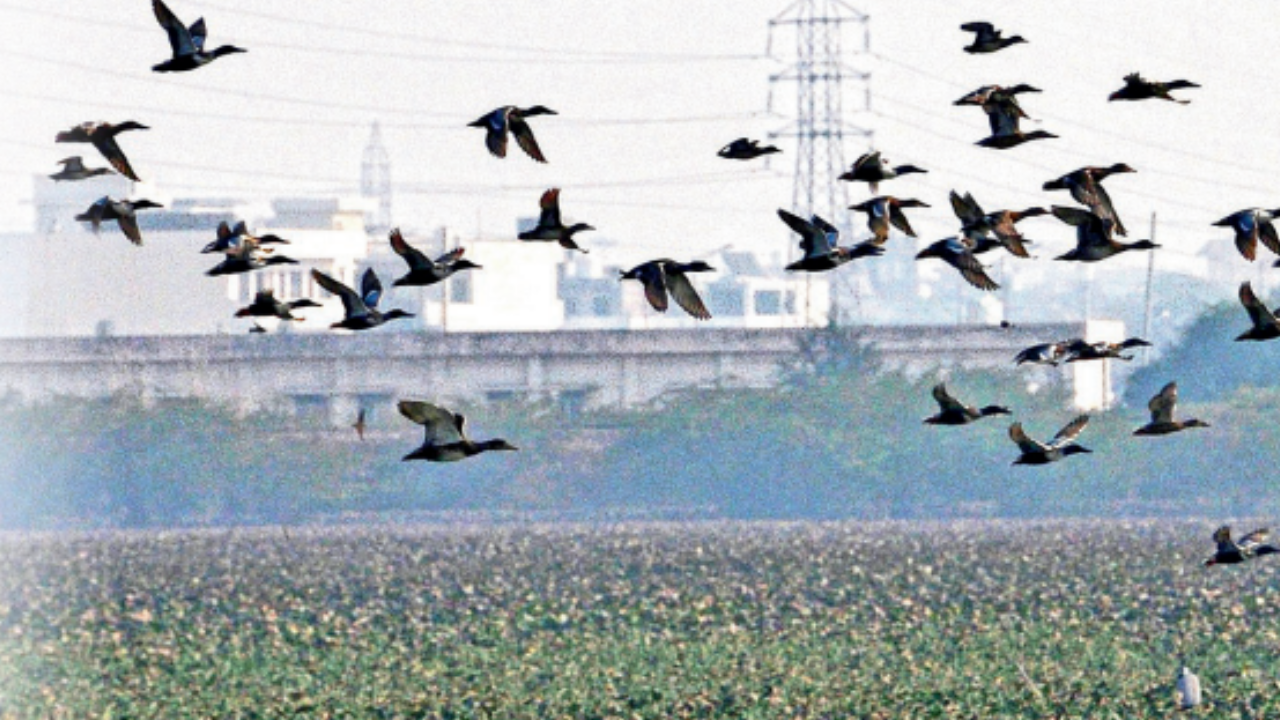
GURGAON: The Gurgaon metro project’s plan to assess the ecological impact of its proposed spur line near the Basai Key Biodiversity Area (KBA) and Important Bird Area (IBA) has come under scrutiny.While GMRL’s environmental and social impact assessment (ESIA) has scheduled the biodiversity survey for July, describing it as the “migratory season”, winter migrants —that earned the site its protected status — leave Haryana months earlier. In short: GMRL’s “migratory season” has come too late.Conducting a migratory bird survey after the migration season “defeats” the very purpose of the exercise, environmentalist Vaishali Rana said, adding biodiversity assessments must be based on ecological cycles rather than project timelines. Maintaining that the proposed survey timing makes little scientific sense, senior birder with Delhi Bird Society Pankaj Gupta told TOI, “There is no point in carrying out a migratory bird study in July because the migratory birds have already left.”The ESIA states in multiple places that an “integrated biodiversity assessment” (BIA) will be carried out in July 2026 to prepare a biodiversity management plan for the Basai wetland in Sector 101. The timeline is repeated in the executive summary, the KBA description, the avifauna impact assessment and other sections of the report.However, Basai was designated an Important Bird Area under BirdLife International’s global network for supporting migratory bird populations along the Central Asian Flyway. The ESIA itself lists species such as the bar-headed goose, greater spotted eagle, imperial eagle, painted stork and sarus crane among birds recorded from the site. Most of these migratory species arrive in north India around Oct and depart by Feb or March.Gupta added, “Migration starts around Oct and continues till Feb or March. If the objective is to assess the species for which Basai was recognised as an Important Bird Area, the survey should be conducted during the migration season. Otherwise, it gives an incomplete picture. In fact, earlier surveys too took place when the migration season ended. It almost appears as if the exercise is designed to show there are no migratory birds at the site.”Rana said, “Such studies are meant to establish an ecological baseline that informs mitigation measures. If the assessment misses the period when migratory birds actually use the site, its findings cannot accurately reflect the ecological significance of the habitat.”The timing assumes significance because the biodiversity assessment is intended to guide mitigation measures for the metro project. Yet, according to the ESIA’s own implementation schedule, piling work near the KBA was expected to begin by the end of June, before the proposed biodiversity survey.A GMRL official told TOI, “Earlier, metro depot was proposed near KBA, but it was later shifted to Sector 33 to avoid any potential impact. Since the metro alignment now passes close to the area, we are carrying out a biodiversity assessment to determine whether the project could have any impact on the birds and the overall biodiversity during either the construction or operational phase. This is a detailed assessment being conducted by domain experts. The exercise will continue for at least three months, covering the monsoon season to assess bird activity during this period. Similar assessments were also carried out in 2023, 2024 and 2025. A dedicated team of experts has now been tasked with conducting the assessment and any further action will be decided based on its findings and recommendations.”The report also reveals that the wetland already underwent major ecological changes before the survey was planned. According to the ESIA, the water body existed because treated wastewater from a damaged sewage drain connected to a nearby sewage treatment plant flowed into the area. After the drain was repaired, the discharge stopped, causing the wetland to dry up. The document states the site has since been backfilled and is being converted into agricultural land.The ESIA also classifies the Basai KBA as a “modified habitat” under the World Bank’s Environmental and Social Standard 6 instead of “critical habitat”, a categorisation that carries stronger protection requirements. The report does not explain whether the classification considered the site’s historical importance as a migratory bird habitat or the ecological changes following the loss of the wetland.
