


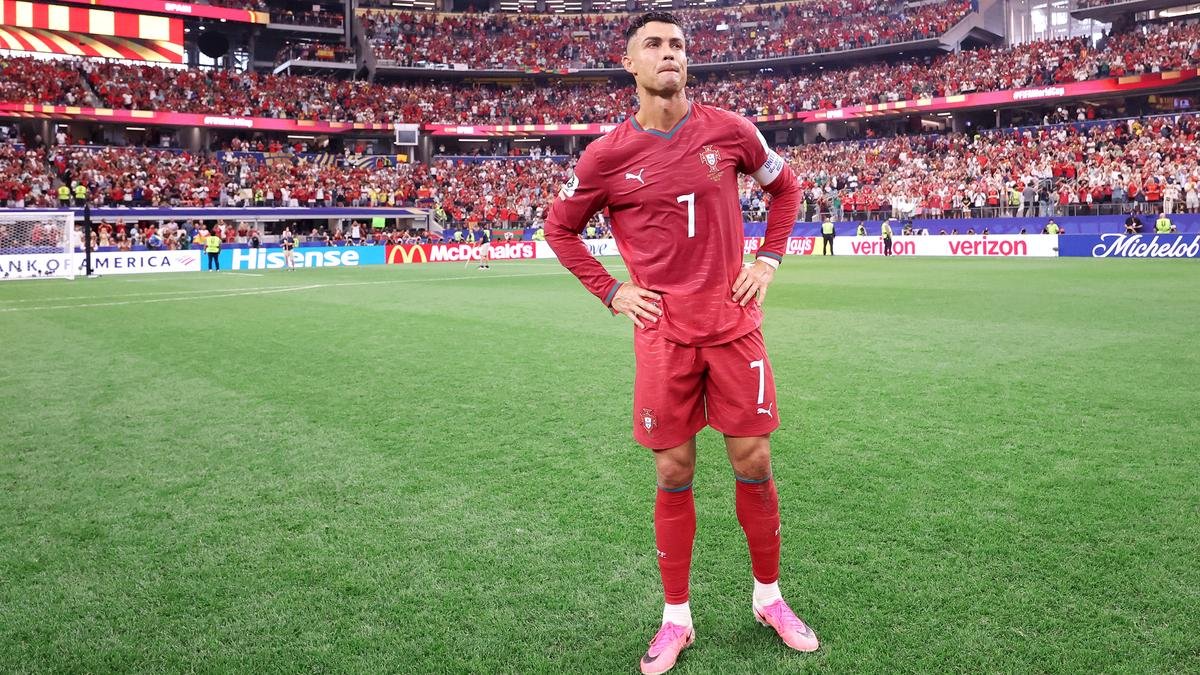
Even in his final moments in a Portugal shirt at the 2026 FIFA World Cup, Cristiano Ronaldo was the cynosure of all eyes. The footballer from Madeira has lived his life in the spotlight for two decades, and would have it no other way in his swansong at the international stage. But for the entirety of the marquee event in the United States, Canada and Mexico, a discomfiting question was at the core of the gaze trained on him: was the forward, now 41 years old and playing his club football for Al-Nassr in Saudi Arabia, impeding Portugal’s chances by leading the line?
He may tend to think such a query stemmed from a position of prejudice towards a certain Argentine, but his critics stood vindicated as Portugal crashed out at the round-of-16 stage after a 1-0 defeat to Spain. Appearing in his sixth World Cup, he netted two goals against a fragile Uzbekistan defence in the group stage and converted a penalty against Croatia in the round of 32. But beyond that, even as other big names like Lionel Messi, Kylian Mbappe, Erling Haaland, Harry Kane and Jude Bellingham set the tournament ablaze with their attacking exploits, Ronaldo’s contributions on the pitch were minimal and deserving of critique.
In the do-or-die game against the Iberian rival, Ronaldo was a bystander for the most part, touching the ball just 19 times across the two halves without ever testing the Spanish back-line. It is true that Ronaldo had long ceased to be the explosive winger who could dribble past opponents with fleet-footed manoeuvres, but even his movement in the 18-yard box lacked the sharpness desired of a goal-poaching striker in a team harbouring ambitions of going the distance.
This is where coach Roberto Martinez, who has left his post since the nation’s early exit, must shoulder much of the blame for Portugal’s disheartening campaign. It would have been a difficult conversation to initiate considering the deity-like reverence that Ronaldo enjoys in his homeland, but Martinez ought to have overlooked sentimental compulsions and examined the wisdom of placing unequivocal trust in a 41-year-old plying his trade in a footballing outpost. Never mind that nobody has scored more goals in international football than Ronaldo’s 146 in 233 appearances.
The former Manchester United and Real Madrid talisman, whose speed and agility were characteristics of the past, could have still had a role to play off the bench given his expertise in front of goal. By starting him in every game when his link-up play with Portugal’s midfield maestros was pedestrian, however, Martinez did not show enough audacity. A damning revelation from the data available is that Ronaldo took 17 shots during the tournament without creating a single chance for a teammate.
It would be disingenuous to suggest the lack of a viable alternative up front when there was Goncalo Ramos, who came on late in the round of 32 against Croatia and promptly produced a stoppage-time winner to send Portugal through.
The 52-year-old manager may argue that his predecessor in the hot seat, Fernando Santos, also endured an early exit despite being bolder at the previous World Cup in Qatar. Having witnessed Ronaldo score just one goal in the first three group games — a spot-kick against Ghana — four years ago, Santos decided to start with Ramos, much to Ronaldo’s seeming discontent, for the round-of-16 duel against Switzerland. The youngster, then 21, responded with a sensational hat-trick, but a 1-0 defeat to Morocco in the quarterfinals brought an unsatisfactory halt to Santos’ stint as Portugal manager soon after.
When Martinez took charge in the build-up to the European Championship in 2024, he steered away from the risk of further alienating the veteran forward. Ronaldo played all five games in Portugal’s run to the quarterfinals at the continental competition, but had no more than a solitary assist to show for his efforts as his team bowed out with a loss to France in a penalty shootout.
Yet, Ronaldo did not pave the way for a transition and soldiered on, refusing to give up on his long-standing pursuit of winning the World Cup. Once he scored five goals from as many appearances in the qualification phase for this year’s showpiece, Ronaldo wasn’t going to be dissuaded from landing in North America for one final shot at the crown jewel.
As was to be anticipated, the cacophony over his spot in the starting XI grew as soon as Ronaldo put up a subdued show in Portugal’s dour 1-1 draw against the Democratic Republic of Congo in their opening joust. While a brace against Uzbekistan in the second game of the group stage relieved the pressure to an extent as he rejoiced with his signature ‘Siuuu’ celebration and yelled to the television cameras that ‘I’m back’, it turned out to be a false dawn.
In the end, Ronaldo racked up 27 appearances and 11 goals in World Cups. His brace against Uzbekistan made him the first to find the net in six different editions. At the same time, he had just one goal in 10 knockout games and never reached a final.
Clear conscience
“I am sad to leave like this but I have given everything, always given my best,” Ronaldo told the media afterwards. “I go with a clear conscience. This is football, it is the life of a footballer. Sometimes you win, sometimes you lose. You have to carry on. It was my last World Cup, yes, but as far as the rest of it is concerned: there will be time to think, to be with my family, [I will] not make decisions in the heat of the moment.
“I won three titles with Portugal. Before Cristiano, Portugal had never won a big trophy. The best trophy I won with the national team was (in) 2016, which for me has the same dimension as the World Cup. So I repeat: I leave here with a clear conscience. Tomorrow will be another day and life goes on,” he asserted.
As much as he tries to ascribe equal importance to winning the Euros in 2016, the absence of the World Cup in his trophy cabinet will rankle. Particularly with Messi — the two have been spurred on an individual level by each other’s extraordinary feats — hoisting the holy grail in 2022 and cementing his place in Argentine folklore, Ronaldo would have been fiercely keen for the grand prize not to elude his grasp.
Where the two greats diverged in recent years was in their style of play and what they symbolised to their national teams. Even as Messi remains the twinkle-toed wizard at the heart of every attacking move for the Albiceleste, Ronaldo’s output was increasingly confined to the number of goals next to his name. For Messi’s teammates in Argentina’s iconic sky and blue, the man from Rosario is a hero and father-figure whom they fight tooth and nail for. The equation between Ronaldo and his peers didn’t appear as symbiotic.
Ruthless goalscorer
Once the dust settles, nevertheless, Ronaldo’s World Cup disappointments shouldn’t affect his rich legacy. In his pomp, lest we forget, he could really do it all. He had the pace and power of a sprinter, and jumped vertically for headers in the box like a basketballer would for a slam dunk. Having started out on the wing, he was able to fine-tune his skills to such a degree that he eventually turned into a ruthless goalscorer. At Manchester United in the 2000s and Real Madrid in the 2010s, both of which had A-listers galore, Ronaldo was a match-winner and entertainer par excellence. He was at the forefront of multiple Premier League, LaLiga and Champions League titles for these iconic clubs. The final stretch of his career may have clouded some of those champagne-popping memories. But as and when he decides to retire altogether — his contract with Saudi club Al-Nassr runs till next year — nothing less than the highest praise will do justice to one of the greatest to have graced the beautiful game. No World Cup setback can alter that.
Published – July 14, 2026 11:53 pm IST
