


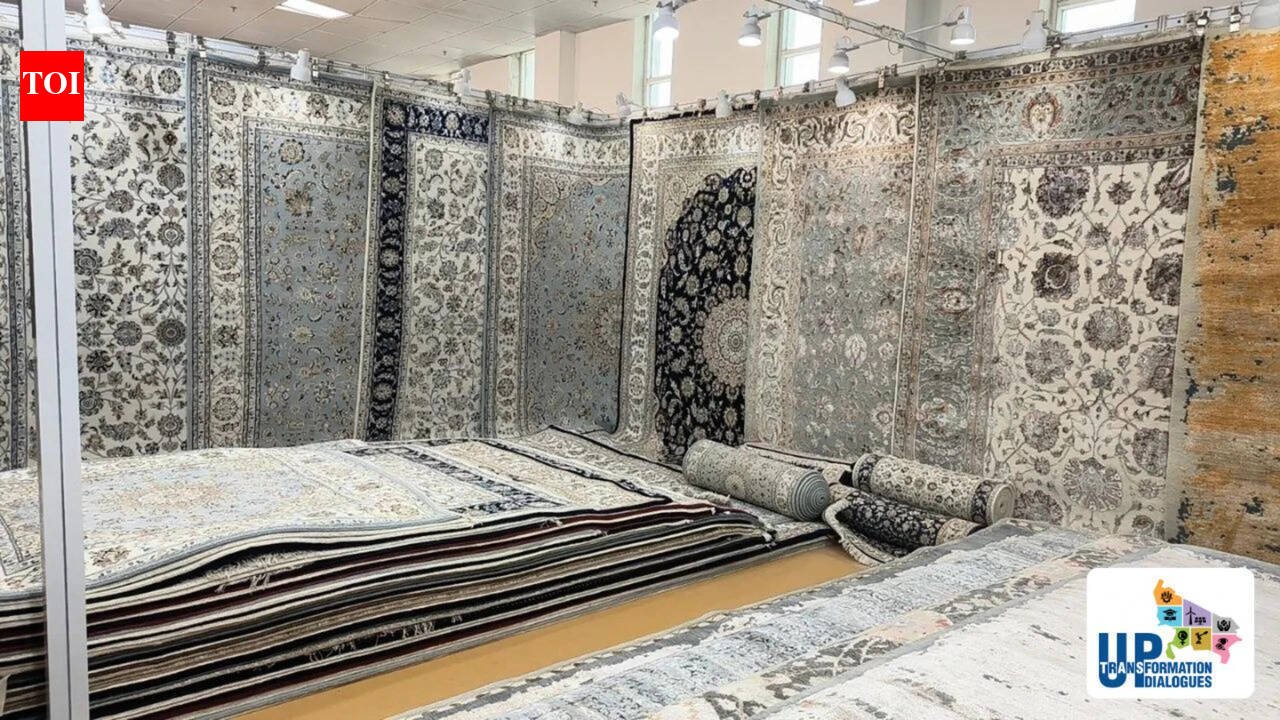
Bhadohi, an old sleepy town in Uttar Pradesh—officially named Sant Ravidas Nagar—has been synonymous with India’s finest hand-knotted carpets. The district’s intricate craftsmanship, passed down through generations of skilled artisans, earned it the title of the country’s “Carpet City.” Every handwoven carpet produced in Bhadohi carries with it a legacy of artistry, patience and cultural heritage that has found admirers across the world. Yet, despite its rich tradition and international reputation, the carpet industry had begun facing severe challenges by the middle of the last decade. Rising competition from machine-made products, inadequate marketing, limited access to finance, outdated designs and infrastructure bottlenecks had pushed many weavers into economic uncertainty.Since 2017, however, Bhadohi has witnessed a remarkable revival under the leadership of Chief Minister Yogi Adityanath. By placing carpets at the centre of the One District One Product(ODOP) initiative and complementing it with financial assistance, export promotion, infrastructure development and skill enhancement programmes, the Uttar Pradesh government has transformed Bhadohi into one of the state’s strongest export-oriented districts. Today, the district stands as a shining example of how traditional craftsmanship can become a modern engine of economic growth.The revival began with a clear recognition that Bhadohi’s carpets were not merely handicrafts but a global brand deserving systematic policy support. Under the ODOP programme, carpets were identified as the district’s flagship product, ensuring focused government attention across every stage of the value chain—from production to marketing and exports. Instead of limiting support to subsidies alone, the government created a comprehensive ecosystem that addressed the industry’s long-standing challenges.Artisans and entrepreneurs received easier access to institutional finance through ODOP-linked credit schemes, enabling them to modernise production, expand operations and improve product quality. Training programmes introduced contemporary designs while preserving the traditional weaving techniques that distinguish Bhadohi carpets in international markets. Toolkits, quality certification, improved packaging, branding assistance and participation in national and international exhibitions further enhanced the competitiveness of local manufacturers.These interventions became particularly significant because the carpet industry remains one of Uttar Pradesh’s largest employment generators. It is estimated to provide livelihoods to nearly 25 to 30 lakh people across the Bhadohi-Mirzapur-Varanasi carpet belt, with a substantial share of the workforce comprising women engaged in home-based weaving and finishing activities. The government’s efforts have therefore not only strengthened exports but also supported rural employment, women’s economic participation and traditional artisan families.One of the most significant milestones in Bhadohi’s transformation was the inauguration of the Carpet Expo Mart in December 2020. Conceived as a permanent international business platform, the Expo Mart brought global buyers directly to the doorstep of local exporters instead of requiring manufacturers to depend solely on overseas trade fairs. This single intervention substantially reduced marketing costs while increasing business opportunities for exporters.The impact became visible through successive editions of the International Carpet Expo and Kaleen Mela organised in Bhadohi. While earlier exhibitions attracted only a limited number of overseas buyers, recent events have witnessed participation from nearly 300 to 450 international buyers representing between 68 and 88 countries. Buyers from the United States, Germany, France, the United Kingdom, Australia, Japan, the Middle East and several European nations now regularly visit Bhadohi to source carpets directly from manufacturers. This direct interaction has helped artisans better understand global consumer preferences while enabling exporters to secure higher-value orders.The strengthening of Bhadohi’s export ecosystem has contributed significantly to Uttar Pradesh’s emergence as one of India’s leading export-oriented states. The state now contributes more than 60 per cent of India’s carpet exports, with Bhadohi accounting for the largest share within Uttar Pradesh. Annual carpet exports from the district have consistently remained in the range of Rs5,600 crore to over Rs 6,100 crore in recent years despite global economic uncertainties, while the wider carpet industry generates exports worth several thousand crore rupees annually.Another important factor behind Bhadohi’s growing international reputation has been the integration of its earlier Geographical Indication (GI) status with modern export promotion strategies. The GI tag protects the authenticity and identity of Bhadohi carpets, assuring buyers of their traditional craftsmanship and geographical origin. This heritage advantage has been strengthened through ODOP branding, enabling Bhadohi carpets to command greater recognition in premium global markets.The district has also benefited from its recognition as a Town of Export Excellence, providing additional support for export infrastructure, modern machinery, common facilities and participation in international trade exhibitions. These initiatives have further improved the competitiveness of local exporters while encouraging investment in the sector.Beyond ODOP, the Yogi government has extended support through several complementary schemes aimed at artisans and small entrepreneurs. Programmes such as the Chief Minister Yuva Swarojgar Yojana, Vishwakarma Shram Samman Yojana and various MSME promotion initiatives have enabled carpet manufacturers to access loans, skill development programmes and modern equipment. Young entrepreneurs have found new opportunities to establish businesses in design, production, finishing and exports, while traditional artisan families have been able to upgrade their skills to meet changing international demand.Infrastructure development has also played a crucial role in Bhadohi’s transformation. Improved road connectivity, railway overbridges, bridges across the Ganga and better logistics networks have facilitated faster movement of raw materials and finished products. Export-oriented districts depend heavily on efficient transportation, and the state’s continued investment in connectivity has strengthened Bhadohi’s competitiveness in global markets. Simultaneously, industrial development initiatives and cluster-based interventions have improved common facilities, production efficiency and supply chain management.The government has also adopted a proactive approach towards emerging global challenges. International trade conditions, including fluctuations in demand and tariff-related uncertainties in major markets such as the United States, have posed difficulties for exporters. Rather than allowing these developments to weaken the industry, the state has encouraged exporters to diversify into newer markets across Europe, the Middle East, Australia and Asia. Efforts to leverage India’s free trade agreements with countries such as the UAE and the United Kingdom are expected to create fresh opportunities for Bhadohi’s exporters. Regular interaction between government officials and industry representatives has helped identify sectoral concerns and formulate timely policy responses.The transformation of Bhadohi is not merely an economic success story but also one of cultural preservation. Traditional weaving skills that had once faced the risk of decline have found renewed relevance in international markets. Younger generations are increasingly viewing carpet weaving not simply as inherited craftsmanship but as a viable entrepreneurial opportunity supported by government policies and expanding global demand.Today, Bhadohi carpets are exported to more than 80 to 100 countries across North America, Europe, the Middle East, Australia and East Asia. The district has emerged as a symbol of Uttar Pradesh’s broader strategy of combining heritage industries with modern economic development. The integration of ODOP, export promotion, financial inclusion, infrastructure development, skill enhancement and global marketing has created a sustainable growth model that benefits artisans, entrepreneurs and the rural economy alike.The journey has not been entirely free from challenges. Dependence on international markets, global economic fluctuations, labour-related issues and evolving consumer preferences continue to require constant adaptation. Nevertheless, the resilience displayed by Bhadohi’s carpet industry over the past nine years demonstrates the effectiveness of coordinated policy interventions.As Uttar Pradesh continues its ambition of becoming a trillion-dollar economy, Bhadohi stands out as one of the state’s most compelling development stories. From a traditional weaving cluster facing uncertainty, it has transformed into a globally recognised export hub where heritage craftsmanship meets modern enterprise. The district’s remarkable revival under the Yogi government illustrates how targeted policy support, combined with the entrepreneurial spirit of local artisans, can convert age-old traditions into powerful engines of economic growth, employment generation and international recognition.The revival of Bhadohi’s carpet industry has unfolded alongside Uttar Pradesh’s broader economic transformation. During the last nine years, the state’s Gross State Domestic Product (GSDP) has nearly doubled—from about Rs 12.75 lakh crore in 2016-17 to nearly Rs 30 lakh crore in 2024-25 (advance estimates)—making Uttar Pradesh India’s second-largest state economy and moving it closer to the government’s goal of becoming a US$1 trillion economy. Exports have witnessed equally impressive growth. Merchandise exports from Uttar Pradesh have increased from approximately Rs 88,000 crore in 2016-17 to over Rs 2 lakh crore annually in recent years. This surge has been driven by policy initiatives such as One District One Product (ODOP), improvements in logistics and expressway connectivity, export facilitation measures, digital single-window clearances and stronger support for MSMEs. As one of the state’s leading export districts, Bhadohi has contributed significantly to this growth through its globally acclaimed handmade carpets, reinforcing Uttar Pradesh’s position as India’s largest exporter of handmade carpets.
