



For much of the past two decades, India’s commercial real estate story revolved around a familiar set of cities. Bengaluru, Mumbai, Delhi-NCR, Hyderabad, Pune and Chennai dominated office demand, attracted multinational occupiers and defined the country’s Grade-A office market. For investors looking to own a stake in India’s growth through premium commercial assets, these were the only addresses that truly mattered.

That map is now being redrawn.
The shift is already visible in the leasing data. Office demand is no longer confined to India’s largest metros and is expanding rapidly into smaller cities. Industry data show that office leasing in Tier-2 cities nearly doubled year-on-year in FY25, while JLL reported a 43% year-on-year increase in Global Capability Centre (GCC) leasing across India in the first quarter of 2026, with a growing share of demand from emerging markets beyond traditional office hubs. The centre of gravity is not shifting away from the big cities; it is simply broadening to include new destinations.
Underpinning this is a structural change in how companies occupy space at all. In March 2026, CBRE and FICCI published Flex-plosion: India’s Flexible Workspaces Era, which put India’s flexible office stock at 110–114 million square feet and noted that it has grown at roughly 23–25% per year since 2020. Notably, the report found that global companies making deliberate, long-term real estate decisions accounted for the majority of flexible-space demand in 2025 — evidence that managed and flexible workspace has moved well beyond its origins as a cost workaround for early-stage startups. Mordor Intelligence values the broader co-working market at around $4.5 billion in 2026, projecting it to nearly double by 2031, with the ‘rest of India’ cluster outside the top metros growing fastest of all.
One coast decided to build
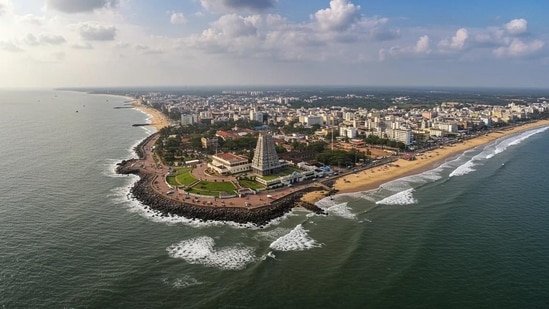
Nowhere illustrates this decentralisation more vividly than the Karnataka coast. Mangaluru, long known for its port, its schools, and its beaches, has over the past few years acquired a new identity that the state government has since made official: the ‘Silicon Beach of India.’
The label is not merely aspirational. The city’s technology ecosystem is expanding on the back of GCCs and R&D units set up by multinationals, supported by a Karnataka policy framework that includes rent reimbursement, a multi-year electricity duty waiver and reimbursement on R&D spending. Infosys has scaled its Mangaluru operations to around 5,000 employees, and several firms in the region have crossed the 1,000-employee mark. Industry estimates cited in recent coverage suggest the local IT workforce could grow from roughly 20,000 today to 200,000 over the next eight years. This reverses the decades-old pattern in which the region’s graduates left for Bengaluru, Pune and Hyderabad.
What makes the trajectory credible is that it rests on fundamentals rather than hype: a large annual output of engineering and graduate talent, operating costs materially below the metros, and a quality-of-life advantage that has become a genuine recruiting tool as Bengaluru’s IT corridors near saturation. The city’s skyline has changed to match. Mangaluru now has dozens of towers above twenty floors, several of them among the tallest under construction in southern India.
Gurudutta Shenoy, Managing Partner at Vertex Managed Workspace, one of the region’s established operators, captured the underlying logic when he observed that tech parks can be built anywhere, but coastlines cannot be replicated. It is a useful way to think about durable advantage, the kind that tends to hold value through cycles.
Why the asset type matters
A growth story is only an investment story if it attaches to the right asset. And here the interesting shift is not simply where demand is going, but what form it takes when it gets there.
The enterprises driving this expansion—GCCs, mid-sized global entrants, and compliance-heavy operations—increasingly want institutional-quality, professionally managed Grade-A space they can occupy quickly, rather than bare shells they must fit out and staff themselves. CBRE and FICCI identify GCCs as the next major demand driver for flexible workspace, already accounting for a large and rising share of enterprise take-up. That preference concentrates value in a specific kind of asset: a well-located, professionally operated commercial building with stable, contracted tenancy.
This is where the broader investment conversation of the past year connects. As capital has grown more discerning, the emphasis across asset classes has shifted from chasing valuation gains to owning assets that generate steady, recurring income. A managed commercial asset with professional leasing and operations sits squarely in that category; it behaves less like a speculative bet on a rising market and more like a contracted income stream with appreciation attached.
The access question
For most individual investors, the catch has always been access. Institutional-grade commercial real estate, the pre-leased, professionally managed office asset, has historically been the preserve of funds and large investors, gated behind capital requirements that put it out of ordinary reach.
That barrier is the one now being dismantled, and not only in real estate. It is the same pattern regulators are testing elsewhere: SEBI’s recent pilot to tokenise corporate bonds is, at its heart, an effort to break high-value instruments into smaller, more accessible units. Applied to property, the logic is identical. Platforms such as Alt DRX are enabling investors to participate in curated, professionally managed commercial real estate at entry points unimaginable a decade ago — including opportunities like the Vertex Managed Workspace asset in Mangaluru, which pairs a Grade-A development with professional leasing and asset management within a single managed structure. It turns a category once reserved for institutions into something an individual can hold a defined slice of.
The direction of travel
None of this suggests the metros are fading. Bengaluru and Mumbai will remain the largest, deepest commercial markets in the country for the foreseeable future. But the more interesting question for an investor is rarely where the market already is, it is where the market is heading, and which assets are positioned early in that path.
India’s office demand is decentralising. Managed, Grade-A commercial space is becoming the default form that demand takes. And ownership of that space is, for the first time, opening up beyond the institutions. Coastal Karnataka sits at the intersection of all three shifts, which is reason enough to watch it closely, regardless of what one ultimately decides to do.
Note to the Reader: This article has been produced on behalf of the brand by HT Brand Studio and does not have journalistic/editorial involvement of Hindustan Times. The content is for information and awareness purposes and does not constitute any financial advice.


