



There was a moment from the Qualifier 1 game at the HPCA Stadium in Dharamsala that perfectly captured what Royal Challengers Bengaluru have truly become.
Rajat Patidar was 16 off 11 balls. RCB were two down. For a brief moment, perhaps the only one in the entire match, the Gujarat Titans sensed an opening. Jason Holder’s two-wicket burst, combined with Rashid Khan building pressure from the other end, suddenly left RCB feeling cornered. That is how brutally fast T20 cricket shifts. One moment you are cruising at over 11 runs an over, the next the innings suddenly feels sluggish after a couple of wickets, and in modern T20 cricket, that change can feel enormous.
A couple of fielding errors from the 2022 champions followed, and Patidar did not merely seize the opportunity; he dismantled Gujarat completely.
Shubman Gill and Ashish Nehra were scrambling for answers. In Ahmedabad earlier this season, Patidar had been peppered with short balls and dismissed quickly. But Gujarat did not have Arshad Khan this time, and the short-ball ploy fell apart completely as Patidar unleashed carnage, smashing 93 not out off just 33 balls to carry RCB into their second straight IPL final.
The innings, the season, and RCB’s stunning rise have all led to one obvious question: how exactly did they get here from where they once were?
How RCB rebuilt themselves from the inside out
For 17 years, RCB were cricket’s great romantics, endlessly loved, endlessly dramatic, and endlessly incomplete. While others collected trophies, RCB collected superstars. They had Virat Kohli. They had AB de Villiers. They had Chris Gayle. They had Kevin Pietersen. They had Rahul Dravid. What they never truly had was a complete team.
The transformation, however, began well before the auction table.
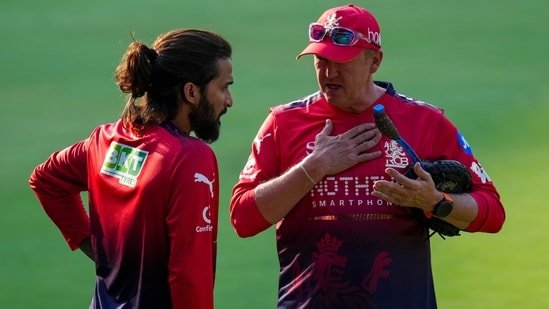
Former England performance director Mo Bobat joined the franchise in 2023 as director of cricket. A year later, former T20 World Cup-winning coach Andy Flower arrived as head coach, while veteran wicketkeeper-batter Dinesh Karthik was brought in as batting coach.
The first major decision was to move away from the superstar-centric model.
Ahead of the mega auction, RCB retained only three players, among them Kohli and Patidar. That immediately gave the franchise the flexibility to target what it had historically neglected most: elite bowling. Bhuvneshwar Kumar and Josh Hazlewood arrived, and together they have formed arguably the most complete new-ball partnership of IPL 2026. Bhuvneshwar, supposedly nearing the twilight of his career, has reignited conversations around an India comeback after two exceptional IPL seasons, while Hazlewood has emerged as the perfect partner in crime.
The batting, meanwhile, was redesigned rather than merely reshuffled, and at the centre of that shift was Kohli’s evolution. For years, Kohli’s strike rate dominated conversations around his T20 batting. But somewhere around the middle of 2024, he accepted what modern T20 batting demanded. A brutal encounter against Sunrisers Hyderabad became the turning point. Kohli transformed himself from a patient accumulator into a ruthless powerplay aggressor. The results followed immediately. His strike rate this season sits above 164, comfortably the best of his IPL career.
Patidar, meanwhile, has been given the freedom to control the middle overs with calculated aggression. Around him, RCB built a strong support structure featuring vice-captain Jitesh Sharma, Tim David and the ever-evolving Krunal Pandya, who has quietly become one of the franchise’s most important all-rounders.
Another major factor behind RCB’s rise has been their depth. When Phil Salt got injured, they trusted Jacob Bethell. When Bethell too became unavailable, they backed Venkatesh Iyer to fill the role at the top. That flexibility simply did not exist in previous RCB sides.
“When an organisation hasn’t achieved its main goal for 17 years, you have to ask why,” Bobat said. “And you have to have the humility to look at your own failings. RCB had a history of relying heavily on a few icon players, and the team’s performance depended on those players performing well. We wanted a more even distribution of talent and experience to give ourselves a better chance of building a championship-winning team.”
That trust between captain and management runs deeper than tactics.
Patidar is, by all accounts, a very different kind of RCB captain. When he was handed leadership last year, there were questions everywhere and growing speculation over Kohli potentially returning to the role. But Patidar remained untouched by the noise, focused almost entirely on cricket. He has largely left the larger strategic thinking to Flower and Bobat. And the management has responded with ruthless honesty, particularly regarding their own shortcomings. When RCB struggled at the Chinnaswamy Stadium last season, they did not deflect blame. They sat down, reassessed how they needed to bat and bowl at home, and rebuilt their approach accordingly. The results reflected instantly. After losing three of their six home games last season, RCB improved to 4 wins in 5 matches in Bengaluru this year.
Then there is Karthik, whose influence sometimes gets overshadowed by Flower’s presence. After years of refining his own finishing skills as a batter, Karthik now does the same from the dugout. He spends individual time with players, mapping strengths, identifying weaknesses and helping them prepare for pressure situations.
Krunal spoke openly about it after his match-winning 73 against the Mumbai Indians, saying that behind RCB’s calmness under pressure and clarity in decision-making was Karthik’s relentless behind-the-scenes work.
Can RCB make it back-to-back titles?
That was the challenge Bobat threw at the squad when they regrouped before the season began:
“Why can’t we be the third team to do it?”
Only two franchises have successfully defended an IPL title before, Chennai Super Kings in 2011 and Mumbai Indians in 2020.
Now, RCB stand one step away.
Two straight IPL finals. One trophy already secured. And perhaps most importantly, a group that looks far from satisfied.
When Flower took charge of RCB, he spoke about wanting to build something special with the franchise. Whether they lift the trophy again this season or not, it is already difficult to argue that he hasn’t.


