



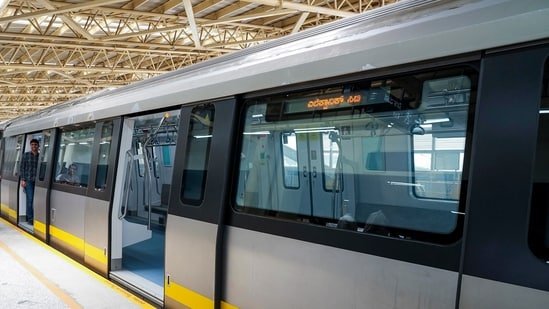
Bengaluru’s expanding metro network is fast becoming a key driver of intra-city connectivity, with the Yellow and Pink Lines expected to spur real estate growth across major micro-markets. Over the next two years, an additional 5–7 million sq ft of Grade A office demand is likely across the CBD, SBD and Electronic City, as improved commute times boost occupier interest and developer activity. Office hubs along these corridors could account for 15–20% of the city’s Grade A stock by 2027, with rentals projected to rise 5–10% in the near term, a report by Colliers India said.


On the residential front, the operational Yellow Line has already enhanced access to South Bengaluru, pushing housing prices up by nearly 45% in Electronic City. Meanwhile, locations along the upcoming Pink Line, including Bannerghatta Road and JP Nagar, are witnessing strong traction, particularly in the mid-income and luxury segments. Overall, better connectivity is expected to trigger a ripple effect across housing, office, retail and hospitality markets in the years ahead, it said.
Enhanced metro connectivity is expected to further accelerate hybrid work models, with primary hubs in CBD locations complemented by satellite offices in residential catchments of SBD 2 and Electronic City. Competitive rentals, coupled with a strong presence of startups and MNCs across technology, engineering, manufacturing, and BFSI sectors, are likely to keep these micro-markets attractive for flex space operators, it said.
“The expansion of Bengaluru’s metro network is set to boost the city’s office market across key central and secondary business districts and peripheral locations such as Electronic City. The operational Yellow Line has already improved connectivity to Electronic City, the city’s southern technology hub, boosting demand. At the same time, the upcoming Pink Line is expected to further enhance Grade A office uptake in its catchment areas,” said Arpit Mehrotra, Managing Director, Office Services, India, Colliers.
Also Read: Bengaluru Metro expansion: How will it impact property prices and rental values?
“As commute time reduces and intra-city connectivity improves, the Bengaluru office market will witness strengthening of demand amid growing developer interest. Office hubs along the Yellow and Pink line are expected to account for 15–20% of the city’s total Grade A office stock by 2027 and witness a rental increase of 5-10% in the next 1-2 years,” he said.
Average housing prices in key localities may rise by up to 40% in the next two years
The operationalisation of the Yellow line has also been instrumental in enhancing connectivity for residents in Electronic City, the southern technology and industrial hub of the city. Average housing prices have increased substantially in select micro-markets along the stretch. Similarly, housing demand has already started picking up in residential catchment areas along the Pink line, which is likely to get fully operational by 2027. Leading developers have intensified their launches along Bannerghatta Road and in nearby localities. Overall, improving metro connectivity will further boost residential demand and drive capital values upwards by up to 40% in the next few years, the report said.
“The impact of metro connectivity is clearly visible in the Bengaluru residential market, particularly along the Yellow and Pink Line corridors. The operational Yellow Line has significantly improved access to South Bengaluru, driving up housing prices by almost 45% in locations such as Electronic City. At the same time, residential catchment areas along the Pink Line, including Bannerghatta Road and JP Nagar, are witnessing a surge in demand, especially in the middle-income and luxury segments,” said Vimal Nadar, National Director and Head of Research, Colliers India.
1-2 msf of industrial and warehousing demand anticipated in key clusters along the Yellow and Pink lines
The phased opening of key metro lines is expected to significantly boost warehousing demand in industrial clusters, with average rentals projected to increase by 5-8% over the next few years. The operational Yellow Line has enhanced connectivity to established manufacturing hubs such as Bommasandra, Jigani, Attibele, and Anekal, improving accessibility for the workforce and logistics movement, the report said.
Also Read: Namma Metro Blue Line: Will improved connectivity push up real estate prices across Bengaluru?
Similarly, the upcoming Pink Line is likely to spur demand in emerging industrial hubs along Bannerghatta Road and Harohalli, supporting e-commerce, quick commerce and last-mile distribution networks. Improved transit infrastructure is also expected to enhance the attractiveness of these locations for labour, it said.
Blue Line to unlock the real estate potential of ORR and North Bengaluru
While the Green and Purple Lines strengthened demand in established locations, the recently operational Yellow Line and upcoming Pink Line will enhance connectivity, particularly in the south’s peripheral areas, such as Electronic City and Bannerghatta. Looking further ahead, the anticipated commencement of the Blue Line by 2028 is expected to fully unlock Bengaluru’s potential, especially along the Outer Ring Road corridor and North Bengaluru, reinforcing the city’s position as a high-growth, infrastructure-led real estate market, the report said.
Bengaluru Metro corridors
Bengaluru currently has five metro lines at various stages of development. The Green Line (Madvana–Silk Institute) and Purple Line (Challaghatta–Whitefield) are already operational, spanning the city’s key north–south and east–west corridors.
The recently operational Yellow Line (RV Road–Bommasandra) has significantly improved connectivity to major employment hubs in South Bengaluru, including Electronic City, Hosur Road and Bommasandra.
The upcoming Pink Line (Kalena Agrahara–Nagawara) is expected to reduce commute times further and reshape real estate dynamics across central and southern parts of the city.
Meanwhile, the Blue Line, slated for completion by 2028, is likely to unlock growth potential along the Outer Ring Road corridor and in North Bengaluru.


