





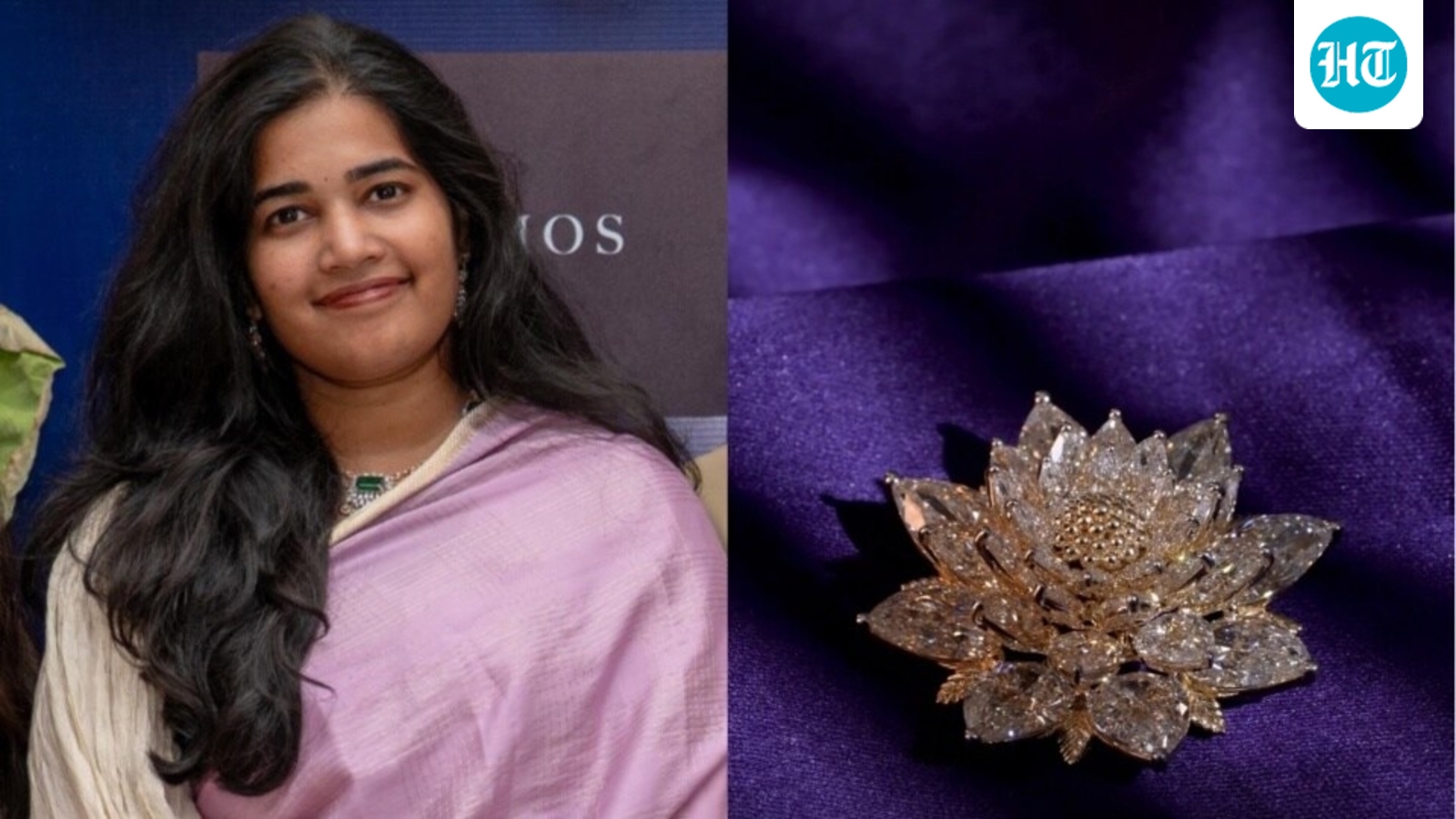
On July 18, 2026, India’s ‘first private orbital rocket’, Vikram 1, launched from the Satish Dhawan Space Centre in Sriharikota and did something no rocket had ever done before. In 16 minutes, it reached low Earth orbit at an altitude of 453 km. And tucked inside, alongside advanced satellite payloads, was something entirely unexpected: ‘Cosmic Bloom’ — a lotus-shaped jewel, set with 32 pear-cut lab-grown diamonds in 14k yellow gold. Also read |₹2.2 crore diamond bracelet, reveals it was gifted by the Ambani family”> Rihanna shows off her ₹2.2 crore diamond bracelet, reveals it was gifted by the Ambani family
It is now the world’s first piece of fine lab-grown diamond jewellery to travel to space and survive. The story behind it belongs to Sanjana Tripuramallu, founder of Bengaluru-based Cosmos Diamonds, who, in an interview with HT Lifestyle, explained how a casual question became an orbital mission, and why this flight could end the debate around lab-grown diamonds.
Here are 10 things you need to know about the lab-grown diamond jewellery that went to space:
1. It all started with ‘Twinkle Twinkle Little Star’
There was no grand strategy deck. There was a conversation: a nursery rhyme, a question, and then, a payload qualified for orbit. “It was never one thing, and it was never planned the way most campaigns are planned,” Sanjana shared, adding, “The idea began in a casual conversation with the Skyroot team, where someone remembered the nursery rhyme ‘Twinkle Twinkle Little Star’ and one question followed: can we actually put a diamond in space? The more we sat with it, the more it stopped feeling like a stunt and started feeling like something that had to exist.”
2. It was a meeting of two very similar ‘disruptors’
On paper, rockets and diamonds have little in common. In spirit, Sanjana pointed out, Skyroot Aerospace and Cosmos Diamonds had everything in common: two young, made-in-India companies taking on legacy industries with technology. The collaboration, she said, felt inevitable.
“Skyroot is the first private rocket company coming out of India. Everything about what they are building champions ‘Made in India’. They are a young company — their average team age is under 30 — and so are we. Two Indian companies, both disrupting industries that had not seen a real challenger in decades, both building through technology while staying completely rooted in this country. When we looked at each other, we saw the same story in a different industry. Placing a lab-grown diamond on that rocket felt like the most natural thing in the world,” Sanjana said.
3. You can’t just put jewellery on a rocket: this took real engineering
Space is hostile. Vacuum, violent vibration during launch, and thermal extremes that can crack unqualified materials in seconds. To be cleared by IN-SPACe, the Indian National Space Promotion and Authorisation Centre, the jewel had to be engineered like a satellite component. “This was not a symbolic gesture. It was an engineering challenge,” Sanjana said.
Think gold screws engineered to mimic aerospace fasteners. Think custom paint solutions on aluminium that could survive orbit. Nothing was ornamental for the sake of it.
“We worked very closely with the Skyroot Aerospace team throughout the entire process. The Cosmic Bloom went through more than 100 sketches and 11 production iterations before we arrived at the final jewel. We tested various metals and materials under guidance from the Skyroot engineering team. We replicated rocket screws in gold to keep the lotus secured during launch. We used aluminium with a custom paint solution to inscribe the Cosmos Diamonds branding directly on the payload. Every detail had a purpose,” Sanjana explained.
4. The design had to be unmistakably Indian, and technically unforgiving
The choice was the lotus — India’s national flower, and a motif found in temples, architecture, mythology, and art for centuries. “The lotus is in our temples, our architecture, our mythology, our art. It has travelled through centuries and still feels completely alive,” Sanjana said.
A symbol of purity and resilience, built with the patience of a rocket program. But there was also a craft reason. The lotus is one of the most demanding forms in fine jewellery. “Beyond the symbolism, there is the craft. The lotus is one of the most technically demanding forms to execute in fine jewellery. Each petal has to be set individually. The geometry has to hold perfectly across 32 pear-cut diamonds. The whole piece has to move as one. It is the kind of craftsmanship that takes years to master and cannot be rushed… much like building a rocket,” Sanjana added.
5. Then, in orbit, the sun did something no one planned
When Vikram 1 reached orbit, the payload cameras captured a moment that was not in the storyboard. Light refracting through 32 pear-cut diamonds, blooming at 453 km above Earth. It was, by all accounts, extraordinary footage.
“When Vikram 1 reached orbit, and the first rays of sunlight touched the Cosmic Bloom, the light came through every diamond and bloomed,” Sanjana recalled, adding, “It was not staged. It was not in any brief. It just happened. Skyroot CEO Pawan Kumar Chandana called it one of the best pieces of footage ever captured from a space mission.”
6. It was the durability test to end all durability tests
Lab-grown diamonds have long battled misconceptions — that they are imitations, less hard, less real. Sanjana has spent years answering those questions. Now, space answered it for her. “The durability proof was almost a side effect,” Sanjana shared, adding, “If a diamond survives all of that, there is very little left to argue about.”
She was clear about what they are: “Lab-grown diamonds are not a different product. They are not an imitation or an alternative. They are diamonds,” she shared. And her analogy has become her signature explanation.
“The best way I have found to explain that is through the analogy of IVF. A baby conceived through IVF and a baby conceived naturally are the same in every way that matters. Only the conception is different. Lab-grown diamonds and mined diamonds are exactly the same. Same carbon structure, same hardness, same grading system, same brilliance, same everything. Only the origin is different,” Sanjana said.
Now, she has a new answer — one forged at orbital velocity. “We have spent years answering that question with words. Now we have a different answer. These diamonds travelled into a vacuum at 450 kilometres above the Earth’s surface. They survived the forces of a rocket launch and experienced extreme temperature changes in space. Not a single diamond budged from its setting. The action spoke louder than any explanation we could have given,” she added.
7. The truth about diamonds
The environmental case is well-documented. Mined diamonds require the displacement of thousands of tons of earth and the consumption of vast quantities of water. Lab-grown diamonds, cultivated in controlled facilities increasingly powered by renewable energy, leave a lighter footprint. But there is also a scientific nuance that surprises many buyers. “We spend so much time in this industry saying lab-grown diamonds are the same as mined diamonds that we have almost undersold them,” Sanjana noted.
“The truth is that because lab-grown diamonds are grown in a controlled environment, they have far fewer impurities than mined diamonds. Mined diamonds form under natural conditions, which means they almost always carry trace amounts of impurities… Kohinoor became as legendary as it did precisely because it had none. But when you look at lab-grown diamonds, that level of purity is not rare. It is the standard. You are not compromising when you choose a lab-grown diamond. In the most literal, scientific sense, you are often getting something better,” she added.
8. The market may have already shifted: Gen Z led it
Sanjana founded Cosmos Diamonds in 2020 out of a personal frustration — the lack of transparently priced, high-quality wedding jewellery in India. At the time, lab-grown diamonds were met with scepticism.
“When we started Cosmos in 2020, lab-grown diamonds were not popular in India at all. Every conversation was an education. Today, the landscape is completely different. Gen Z do not compare. They have accepted lab-grown diamonds from the start without needing any explanation. They understand technology, they care about sustainability, and they are not attached to the idea that a diamond must come from the ground to be meaningful,” Sanjana said.
That shift is now visible in trade data, with India’s lab-grown diamond exports accelerating and demand expanding far beyond metros into tier-II cities. Conscious luxury is no longer a niche.
9. You can actually wear what went to space
Following the mission, Cosmos launched ‘The Cosmic Bloom Collection’ — fine and high jewellery inspired by the orbital lotus, comprising rings, earrings, pendants and statement pieces designed for everyday modernity. This, Sanjana said, is only the prologue.
“The Skyroot collaboration was chapter one of a much longer story,” she said, adding, “We have two collections coming up that draw from India’s cultural heritage and the stories woven into this country’s art, symbols, and ways of living, but designed entirely for the modern woman. The idea is not to recreate the past. It is to take what has always been ours and make it feel like it belongs to right now.” Heritage, re-engineered for the present.
10. If she gets to send one more jewel to space, she knows exactly what it will be
“A heart,” Sanjana said, adding, “The lotus was India going to space. The heart would be humanity’s journey into space. Those feel like the two most honest things we could send.”


