



In a rare move, a Bengaluru real estate developer has decided to voluntarily demolish and rebuild an 18-storey residential tower after it developed a slight tilt barely three months after receiving an Occupancy Certificate (OC), even though all 49 apartments had been sold and were ready for handover, media reports said.

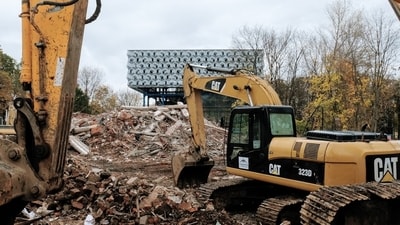
The affected tower is part of SNN Raj Etternia, a housing project near Kudlu, off Hosur Road in South Bengaluru. The development comprises around 15 towers with nearly 970 apartments, but the structural issue has been identified only in Block E-3, which houses 49 ready-to-move-in flats. Apartments in the tower were reportedly priced between ₹1 crore and ₹5 crore.
A set of questions has been sent to the developer. The story will be updated after the company responds.
How does the Bengaluru tower demolition differ from previous residential demolitions?
The proposed demolition of the 18-storey SNN Raj Etternia tower in Bengaluru is markedly different from the country’s two most prominent residential demolition cases, the Supertech Twin Towers in Noida and the Maradu apartment complexes in Kochi.
In Noida, the Supreme Court ordered the demolition of the 29- and 32-storey Supertech Twin Towers in 2022 after finding they were constructed in violation of building norms and with illegal approvals.
Similarly, four apartment complexes in Kochi’s Maradu were demolished in 2020 following a Supreme Court order for violating Coastal Regulation Zone (CRZ) norms.
In contrast, the Bengaluru case involves a voluntary decision by the developer to demolish and rebuild a newly completed tower after it developed a slight tilt due to an alleged geotechnical error, despite having received an Occupancy Certificate and before homebuyers took possession, said experts.
Bengaluru developer seeks to demolish and rebuild the tower
Greater Bengaluru Authority (GBA) Chief Commissioner M. Maheshwar Rao confirmed to PTI that the developer, SNN Raj Corporation, has approached the authority seeking permission to demolish the affected tower and reconstruct it.
“They have voluntarily come forward (to demolish it),” the Chief Commissioner told PTI.
The building comprising about 49 flats was constructed by SNN Raj Corporation at Haralur. It is found that the building is slightly tilted, GBA officials told PTI.
What caused the problem?
Anuj Sanjay Jain, Director, SNN Raj Corporation was quoted by media reports as saying that the issue was traced to an error in the original geotechnical investigation.
Also Read: Supertech twin towers: SC defers hearing on plea seeking refund for homebuyers
“With all approvals in place, we were about to hand over the units when we noticed undulations in the slope,” Jain told The Times of India.
Also Read: Bengaluru illegal 5 storey building tilts in Koramangala raising safety concerns: Report
“Some consultants suggested repairs and rectification works, but we decided not to take shortcuts in the interest of our buyers despite the significant financial implications. We will reconstruct the entire 49-unit tower,” Jain told Deccan Herald.
No cost to homebuyers
The developer was quoted as saying by the newspaper that it has also informed the Karnataka Real Estate Regulatory Authority (RERA) about the issue.
According to the report, affected homebuyers will not incur any additional financial burden.
How was the tilt detected?
According to a senior engineer quoted by The Times of India, the tilt came to light during a water load test carried out by the developer.
“The builder found that the building was sinking and immediately approached the authorities seeking permission to demolish the tower,” the engineer said.
The official also clarified that an Occupancy Certificate is issued by the town planning department after verifying compliance with sanctioned building plans and does not certify structural engineering or geotechnical integrity.
“How the soil behaves cannot always be predicted. Sometimes cavities located 30 to 40 metres below the surface become evident only after load testing,” the engineer was quoted as saying.


