






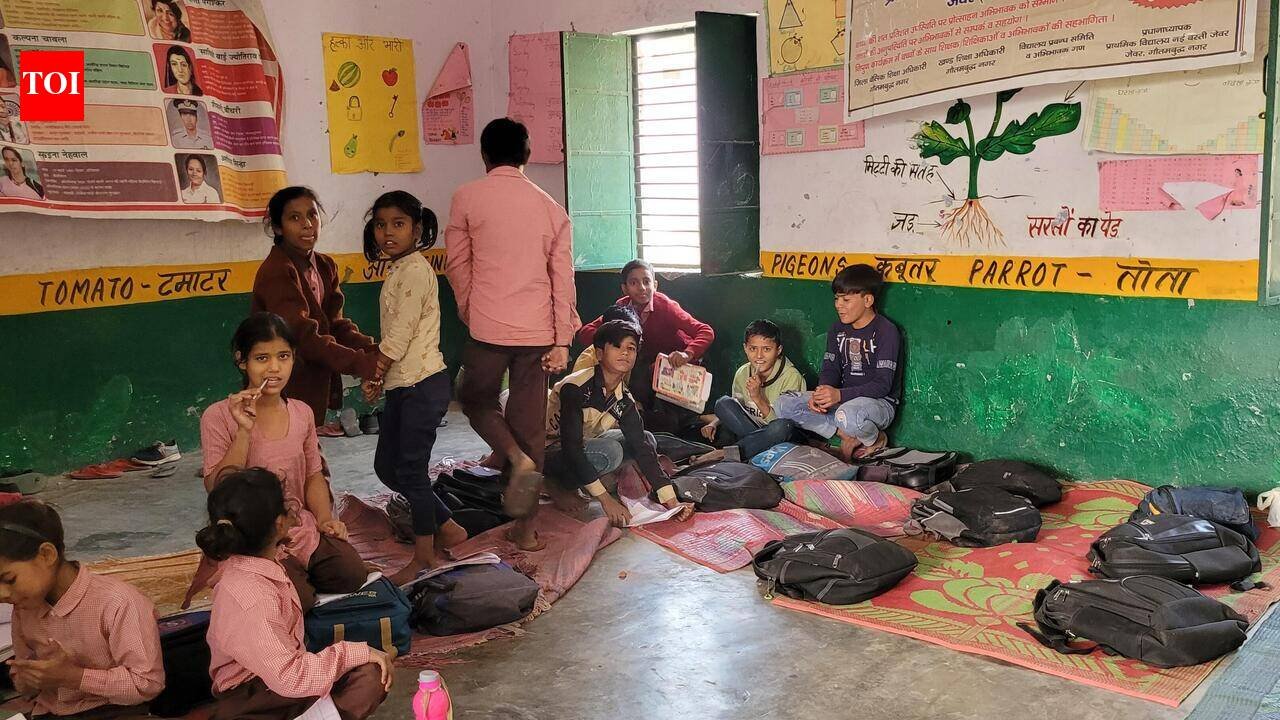
Noida: Over the past four years, several reports by TOI on infrastructure deficiencies in Noida’s govt schools have led to remedial action. A primary school in Jewar received benches after students were found studying on the floor. Similarly, TOI’s reports on overcrowding and children studying in inadequate spaces led to infrastructure upgrades, with govt adding classrooms across Noida schools in 2026. At Chhijarsi’s composite school, a TOI report on students attending classes in the open led to a Rs 1.5-crore CSR grant for 12 new classrooms.On Dec 8, 2023, a TOI report, ‘Nearly 2 decades gone, these schools still wait for benches’, highlighted that children in at least five primary schools in Jewar were being made to sit on classroom floors because the schools lacked benches or desks. Teachers said some schools had not received benches in nearly 18 years, while some had more than 300 students. Days later, 80 benches were provided to New Basti primary school in Jewar, ending the 18-year wait.A June 2023 report found that facilities installed at several govt schools under CSR programmes were deteriorating because the schools had little or no money for upkeep. It documented broken benches, blackboards and toilets, and examined the gap between companies, NGOs and the education department over who was responsible for maintenance.In Oct 2023, another report, “11 rooms for 1.2k students, classes under trees & stairs”, flagged how students at the composite school in Chhijarsi were attending classes on an open ground under trees for want of classrooms. On July 12, 2025, TOI’s report, “Their uniforms soaked in rain, but classes go on —in open corridors at this Noida school”, laid bare how more than 1,200 students of classes 6 to 8 were found attending lessons in open corridors, sitting on wet floors during the monsoon. When TOI went back to the school, it found that days after the report, the school received a Rs 1.5-crore CSR grant for 12 additional classrooms. Construction of the new rooms began in 2025.In April 2023, TOI reported that infrastructure gaps had forced students of Balla Ki Madiya primary school in Dankaur to attend classes in a community hall on temple premises. Two of the school’s three classrooms had remained shut for over two years due to damaged ceilings and benches, with classes 3 to 5, comprising 140 students, shifted to the temple compound. Before the hall was made available, students had been taught in the school courtyard, often under trees. By 2024, the school had two newly built classrooms funded through CSR, with four more being built by the authority at a cost of Rs 80 lakh.Subsequently, in April 2026, 39 new classrooms were built across 35 govt schools in the district at a cost of Rs 7 crore, after repeated concerns over space shortages and multiple classes being conducted in single rooms.TOI also flagged the poor condition of govt schools in Ghaziabad. In March 2024, a TOI report, “Principal absent for 3 years, no teachers either for 150 kids”, highlighted how a govt primary school in Kaila Bhatta, with around 150 students, had been functioning without permanent teachers for three years, with the principal absent and students taught in combined classes. The report also flagged irregularities in the mid-day meal scheme and under-utilised development funds. Two months later, when TOI revisited the school, it found students had returned to regular classes after the education department appointed two new teachers, though the school continued to suffer from poor ventilation and classrooms that went dark during power cuts.Before that, on Aug 2, 2023, TOI’s report, “Asbestos roofs, outages: Students sweat it out in classes, one fall ill”, showed that at least 130 students at Bajaria Primary School were crammed into three asbestos-roofed classrooms that turned excessively hot in summer. One student had suffered nose and ear bleeding during a prolonged power cut.In July 2026, TOI’s report, “Wires or transformers, power hazards within an arm’s reach at 24 Ghaziabad schools”, flagged that high-tension power lines passed over campuses of at least 24 govt schools in the district. In some, transformers were found located close to entrances and boundary walls, with 15 schools affected directly. Officials later told TOI that a list was being prepared for action by the power department.The reports also prompted wider scrutiny. In Aug 2026, following student protests over teachers, toilets and other infrastructure, the administration formed a three-member team to inspect schools, with the DM promising corrective action on deficiencies found.In Feb 2026, the UP govt sanctioned Rs 4.6 crore for the renovation and expansion of 27 govt schools in Ghaziabad, with 20 schools receiving additional classrooms, five getting dedicated classrooms for differently-abled students, and funds earmarked for toilets, buildings and a deteriorating block resource centre.More recently, in Sept 2026, TOI reported that the govt girls’ inter college building in Premnagar had developed deep cracks and dampness just seven years after being handed over. The report, “Wall cracks, floor subsidence at Ghaziabad school building just 7 years after handover”, dwelled at length on how the school, built under Pradhan Mantri Jan Vikas Karyakram and used by more than 200 students, showed signs of damage nearly a year earlier, with a former principal’s warnings going unheeded. After an inspection, officials ordered safety measures and cost estimates for repairs.A July 2026 report found more than 33,000 students in govt primary schools across Noida and Ghaziabad, four months into the academic session, still waiting for a Rs 1,200 composite grant meant for uniforms, shoes, sweaters, bags and stationery. Officials cited pending registration, verification and Aadhaar-bank account linkage for the delay, while some students attended school in home clothes and slippers.Another July 2026 report highlighted the gap between a school’s public image and its students’ reality. Ajabpur Primary School in Muradnagar, once visited by then Norwegian Prime Minister Erna Solberg, had been shifted to a temporary campus at a Ram Leela ground nearly 3km away after its original building was declared unsafe in Nov 2025. Renovation had not begun and funds had not arrived, leaving 108 students sharing one makeshift hall and a single toilet described as unusable, with the risk of the arrangement extending into the monsoon.


