






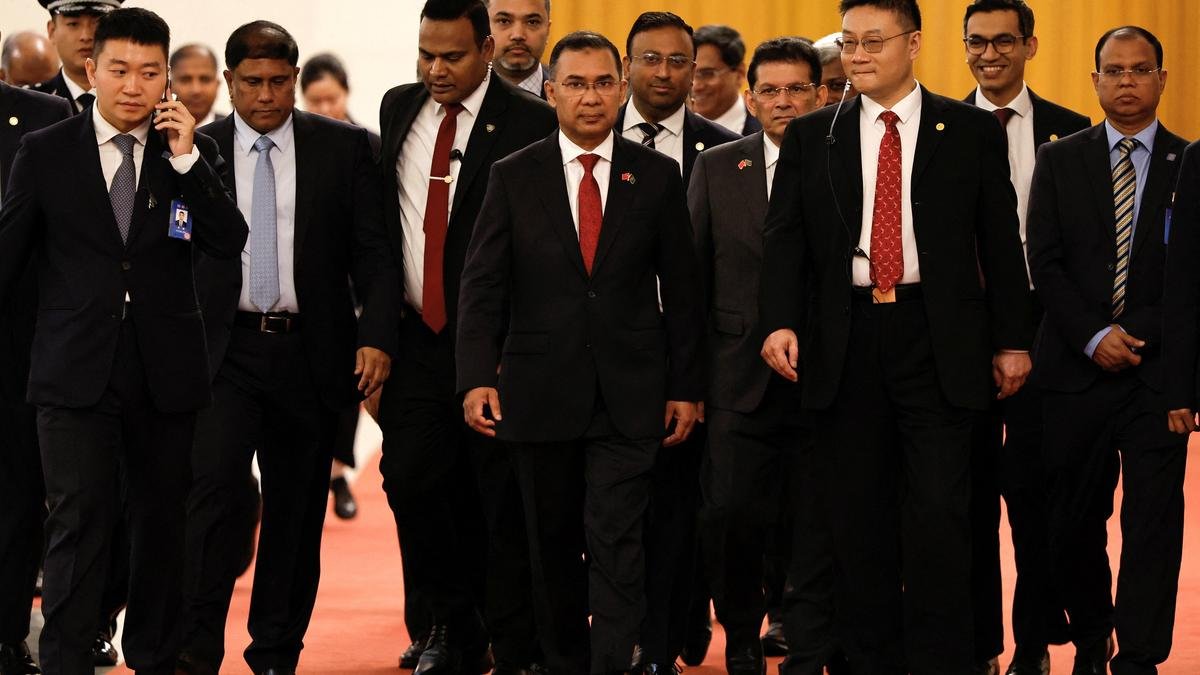
Bangladesh’s Prime Minister Tarique Rahman arrives for a meeting with Chinese President Xi Jinping at the Great Hall of the People, in Beijing on Friday.
| Photo Credit: Reuters
China’s relation with Bangladesh does not “target” a third party, said the Ministry of Foreign Affairs (MoFA) of China on Friday (June 26, 2026).
The remark from the spokesperson of the MoFA came soon after China expressed support for Bangladesh’s Teesta River Comprehensive Management and Restoration Project, one of the largest river-based development projects in South Asia and said it will expedite a feasibility study of the project.
“The comprehensive treatment and rehabilitation of the Teesta river is a livelihood project the Bangladeshi side attaches high importance to. China is ready to do what it can to support this project. I would like to stress that China-Bangladesh cooperation does not target any third party and should be free from third-party influence,” said spokesperson Guo Jiakun while briefing presspersons in Beijing.
The discussion on the Teesta river took place during Bangladesh Prime Minister Tarique Rahman’s first official visit to China. Mr. Rahman was hosted by Premier Li Qiang and had a meeting with President Xi Jinping during June 25-26.
A joint statement issued at the end of the visit mentioned that China will “provide support and help within its capacity to the Teesta project”. It also said that Beijing will support experts from two countries in “expediting the feasibility study of the project” while announcing stronger cooperation in maritime affairs.
Water diplomacy
Apart from Teesta, the two sides agreed to collaborate in areas like integrated water resources management, water resources planning, hydrological forecasting, flood prevention and disaster reduction, and river dredging. River-related collaboration is expected to help in managing Meghna (Brahmaputra/Yarlung Tsangpo), the second biggest river of Bangladesh, and also responsible for annual floods in the country.
Mr. Xi during his meeting with Mr. Rahman assured that China will remain a “trusted friend” of Bangladesh and help in implementing the development plans of the BNP government. The Chinese President remembered Mr. Rahman’s parents – late Prime Minister Khaleda Zia and President Ziaur Rahman – and said, both were “good friends of China”.
Mr. Rahman on his part conveyed Bangladesh’s commitment to “one China policy”.
“There is but one China in the world, Taiwan is an inalienable part of the territory of the People’s Republic of China and the Government of the People’s Republic of China is the sole legal government presenting the whole of China,” stated the joint statement expressing Bangladesh’s opposition to “any form of Taiwan independence”.
Healthcare tourism
In response, China expressed support for Bangladesh’s “national independence, sovereignty and territorial integrity”. As part of healthcare cooperation, China will allow more medical tourists from Bangladesh to its Yunnan province which has been receiving Bangladeshi medical tourists. Yunnan is seen as an alternative to India which has not granted adequate number of visas till recently.
The two sides expressed support for “high quality cooperation” as part of the Belt and Road Initiative and work jointly for modernisation. China supported greater role for Bangladesh in multilateral organisations like the UN and supported “Bangladesh to participate in the BRICS” and the Shanghai Cooperation Organisation (SCO).
Mr. Rahman appreciated zero-tariff treatment for 100% tariff lines, and said Dhaka will help facilitate greater Chinese investments. The two sides agreed to advance modernisation of the Mongla port and develop a Chinese Economic and Industrial Zone (CEIZ) in Chittagong.
China also appreciated Bangladesh for hosting the Rohingya refugees of the Rakhine state who were evicted by the Myanmar military in an operation in August-September 2017. China expressed support for “friendly consultation” with Myanmar and Bangladesh to settle the refugee crisis. The joint statement on the matter however did not use the term “Rohingya” and used “forcibly displaced people from the Rakhine state of Myanmar” to refer to the Rohingya community.
Published – June 27, 2026 02:08 am IST


