



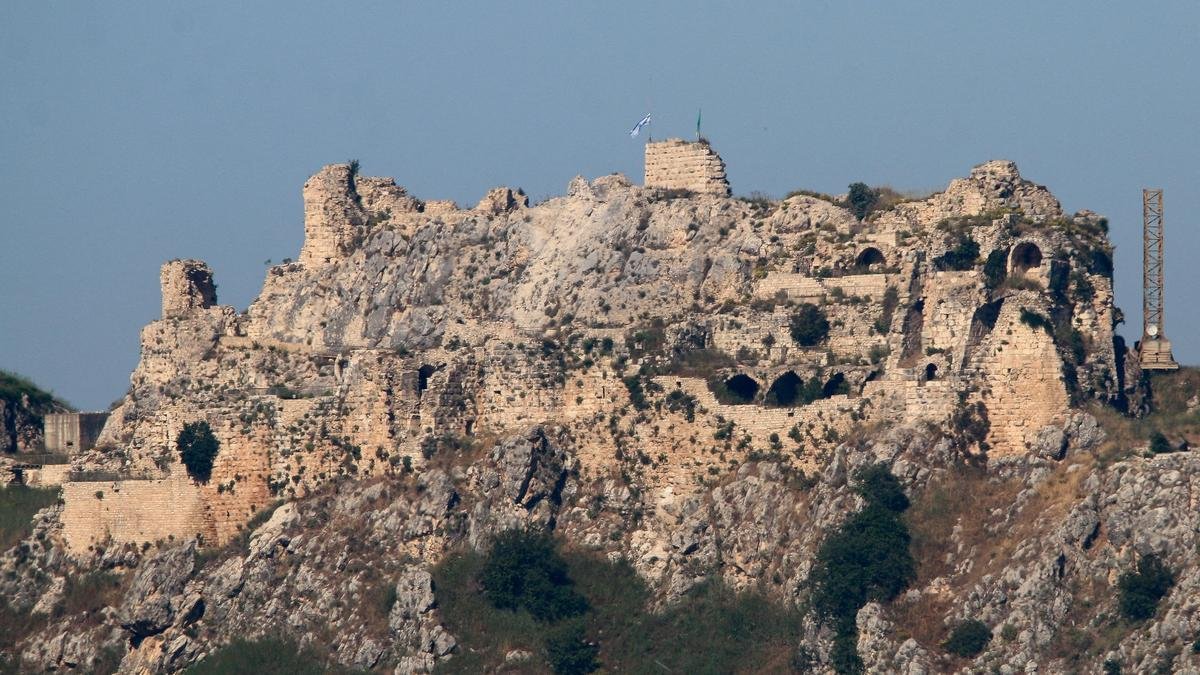
An Israeli flag and a flag of the Golani Brigade fly on Beaufort Castle, as seen from Marjayoun, southern Lebanon, on June 1, 2026.
| Photo Credit: Reuters
The Beaufort Castle sits right beside the Litani River in southern Lebanon, with an unobstructed view of northern Israel and the sweeping Beqaa valley. The 900-year-old structure, which literally means “beautiful fort” in Old French, has come under renewed spotlight after the Israeli military invasion on June 1.
Originally called Qalaat al-Shaqif, or the “Castle of the High Rock,” Beaufort was built by European crusaders atop older fortifications in 1139. Invaded and besieged multiple times throughout its long history, the bastion has been at the centre of the Israel-Lebanon conflict and a pain point in the fragile ceasefire, announced by U.S. President Donald Trump on April 17.
In 1190, the stately structure was captured by Saladin, the first Sultan of Egypt and Syria, who used it as an important border outpost to strengthen his reign. Due to its military importance, the castle has changed hands frequently, with Crusaders (most famously the Knights Templar), Egyptian Mamluks, Ottomans, and the French all leaving their marks on it.
The Frankish Crusaders created its two-storey keep with an entry through the ground floor, unlike other forts of its time. Exposed stone staircases cut directly into the rock were built, forcing visitors and attackers to ascend in a single file on the highly exposed path.
The Mamluks added curved towers to defend against the firing of spherical stones. They inscribed Arabic victory messages into the front gates of the castle. The Ottoman takeover saw the repartitioning of the 15,000-square-metre area for logistical and residential usage. They built barracks and added slits in the fort walls for precise firing.
Internal politics led to many of the early constructions being mined and later restored using crude stone.
The French period saw the stripping away of Ottoman influence and attempts at restoring Crusader architecture. Beaufort has a sharp 300m drop on one side and the valley on the other, protecting it from enemy attacks. This vantage point is still used for military strikes, surveillance, and the deployment of weaponry.
The natural trench between the fortress and the fast-flowing Litani leads to the city of Nabatieh, an ancient centre for the trade of precious spices and commodities like Myrrh and Frankincense in its historical Souk el-Tanen market.
Caught in the war
The sand-battered behemoth is on track to become a UNESCO World Heritage Site and has been included on the country’s ‘tentative list.’ November 2024 saw the global body granting it provisional enhanced protection under the 1954 Hague Convention.
During the 1970s, the Palestine Liberation Organisation (PLO) attacked Israel from the fort’s ramparts. Underground bunkers and command centres were constructed, with some going as deep as 65m underground.
In 1982, Israel invaded Lebanon, seized the fortress from the PLO, and raised the ‘blue and white’ for the first time. This was a significant moment. Then Israeli Defence Minister Ariel Sharon called the taking of Beirut a war that was “worth it” and rejected the allegations of it being “immoral.”
The banner of Israel came down in 2000 when the Israelis blew up their bunkers and abandoned the castle, when they withdrew from Lebanon after 18 years of occupation. What followed was its opening to the public and years of restoration, with a brief pause in 2006 due to another Israeli invasion.
The 2026 invasion by Israel marks one of the most significant escalations in the conflict since the dawn of the millennium.
In March this year, Hezbollah fired rockets at Israel in retaliation for the U.S.-Israeli assassination of Iranian Supreme Leader Ayatollah Ali Khamenei. In response, Israel launched massive air strikes which were followed by a ground invasion.
The U.S.-backed ceasefire is functionally defunct, with both sides launching attacks against each other. Israel wants to push Hezbollah out of southern Lebanon and keep the territory it has captured. Hezbollah says it would continue to fight as long as Israel continues the occupation of Lebanese land.
Published – June 07, 2026 01:34 am IST


