



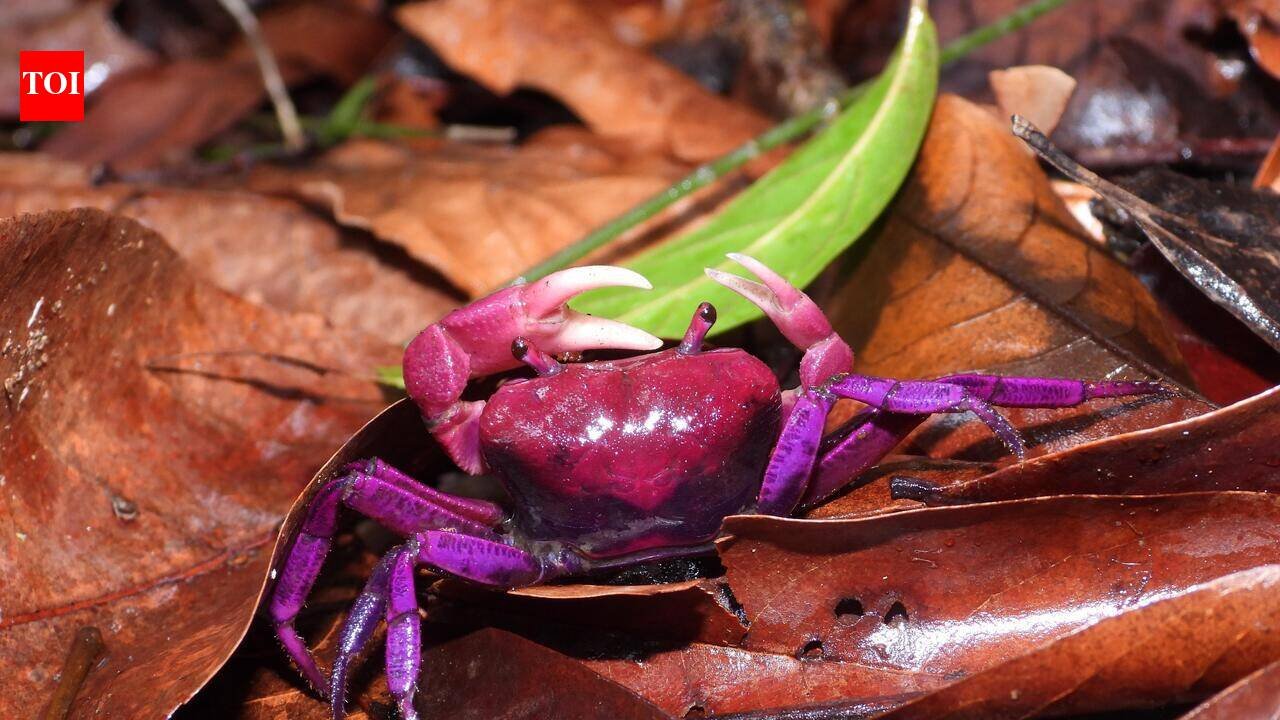
Udupi: A routine forest patrol turned into a scientific discovery when beat forester Ajmeer K spotted a freshwater crab with unusual colour and movement in the Kollur range of Mookambika Wildlife Sanctuary last year. His curiosity led to the identification and scientific description of a new species, Ghatiana karnataka, which he co-authored with Santanu Mitra of the Zoological Survey of India (ZSI) in a research paper published recently in Species.“Its colour and movement caught my attention and prompted me to find out more about it,” Ajmeer told TOI.He contacted Mitra, who also suspected that it could be an undocumented species. After permission was obtained from the principal chief conservator of forests and chief wildlife warden through the range forest officer and deputy conservator of forests, specimens were collected for a detailed taxonomic study.The research involved collecting both male and female specimens and documenting their physical characteristics, colouration and habitat. The genus Ghatiana now comprises 15 known species, all endemic to the Western Ghats. The discovery of Ghatiana karnataka brings the number of species recorded in Karnataka to eight.The male of the newly described species has a predominantly dark-purple body, with a distinctive light-pink to mauve V-shaped marking on the front of its carapace. Females have a grey-violet front and a dark grey-brown rear.The published study identifies Mavinakaru, near Kollur, as the species’ currently confirmed locality. Ajmeer said his wider field observations indicate the presence of similar crabs across a roughly 35-km stretch covering Megini Valley, Madibare, Murkodihola, Gunduberu, Korathikal Bare, Korakoppada Hola, Jannalane and Abbigudde. The crab is associated with highly moist evergreen and semi-evergreen forest habitats.Specimens have been found in crevices between boulders, water-filled holes in laterite rocks and moist tree cavities. The region is fed by perennial river systems, including the Souparnika, Mavinakaru and Jadkal rivers, helping maintain humid conditions and water-filled natural cavities even during drier months.Ajmeer said during the monsoon, they may be seen moving across laterite rocks, while in the dry season they retreat into moist tree hollows and rock cavities. Decaying plant matter, bark, algae and other organic material serve as food.Ajmeer, who hails from Hosapete in Vijayanagara district and holds a BA degree, has developed a keen interest in documenting the biodiversity of the forests he patrols. He initially hoped the species would be named after the region in which it was discovered. Mitra, however, suggested naming it after Karnataka in recognition of the state’s rich biodiversity.Kundapur deputy conservator of forests Ruthren P said the discovery highlights how much of the region’s biodiversity remains undocumented. “There is still so much in our biodiversity waiting to be uncovered. We are custodians of a rich natural heritage. The department will always support staff members who show an interest in research and biodiversity,” he said.


