



The end came swiftly. It took New Zealand only 51.2 overs to wrap up the England second innings at Trent Bridge.
Jamie Smith’s slog against Mitchell Santner ended in the hands of a diving Nathan Smith, running in from long-on. That was not just the end of the third Test. It was also the end of what was perhaps the most discussed, or debated, style of playing Test cricket since Bodyline.
Breaking point
New Zealand won by 160 runs, and also became the first team ever to win a three-match series in England after losing the opening Test. It was indeed a fabulous achievement by Tom Latham’s men.
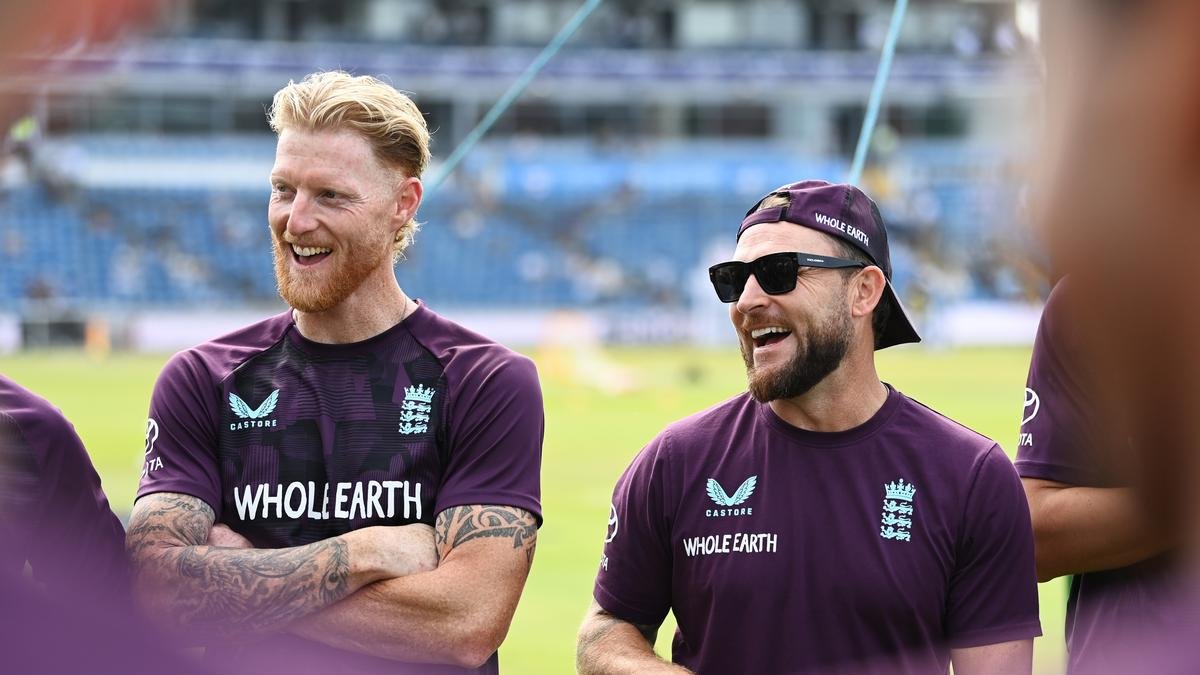
For Latham’s English counterpart, Ben Stokes, it was his last international match. For the coach, Brendon McCullum, it was the last Test in charge of England.
Bazball thus came to its inevitable end. Ironically, it had begun with a series against New Zealand in an English summer, four years ago. And it had begun in magnificent fashion, with England winning four Tests, all chasing, all with guns blazing, in a row — three against New Zealand and one against India.
It was even more remarkable because the England Test team was going through a tough period at that time: it had won just one of 17 matches after the first Test against India at Chennai in early 2021. Coach Chris Silverwood lost his job, following the 0-4 drubbing in the 2021-22 Ashes in Australia, and after the defeat in the Caribbean in March 2022, Joe Root resigned.
So, it wasn’t the most ideal of situations when McCullum was appointed as England’s Test coach by Rob Key, managing director of England men’s cricket. And the Kiwi had no previous experience of coaching in red-ball cricket, though he had been in charge of franchise teams such as the Kolkata Knight Riders.
Greatness in miniature: But for Bazball, we would not have witnessed Jonny Bairstow briefly metamorphosing into Viv Richards in 2022.
| Photo Credit:
Getty Images
McCullum conceived, Stokes executed. They will be remembered as one of cricket’s most remarkable coach-captain duos.
Their approach to playing Test cricket was the kind that hadn’t been witnessed before. New Zealand and India weren’t prepared for the ultra-aggressive mode of cricket England played in the summer of 2022.
It was not just England’s style that was spectacular. The results were, too.
Against New Zealand, England’s scores in the second innings were 279 for five, 299 for five, and 296 for three. Against India, it was 378 for three. And those chases were completed at brisk strike-rates.
Chasing a big total has always been a daunting task in Test cricket. Safety first has nearly always been the mantra, and even that stunning chase by India against Australia at Brisbane in 2021 had begun on a cautious note. It took an extraordinary hook by Washington Sundar against Pat Cummins and an out-of-the-world counterattacking knock by Rishabh Pant to make India shift gears and aim for the ultimate glory.
Interestingly, Stokes once spoke of how the manner in which Pant played made him think about the possibilities of aggressive batting in Test cricket. And before Pant, there were Adam Gilchrist and Virender Sehwag, but what made the concept of Bazball different was that everyone wanted to bat as if there was no tomorrow. If a wicketkeeper as accomplished as Ben Foakes could not find a place in the eleven, it showed what McCullum and Stokes wanted.
Finding expression
What Bazball looked to do was to remove the fear of failing. So regardless of the situation, a player was allowed to play his strokes, or express himself, as England cricketers would explain in press conference after press conference. When England fielded, the bowlers were asked to always look for wickets; restricting the batters from making runs wasn’t the priority.
And England wanted to win. An exciting — though not successful — chase was found more appealing than a draw. One was never sure if that was quite right in competitive sport. And one of the charms of Test cricket — and also what someone new to cricket would not understand — is the sheer thrill of not getting a decisive result after playing for five days, more than 30 hours.
Such trivial matters, however, didn’t cross the minds of the English players, and their fans, for much of the early part of the Bazball era, as the team posted some astounding wins, like the one against Pakistan at Rawalpindi in 2022, when England scored 657 from just 101 overs. Two years later, the victory against India in the first Test at Hyderabad was even greater, as England had conceded a first-innings lead of 190.
The four Tests that followed, however, showed why Bazball can’t work all the time. India won all those matches. For all England’s aggressive intent, it is debatable whether a batter of Root’s quality needed to play a reverse scoop against a bowler of Jasprit Bumrah’s quality.
An identical scoreline (4-1) in the most recent Ashes in Australia meant that Bazball couldn’t click against stronger opposition. Bazball also worked more on flatter surfaces, while it had problems when the ball moved or turned.
Right from the beginning of Bazball, the big question was whether it was a sustainable model. As former England batter Mark Butcher told The Hindu recently, Test cricket is a format that dictates to you what is necessary. “If you push too hard, the game will bite you back,” he said.
Topsy-turvy: Bazball was an attempt to entertain the paying public, and Harry Brook often did just that. But it may have lasted longer had England chosen its moments more judiciously.
| Photo Credit:
Getty Images
McCullum and Stokes had indeed pushed too hard. When you go on to lose a Test match by two wickets after declaring on the opening day with two wickets remaining, questions are bound to be asked.
Questions were also asked about how some of the England players behaved off the field during the Bazball era. The pub-incident involving Stokes and Gus Atkinson this summer didn’t help, either.
The statistics may not say that England benefited much from Bazball. In 49 Tests, England scored 27 wins, but lost 20. That there were just two draws is of course hardly surprising.
A fair evaluation
But it would not be fair to evaluate Bazball’s legacy just based on numbers, even if they are impressive when it comes to run-rates, strike-rates and hundreds. It was an attempt to play Test cricket in a different way and entertain the paying public.
But for Bazball, we would not have been able to witness Jonny Bairstow metamorphosing into Viv Richards in 2022 or Ollie Pope turning the reverse sweep into the best form of defence during his monumental 196 in the Hyderabad Test. Bazball was fun while it lasted.
It could have lasted longer perhaps if England had been a little more conservative on occasion and realised that Test cricket’s charm lies in its infinite variety. There is more than one way to play what is the most demanding form of all sports.
There is joy in watching Harry Brook dance down the track. There is also joy in watching Shubman Gill play a perfect forward defensive push.


