



New Delhi: When you step onto the badminton court and swing your racquet, sometimes it all just clicks. The technique, the weight of the racquet, the tension on the strings… it flows and creates the perfect shot. At the amateur level, one picks up a random racquet and hopes to create magic.


But at the professional level, there is no place for hope alone. Excelling at the highest level, where the difference between winning and losing a crucial rally often comes down to milliseconds and millimetres, demands precision. This is why players obsess over everything from the racquet grip to the shoes.
While many players spend lots of time selecting the racquet frame, the string bed tension has a more dramatic impact on power, control, and overall performance. Badminton strings, often called the “soul” of the racquet, fundamentally change the game by balancing power, control, feel, and sound.
Thinner strings (<0.68mm) increase repulsion and control, while thicker strings enhance durability. Higher tension (>28lbs) provides precision for advanced players, while lower tension aids power for beginners.
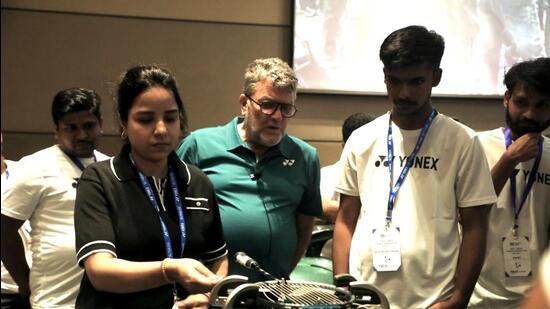
And there is no one better than Tim Willis to break it down. The 59-year-old who is the head stringer and supervisor of Yonex, has worked with several greats including Olympic champions Viktor Axelsen and Carolina Marin over the last 40 years.
It might not seem like a lot but for the top players, a tiny shift can make a huge difference and Willis’ experience can sometimes let him see what is invisible to others. For instance, he told Marin that she needed to change her “guts”.
“Carolina was 12.5kg (tension, approximately 28lbs). Not super high. She hardly broke any strings. I was the one who changed her from Nano G95 to Aerobite after the 2016 Olympics where she was still using Nano G95,” Willis said while appreciating Marin’s control despite using a less tension racquet.
“In Spain, you didn’t have many good stringers. They used strings that lasted the longest which is amazing (because back then) she was probably playing with only 11kg (tension, approx 24-25lbs).
Sometimes, it is about helping players realise what works for them. It isn’t always a smooth process though.
“Lakshya (Sen) is a bit fussy. We (recently) strung quite a few racquets for him and then he just cut the strings out (after two days), brand new ones he hadn’t even played with, and had them done again, saying they had gone soft. In reality, it can’t go that soft (so quickly),” said Willis while explaining the psychology of shuttlers.
“Ayush (Shetty) is quite fussy too. He wants a fresh re-string every match and it has to be 31-33lbs with 10% pre-stretch, BG80 White (type of string).”
The Briton has built a reputation as one of the most trusted string experts, playing a critical role in ensuring that racquets used at the highest level meet exacting standards.
Normally, amateurs use a tension of 18–22lbs for a larger sweet spot while professionals opt for higher tension (26–30lbs) for control and precision. Lower tension creates a ‘trampoline effect’, providing power but reducing arm strain.
However, as players graduate to the pro level, bettering their technique, they gain superior control and want that ‘crisp’ feeling on the racquet for which they increase the tension to over 30lbs. It gives a shuttler ultimate precision but reduces the sweet spot significantly.
“Tighter the strings, smaller the sweet spot. A pro generally hits it in the middle of the racquet. With high tension, you have more control. You can generate a little more spin as well,” explains Willis, who comes from Hampshire but is now settled in Stockholm.
“Viktor (Axelsen) was 32-34lbs with 10% pre-stretch. That’s quite high, but look at the size of the guy and how steep he hit it. Indians are all a bit higher. Ayush is 31-33lbs with 10% pre-stretch, Lakshya is 31-33lbs, Chirag is 31-33lbs, Satwik is 30-32lbs. The Chinese and Japanese are around 30lbs.”
Indian shuttlers mainly use BG80 Power, not because it is the best or offers a significant advantage, but because of the “distribution system”.
While natural guts (made of organic material, specifically cow intestines) are rarely used in modern badminton (common during the days of wooden racquets), strings nowadays are normally made of multi-filaments with nylon being the most common material. While some are more durable, others can generate more power or spin while some are just loud, giving the opponent the impression that the smash was hit too hard!
“With the Exbolt range, the hitting sound is so loud, especially Exbolt 65. When Mark Lamsfuss (and Isabel Lohau) won the (mixed doubles) bronze at the (2022) World Championships, we changed his string halfway through the tournament from BG80 to Exbolt 65,” says Willis.
“When they beat the Thai pair (second seeds Dechapol Puavaranukroh/Sapsiree Taerattanachai), I asked Dechapol about Mark’s smashes. He said he thought Mark was hitting so hard. But he wasn’t. It was just the noise of the strings. But that created a psychological impact on the Thai pair.”
Interestingly, even the colour of the coating can make a difference. While the makers say BG80 White and Yellow have the same kind of impact, Willis believes there is a difference. “I know there is,” he said, adding that players have confided in him that the Yellow gets more spin at the net. “It depends on what the dye is made of. There are still so many secrets about strings that even we’re not allowed to know.”


