






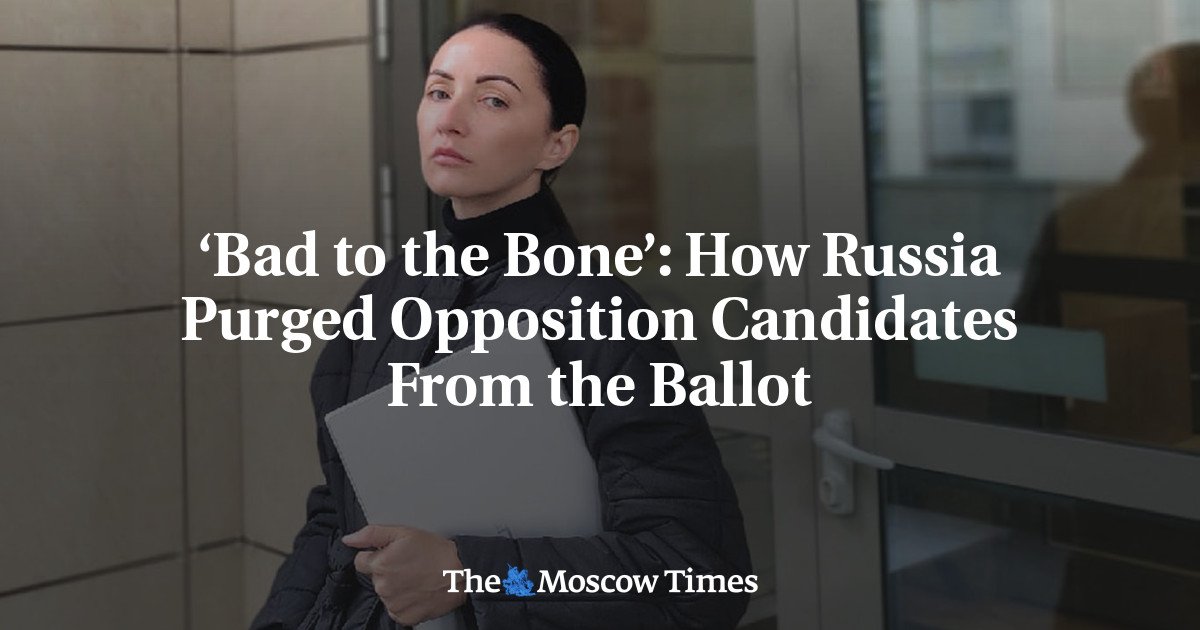
George Thorogood & The Destroyers’ 1982 hit “Bad to the Bone” may be best known for soundtracking car commercials and dimly lit games of pool.
But for Iya Boronina, a politician from Russia’s republic of Udmurtia, using the song in a campaign video cost her a place on the ballot in this weekend’s elections to the lower-house State Duma.
Udmurtia’s highest court disqualified Boronina from the race last week, ruling that she had violated Russian intellectual property law by using “Bad to the Bone” in her social media videos, the Kommersant newspaper reported, citing the court’s press service.
The court sided with the plaintiff from the left-wing A Just Russia party, who claimed Boronina could not have obtained a song license “because it can only be purchased in U.S. dollars, which cannot be done from a candidate’s campaign account,” according to Kommersant.
“Just how desperate were they to have me removed from the election? The Supreme Court of the Udmurt Republic heard the case not only without my participation, but without even notifying me of the date and time of the hearing,” said Boronina, whose subsequent appeal was rejected.
Boronina is one of dozens of opposition candidates barred from Russia’s Sept. 18-20 elections in recent weeks, further weakening the already limited effort to challenge Kremlin-backed candidates.
Twenty-nine of those disqualified from the State Duma race were from the liberal Yabloko party. Four of them, including Boronina, lead regional Yabloko branches.
“Yabloko’s disqualification … has to do with reducing the chances of protest voting and thereby suppressing turnout,” said Andras Toth-Czifra, an expert on Russia’s domestic politics and political economy. “The latter has been a longtime technique of the Kremlin in legislative elections.”
Under Russian election law, half of the State Duma’s 450 seats are allocated through party lists to parties that win at least 5% of the vote. The remaining 225 seats are decided in single-member constituencies.
Yabloko, the only party contesting the elections on an anti-war platform, suffered a major setback last month when the Supreme Court removed it from the nationwide party-list ballot.
Igor Ivanko / AFP
Though it can still field candidates in single-member districts, the party said only 106 Yabloko candidates in 45 regions remained in the race as of Thursday, down from an already low 135 at the start of the campaign.
But Yabloko’s misfortunes have not been limited to the closely watched State Duma race.
Its candidates will compete in just one of 39 regional legislative elections after courts in seven regions disqualified the party’s lists.
In the latest case, a court in Siberia’s Tomsk region barred the party from the regional assembly elections over alleged campaign spending violations, copyright infringements and the use of banned social media platforms.
The most common grounds for disqualifying Yabloko members were old posts mentioning late Kremlin critic Alexei Navalny, including photos of him or references to projects associated with him, according to the exiled news outlet Vyorstka.
Other reasons included ownership of shares on foreign stock exchanges, a social media post featuring a caricature of Adolf Hitler and errors in registration documents.
Because removing every minor candidate from the ballot would serve little direct political purpose, the widespread disqualifications may instead reflect efforts by regional political officials and civil servants to demonstrate loyalty to the Kremlin, Toth-Czifra said.
“When it looks like the ukaz [decree] from the center is that Yabloko candidates cannot run, lower-level officials will start to behave accordingly,” he told The Moscow Times.
Yabloko’s candidates were removed based on complaints from their electoral rivals. But even candidates from Russia’s “systemic opposition” — parties nominally opposed to the Kremlin but allowed to operate within the political system — have faced growing pressure this electoral cycle.
At least eight Communist Party candidates meant to stand for the State Duma or regional legislatures have been disqualified, according to Vyorstka.
The disqualification of Communist Party candidate Nikolai Bondarenko became the most-discussed election-related story on Russian social media last week. Posts about the case received upwards of 3 million views, according to monitoring by the Electoral Atlas project.
kprf.ru
Bondarenko, a former Saratov regional lawmaker with over 2 million YouTube subscribers, was disqualified after his appearance at a televised debate went viral — a rarity in an electoral cycle in which most candidates did not appear at scheduled TV debates at all.
The official reason for his removal was an old social media post featuring a photo of Navalny.
Bondarenko was a “highly visible” candidate set to compete “in a district considered a fiefdom” of incumbent State Duma Speaker Vyacheslav Volodin, Toth-Czifra said.
His disqualification and the pressure faced by fellow Communist candidates followed a “more disjointed pattern” of political repression than the campaign against Yabloko, he added.
“What we are looking at here is simply a further modification of the deal offered to systemic opposition parties by the authorities,” Toth-Czifra said.
“In protest-prone regions with strong Communist Party chapters, the party faced a very different kind of pressure, which was much more akin to what Yabloko’s facing now,” he continued, referring to a string of administrative cases and arrests targeting communists in the Altai region earlier this year.
Fear of a possible clash with the Kremlin-backed United Russia party may also have prompted some candidates to drop out voluntarily.
Nikolay Skrynnik, a refugee from the border town of Sudzha that was temporarily occupied by Ukraine in 2024-2025, withdrew from the Kursk regional parliament race this month.
Skrynnik, 75, said he made his decision under pressure from within the Communist Party, which had backed his candidacy earlier in the year.
“What’s disheartening is that the pressure came from the very party I had believed in. There are no ideals here — just loud, meaningless phrases and slogans,” Skrynnik said in a social media post.
He said that he was “urged to delete any posts touching upon the activities of the regional government, the governor or United Russia” immediately after his nomination was confirmed, “so as not to provoke anyone or draw fire onto the party as a whole.”
“It is absolutely clear that my candidacy had a clear advantage over the candidate from United Russia…His defeat could not be allowed,” Skrynnik added. “Conclusion: no one wants the truth — not even the people you trust.”
A Message from The Moscow Times:
Dear readers,
We are facing unprecedented challenges. Russia’s Prosecutor General’s Office has designated The Moscow Times as an “undesirable” organization, criminalizing our work and putting our staff at risk of prosecution. This follows our earlier unjust labeling as a “foreign agent.”
These actions are direct attempts to silence independent journalism in Russia. The authorities claim our work “discredits the decisions of the Russian leadership.” We see things differently: we strive to provide accurate, unbiased reporting on Russia.
We, the journalists of The Moscow Times, refuse to be silenced. But to continue our work, we need your help.
Your support, no matter how small, makes a world of difference. If you can, please support us monthly starting from just $2. It’s quick to set up, and every contribution makes a significant impact.
By supporting The Moscow Times, you’re defending open, independent journalism in the face of repression. Thank you for standing with us.
Continue
Not ready to support today?
Remind me later.
×
Remind me next month
Thank you! Your reminder is set.


