



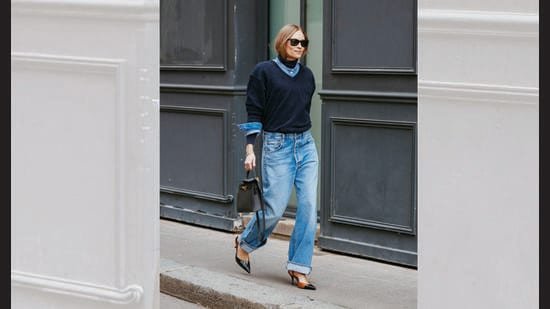
Everyone’s doing it raw again. And they’re loving it. Get your head out of the gutter. We’re talking jeans.
A nice pair of blue (the more faded the better) was a closet staple from the late 1970s to the 2010s. Fashion gurus would offer tips about fit, rise, fray and rinse. Styles went from flared to bootcut, high-rise to low, slim to stretch, skinny to baggy. Someone reading this probably has a pair of jeggings (eww) and green-ankle-crops (kinda cool) in the back of their cupboards. But for the last decade, it seems, no one really bothered with denims.
Until now. Jeans are back, but the playbook has changed. No one wants Mum and Dad’s chunky styles – vintage fits mean a whole other thing. Denim is in designer collections and at Uniqlo and Zara in the mall. And denimheads are suddenly talking about Japanese selvedge, fabric weight, knee room, barrel fits and back-pocket sizing. Wake up babe, denim has changed. Here’s your guide.
First things first: What is selvedge?
The thing that makes jeans high quality is not the fit, it’s the denim itself. Because denim is not a fabric but a type of weave. You’ll want 100% cotton, but with a glow-up. While most fabric is created with two yarns – the warp and weft that criss-crosses into cloth – selvedge is made on a shuttle loom. Most mass manufacturers (those guys who outsource to China, Bangladesh and poorer nations) don’t have shuttle looms, and can’t produce the heavy-but-smooth denim with edges that are sealed against fraying (often with a red, white or blue line at the edge).
The US had the looms, but as American manufacturing waned in the 1970s, Japanese shuttle machines took over. So, most selvedge denim comes from Japan. “It is considered the gold standard, because many mills still use traditional shuttle looms and focus on incredibly meticulous production,” says Amrita Singh, stylist and wardrobe consultant. Luxury house Maison Alaia just launched a denim line with a focus on Japanese denim. Even Levi’s produces its top-shelf range in Japan.
What is ‘sanforised’ and why didn’t we see it on labels before?
Selvedge denim is usually sold unwashed. It is meant to adjust its shape to the wearer’s body, and fade (according to how you sit, bend your knee and walk) only after several washes and consistent use. So, raw jeans will almost never fit well in the trial room. That’s bad news for big brands. (Who wants to sell a product that will shrink by 10% after people have tried and bought them?) The solution: To sanforise or pre-shrink the weave in the last stage of manufacturing. It makes finding the right fit, and sticking to it, much easier.
Why bother, when stretch jeans exist?
Brother, eww. Jeans that are spun with Lycra, Spandex or elastane will fit well initially, but loosen after a few washes – notably in the butt, crotch, knee, and waist, which are precisely the spots where jeans should fit well. The bigger fail: It’s terrible for the planet. Synthetic stretch ingredients take decades longer to decompose and they make it harder for denim fabric to be recycled. “The minute you put denim through mechanical recycling, it sheds down back into its fibre. In order to strengthen that short fibre, you have to add polyester, which defeats the purpose of recycling,” says Ritwik Khanna, founder of Rkive City, an upcycling clothing brand. So, choose 100% cotton as much as you can.
Indian labels are experimenting with khadi denim. Labels like Kartik Research have created patchwork jeans with khadi, and Summer House has rolled out a range of shirts and jackets in the past, which are better options.
Entered the mall. How much can I expect to spend?
By all means, pay what you can afford. But if you have the money, spend it on better craftsmanship, not just a trendy label or cut. Brands such as Levi’s have a premium and a cheaper range. The more coveted labels include 7 for All Mankind, Maje and True Religion, which cost somewhere between ₹15,000 and ₹50,000 for a pair. If you want to drop ₹2 lakh on jeans, Maison Alaia will gladly take your money.
Be real. How much should I actually spend?
“Realistically good-quality denim starts around the ₹20,000 mark,” Singh says. This is for jeans that have even stitching, sturdy rivets, reinforced seams, a solid metal zipper and one selvedge edge along the inner leg. With care, this is the pair that should last you more than a decade – all the more reason to not pick an in-today-out-tomorrow style. “I often return to Citizens of Humanity for modern silhouettes,” says Singh. The brand sells striped, straight-legged, printed, flare-legged, and classic dark washes that cost between ₹20,000 and ₹30,000. “They’re a great price point and they have styles that work across a number of body types.”
Help. There’s Levi’s but also JW Anderson now…
“The Levi’s 501 Original Straight Fit is essentially the blueprint for modern jeans – five-pocket construction (the fifth is that little one built into the front pocket), durable cotton denim, and a fit that’s remained relevant for decades,” says Singh. JW Anderson, Dior’s creative director, also operates his eponymous label. It’s a step up from the high street and sells unconventional styles in which the front is tilted just so, or in which the seams run down on the front of the leg, rather than the sides, offering a wider fall. He’s also into playing around with big pockets.
“These styles are less about heritage and durability and more about creative expression,” adds Singh. An older person, perhaps at a manager-level, might wear classic Levi’s. But the nepo-baby/part-time influencer with generational wealth might show up in JW Anderson. For those on a tight budget, Anderson also has a straight-forward denim collection with Uniqlo in the ₹3,000 range.
I’m hoping to thrift a vintage pair. Any tips?
Watch for the sizing. What we know as size 10, waist 26 or S today has meant different things in every decade, on different continents, across every label. So, try on as many pairs as you can to get a sense of what fits well.
With Levi’s, if the label on the jeans has a big E, it was manufactured before 1971, likely on an American shuttle loom – the Holy Grail. But let your heart decide. “Denim is an emotional buy,” says Khanna. “One of the things I learned at the vintage stores was that I might find the best-looking denim, but it might not fit me. The one that fits you the best is yours.”
Should I fall for the new barrel fit?
The balloon-like shape, with a cinched waist and tapered hem has been a very visible trend. “They are structured, not sloppy, and that is exactly why fashion is interested in them right now,” says Devanshi Tuli, stylist and creative consultant.
Alas, the inseam (the part that runs down the inner leg to the hem) on this style runs short, meaning they usually end at the ankles. If you’re tall, look for a brand that makes them with longer inseams. They also tend to make top-heavy bodies look chunky. But if you like what you see when you try one on, style it simply. Fitted top or T-shirt and sleek footwear so you don’t look weighted down.
For work, get jeans with a dark wash, medium rise, straight leg, tailored shape, no rip, no fade. “When styled with a blazer or crisp shirt, it can almost function like tailoring,” recommends Singh. Just make sure the back pockets land on your butt, not below them – that’s pointless for both a viewing and utility angle. For low-rise (ugh, it’s back) you don’t want the back to gape open when you sit or lean forward. Buy jeans that are at least two inches longer from crotch-to-back, than to the front.
What’s a total no-go?
“Ultra-distressed jeans, aggressively low-rise fits, and extremely skinny silhouettes. The mood has shifted toward more thoughtful proportions – straight, relaxed, or slightly sculptural shapes”, says Singh. “Colourful denim definitely resurfaces every few years, but it’s usually more of a fashion moment than a long-term wardrobe staple.” No one is touching jeggings, severe boot-cuts (they’re too tight in the knee), cropped styles and ripped jeans either. And strangely, no one is wearing black denim much. White, even less so.
Can I throw this in the machine?
It depends on what you want out of a wash. Every round of cleaning brings more fade, especially with raw denim, and especially for darker jeans. Denimheads will tell you that jeans need a wash after every 10 wears (assuming you didn’t spill something on them or trudge through sludge). A gentle soak and handwash (no hitting, no pounding) will keep the look fresh for longer. It will also minimise the post-wash shrink, prevent fraying, and keep creases away.
Never tumble dry. And if you’re drying your jeans out in the sun, hang them inside out, and horizontally if you have the space (It dries faster and shrinks less). And unless you want to look like your Uncle from 1985, do not create a front crease when you iron.
From HT Brunch, May 09, 2026
Follow us on www.instagram.com/htbrunch


