


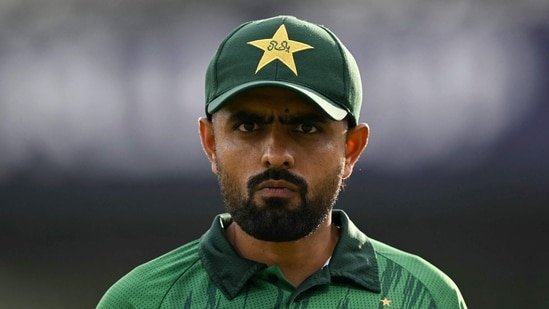
Former South Africa captain Faf du Plessis was quite honest in his assessment of Babar Azam‘s game in the shortest format, saying the evolution of the T20 format has seen the Pakistan batter falling behind in terms of strike rates. He told the former Pakistan captain to have honest conversations with head coach Mike Hesson and try to get better, as there is always scope for some growth. Over the last few years, Babar’s T20I game has been criticised left, right and centre as he has found it tough to change gears and increase the tempo when required.
The T20 World Cup 2026 has been mediocre for Babar, to say the least, and the situation got so bad that he wasn’t sent out to bat at No. 4 against Namibia in the last group-stage game. He has been guilty of playing two horrendous slogs in the matches against the Netherlands and India, throwing his wicket away when the team desperately needed him to stay in the middle.
Babar entered the World Cup campaign on the back of a poor Big Bash League (BBL) season for the Sydney Sixers, and in the game against Sydney Thunder, he was denied a single off the final ball by Steve Smith as the latter wanted to make the most of the Power Surge while Babar remained hell bent on taking singles.
“We have known Babar as one of the world’s best players for a very long time. I think the game of T20 cricket has moved so fast forward into strike rates that he’s found himself a little bit behind in terms of strike rates,” Du Plessis said on ESPNcricinfo’s TimeOut show.
“If you’re Mike Hesson, you’re trying to find the best way to introduce him into the game. On tricky surfaces, there is a role for someone to play in the 120-130 strike rate. Hesson would have thought, ‘How can I get the best out of Babar Azam?’ The game has moved too far forward to be at 120-130. Now, you need to be 160 to 190 to 200-plus for you to maximise that first six,” he added.
‘Honest conversation’
Earlier, before the match against New Zealand in the Super 8s, Hesson had openly once again criticised Babar’s strike rate, saying he is not able to take the bull by its horns inside the powerplay, and hence the management decided to have him at No.4. This statement did not sit well with Mohammad Hafeez, who said that Babar’s ideal position is as an opener or at No.3.
However, Faf believes that Babar has it in him to turn the tide, provided he’s willing to accept the flaws in his game and make the necessary changes.
“It starts with honesty. That’s the groundwork of any conversation that happens. Once you’re honest in your conversation as a coach, everything flows from that; whereas if you are hopping around and not telling the truth as a coach or a captain, it leads to holes a player can jump into. So the nature of the conversation is always really important. For a coach, it’s like, ‘Listen, these are the numbers. The numbers are suggesting this … Once the stats are in front of a player, it’s pretty difficult to go ‘I’m not agreeing with you.’” said du Plessis.
“Growth happens when you’re uncomfortable. The challenge with that is that what you then go through is uncomfortable. Because now you’re doing something for the first time that you’ve never done in your entire career. I had to do that against spin. But it’s very easy on the net because there’s no consequence. I went to the Hundred, tried to replicate what I did in the nets, and failed. And the guy on my shoulder said, ‘Why are you doing this, you’re successful?’ But the other guy goes ‘stick with it’,” he added.


