






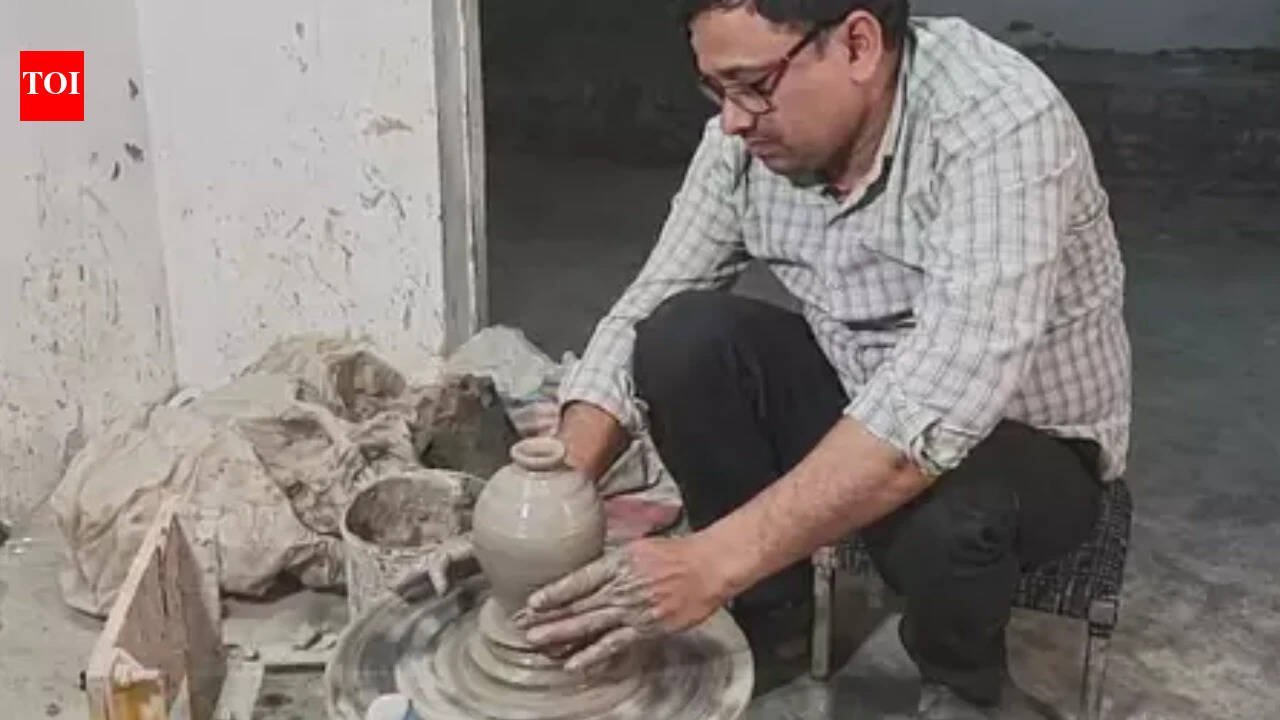
In the quiet town of Nizamabad in Uttar Pradesh’s Azamgarh district, a centuries-old craft has undergone a quiet but significant transformation over the past nine years. Nizamabad black clay pottery—known for its deep, lustrous black surface etched with delicate silver-toned floral and geometric patterns—has moved from the brink of decline toward renewed visibility, stronger market linkages, and growing export interest. This shift has been driven by the Geographical Indication (GI) tag secured in 2015 and, more decisively in recent years, by targeted promotion under the One District One Product (ODOP) scheme and associated export-assistance measures.The pottery’s distinctive character rests on local materials and a labour-intensive process refined over generations. Artisans use mica-rich clay drawn from nearby ponds. Pieces are shaped on the wheel or by hand, dried, and often decorated with fine grooves made using sharp twigs or needles. They are then smoke-fired in closed kilns—traditionally with rice husks or dung cakes—in a low-oxygen environment that produces the characteristic matte-to-shiny black finish. After firing, the engraved patterns are filled with a silvery amalgam (commonly involving zinc, tin, lead, or mercury powders), washed, and polished. The result is a striking contrast: dark body against bright inlay. Products range from everyday items such as teapots, bowls, plates, and lamps to decorative vases, incense holders, and religious statues of Hindu deities.Historical accounts trace the craft’s roots to potters who migrated from the Kutch region of Gujarat during the Mughal period, particularly associated with the reign of Aurangzeb. Local artisans adapted the technique, incorporating influences reminiscent of Bidri metalwork, and made it indigenous to Nizamabad. For generations the Prajapati community and related families sustained the tradition. By the early 2010s, however, the craft faced serious pressure: younger people were leaving for other work, markets were limited, production costs were high, and competition from cheaper alternatives had reduced demand. Many families struggled to keep kilns lit.A formal turning point came with the GI registration of “Nizamabad Black Clay Pottery” in December 2015 .The GI tag legally links the product’s name and distinctive qualities to its geographic origin, helping protect authenticity and build consumer confidence. It marked the craft as a recognised heritage product of Azamgarh. Yet artisans and observers note that the GI alone did not immediately reverse economic decline. Visibility increased modestly, but consistent market access, credit, skill upgradation, and infrastructure remained limited through the mid-2010s.The more substantive revival has unfolded under Uttar Pradesh’s ODOP initiative, which designated black pottery as Azamgarh’s flagship product. Launched statewide around 2018 and strengthened in subsequent years, ODOP provided a coordinated framework of financial support, training, common facility centres (CFCs), toolkits, and marketing platforms. Artisans report easier access to bank loans, often with interest subsidies (commonly cited at around 25 per cent in local accounts), which reduced dependence on informal credit. Training programmes and modern tools—electric wheels, improved kilns, and better finishing equipment in some clusters—helped raise productivity and quality without erasing traditional methods. Common Facility Centres established under schemes such as Scheme of Fund for Regeneration of Traditional Industries (SFURTI) offered shared infrastructure for raw-material storage, production, and display. Participation in national and international exhibitions, craft fairs, and buyer-seller meets expanded reach.Export assistance has complemented all these efforts of the government. While much of the pottery has long moved through traders based in larger centres such as Delhi, government-linked outreach has sought to improve direct capabilities. Capacity-building programmes involving the Directorate General of Foreign Trade, District Industries Centres, MSME departments, Exim Bank, and ODOP cells have focused on export procedures, quality standards, packaging, and market intelligence. Efforts have included exploring e-commerce platforms, seeking clearer HSN CODE classifications, and encouraging participation in international trade events. Artisans and organisers note rising overseas interest; pieces have been presented as diplomatic gifts, including instances associated with high-level visits, which generated pride and publicity. Domestic demand has also grown through government procurement for events, tourism linkages, and online sales.By the mid-2020s, local accounts describe a noticeable change in sentiment and activity. Several hundred artisans and families remain engaged, with some estimates of registered craftspeople reaching around 500 in broader counts. Younger people who once migrated for work have begun returning or joining family workshops. Organisations such as Black Pottery Nizamabad and related foundations report improved order fulfilment, better quality consistency, and steady growth in sales, including exports. Turnover figures cited in district plans and media reports place the cluster’s activity in the crore range, reflecting both traditional household production and more organised units. The craft has gained recognition as a symbol of Azamgarh’s cultural economy alongside agriculture.Despite several with regards to raw-material consistency, the lengthy firing cycle, careful packaging of fragile products for long-distance transport etc, the reports from the early 2020s suggested some positives in terms of underscoring the gradual revival.Nevertheless, the trajectory over the last nine years illustrates how GI protection, when paired with practical support for production, finance, and markets, can stabilise a traditional craft. The combination of heritage recognition and targeted assistance has helped keep kilns active, encouraged skill transmission, and positioned Nizamabad black pottery for wider domestic and international audiences. As artisans refine techniques, expand product ranges, and navigate modern channels, the craft stands as a working example of how policy frameworks can support living cultural industries in rural India. Continued attention to infrastructure, design adaptation, and genuine market linkages will determine how firmly this revival takes root in the years ahead.


