



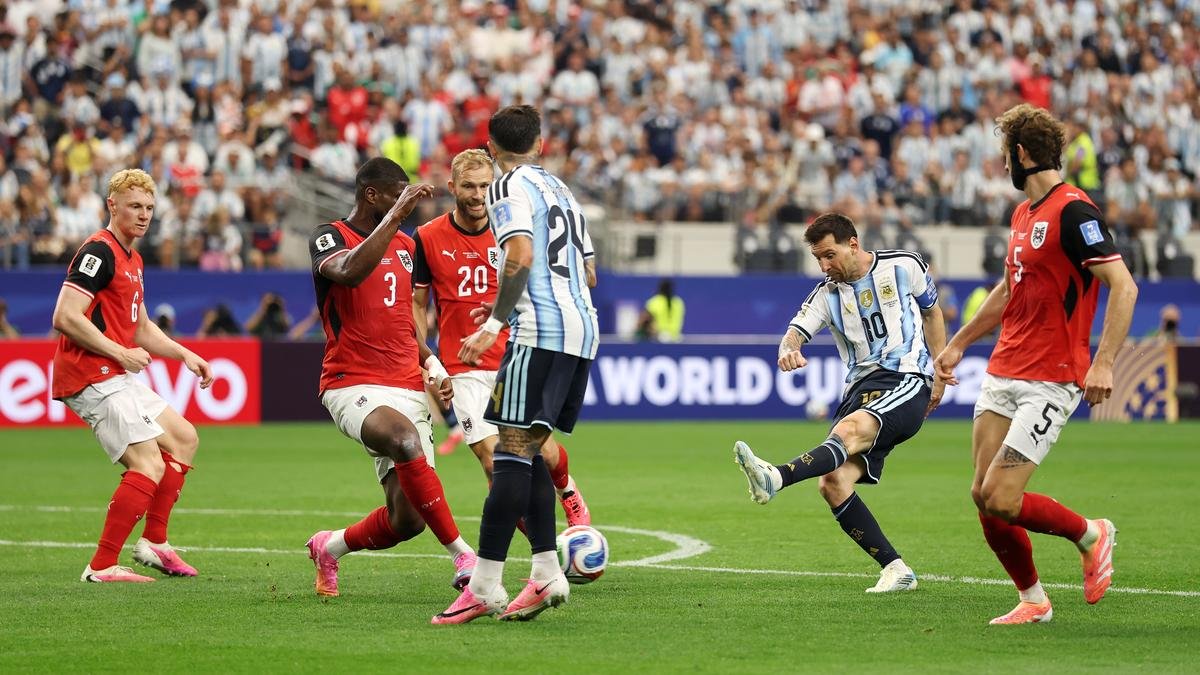
Messi tormented the Austrian defence and his brace proved to be the difference between the two sides.
| Photo Credit: Getty Images
For long stretches at the AT&T Stadium on Monday, Austria made life difficult for Argentina. It controlled possession and stopped the world champion from dictating the game.
Yet when the match was over, both coaches found themselves arriving at the same explanation for Argentina’s 2-0 victory.
Lionel Messi.
“This is Messi. He doesn’t need many situations to decide a match,” Austria coach Ralf Rangnick said.
Argentina coach Lionel Scaloni echoed the same sentiments. “When Leo gets activated, everyone gets activated,” he said.
The consensus reflected the reality of the afternoon. Austria’s game plan worked for significant periods, but Messi, despite missing a penalty, finally found a way.
“We were in control of the ball, which nobody expected,” Rangnick said. “During every match in a World Cup there are phases when one team has the momentum. We were fortunate with the (Argentina) penalty miss and I would have liked my players to shoot more.”
Austria’s frustration extended beyond its inability to convert possession into clear chances. Rangnick felt the opening and Messi’s record-setting goal should never have stood, arguing that VAR should have intervened. “Before the first goal, VAR should have asked the referee to see a foul against one of our midfielders Xaver Schlager by Alexis Mac Allister,” he said.
Rangnick, however, acknowledged that his side ultimately failed to capitalise on the opportunities and was left undone by Messi’s quality.
“We were not able to nullify all counter-attacks. In the second half we did a much better job except the last five minutes,” he said. “If someone is 39 (sic) and scores two goals and has already scored five goals in two matches this early in the tournament, it shows us that he is one of the best.”
Scaloni, meanwhile, was also pleased by his captain’s overall contribution in the field. “We are happy with Leo’s performance. When the team was having a rough time without possession, you could see his commitment. He was everywhere, stealing the ball and working hard for the team.”.
While accepting that his team spent periods without possession, Scaloni viewed Argentina’s resilience as one of the most encouraging aspects of the performance. “Today we did suffer at times because we didn’t have possession, and we know how to suffer as a team,” the World Cup-winning coach said. “That is praiseworthy. When you do not have the ball, you have to defend. When the opponent is attacking with a lot of players, you have to defend.”
Scaloni, however, rejected suggestions that Austria’s territorial advantage amounted to domination. “I won’t say the opponents dominated because domination didn’t mean shots on goal. They made it difficult for us when we didn’t have possession.”
That difference in interpretation may remain, but there is no doubt about the player who made the difference.
Published – June 23, 2026 05:54 pm IST


