



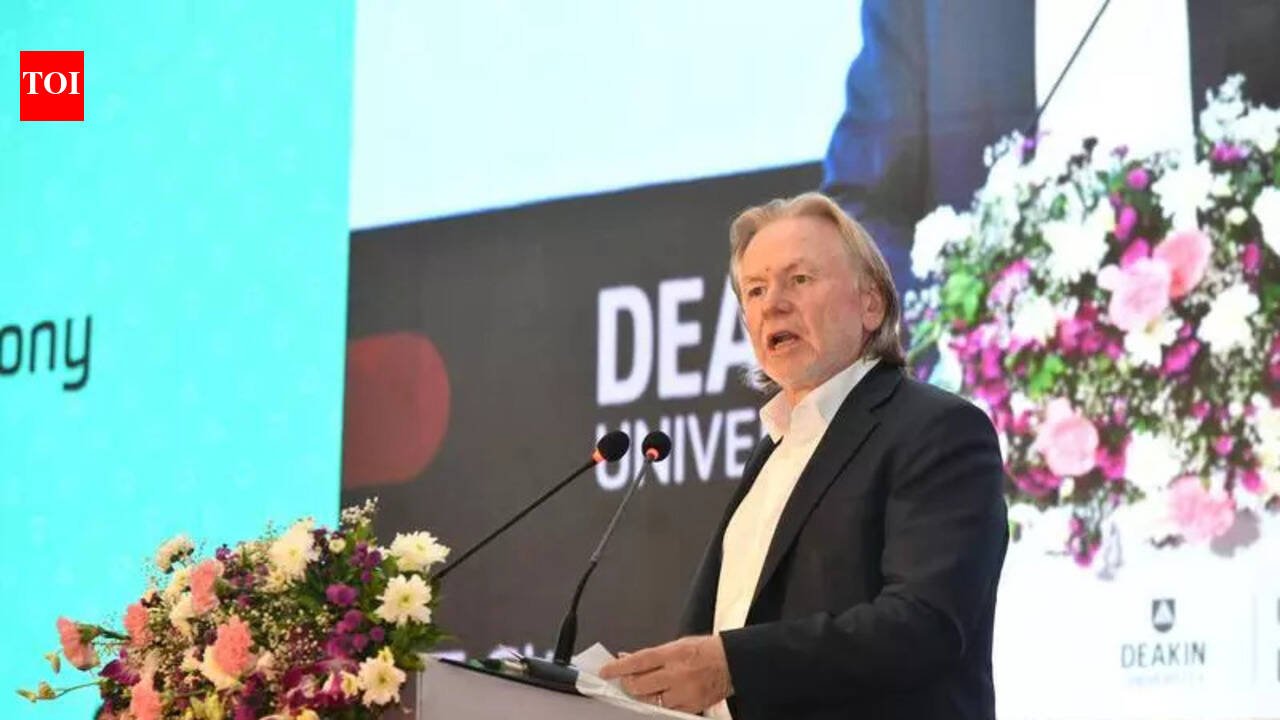
Ahmedabad: Australian high commissioner Philip Green laid out broadly the next phase in Australia-India ties, on his visit to Gandhinagar on Monday, built around critical minerals, a two-way education architecture, and a growing number of Australian global capability centres (GCCs), calling the moment “landmark”.“Australia is the not only the largest exporter of lithium in the world, we produce more than 50% of the world’s lithium,” he said, adding that there are “very few direct supply lanes between Australia and India at present” and that “we would like to build a direct pipeline of lithium exports” between the two countries. He cast the model as joint processing: partial refining in Australia, with final conversion in India into “cathode active material and cells and batteries”, creating “beneficiation benefits for both countries” and securing Indian supply “from a partner that it can trust”. Green said a lithium partnership is crucial because India is fast emerging as a major global player in green energy, while Australia remains the world’s leading supplier of the raw mineral.Access to ore is the precondition, he cautioned, “Indian firms need to get access to Australian ores whether that’s by way of equity arrangement or off-take agreement and that’s for the private sector to work out.” Green confirmed that a delegation of Indian firms interested in critical minerals travelled to Australia last year to explore partnerships — “a mix of Indian private and public sector companies” — while others have gone independently to build connections.On visas, he described Mobility Arrangement for Talented Early-professionals Scheme (MATES) scheme as targeted exchange, not migration. “MATES seeks to give opportunities for Indian skilled people in fields of particular interest to Australia and strengthen their capabilities,” he said. “It’s not intended that people would choose to live in Australia. It’s deliberately framed around mobility,” with outreach “widely amongst India’s best universities” for the next batch.He argued the education relationship should no longer be a “one-way street”. With Deakin and Wollongong already operating in India, “five more universities” are considering campuses so students can obtain “the same quality education in India at a fraction of the cost and without the dislocation of families”.The University of Queensland is investing in joint PhDs; Macquarie brings medical students for training in India; and “articulated degrees” now split study across countries, including a recent Mahindra University–La Trobe arrangement, he said. “There are lots of ways in which the education partnership can and should work both ways,” Green said.Green said Australian GCCs in India are expanding and new entrants are evaluating hubs, part of what he called a tripling of Australian investment in India over the past decade. During his visit to Gandhinagar, he met deputy chief minister Harsh Sanghvi and joined a friendly cricket game featuring his staffers and an Australia-dyCM mixed team.


