



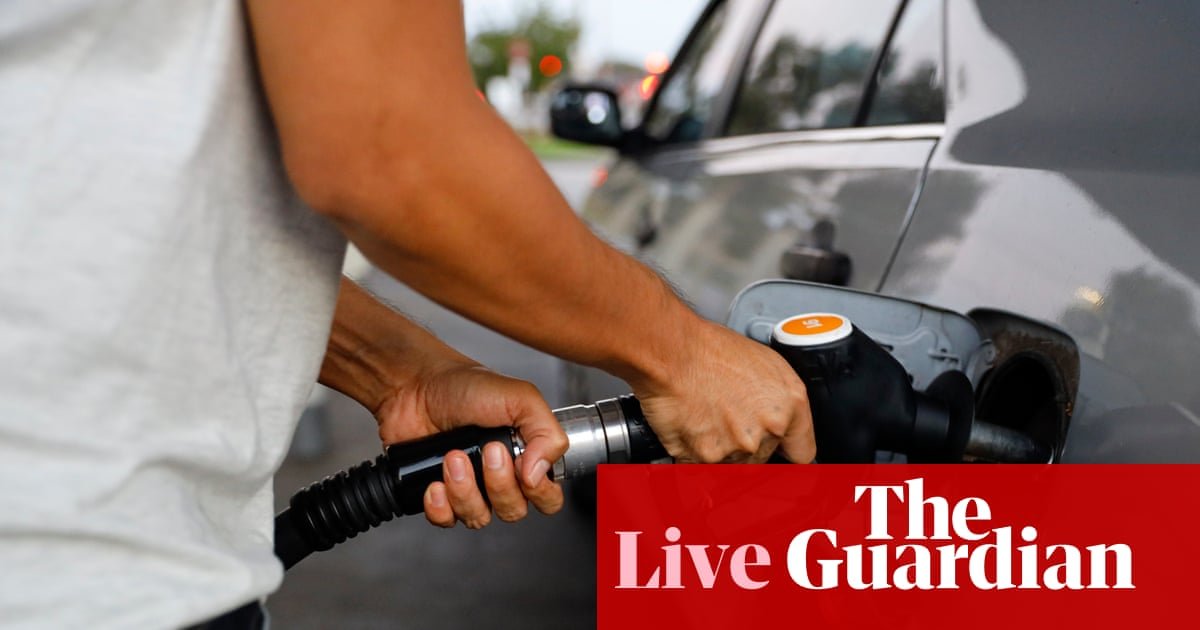
‘Way too soon’ to talk about fuel rationing, says Labor minister
The education minister, Jason Clare, says it’s too soon to be talking about fuel rationing in Australia, while the crisis in the Middle East deepens.
The government has pulled a range of levers to increase fuel supply, so far lowering standards for petrol and diesel.
Speaking to ABC News Breakfast this morning, Clare says:
They’re the sorts of measures that we’re taking to make sure that people have got petrol to put in the tank and diesel for farm equipment, as well as for vehicles in the cities. But any talk of rationing, I think it’s way too soon to be talking about that.
Labor could also consider increasing ethanol supply in fuel – a move backed by the NRMA.
Asked whether more Australians should be working from home to save fuel, Clare says there’s a range of households already doing that, and that it’s “become part of life already.”
Key events
Government introducing bill to close loophole for child sex abusers
The government will today introduce legislation that will help close a loophole to stop convicted child sexual abusers from hiding their assets in superannuation and avoid paying compensation to their victims.
The survivors law will allow survivors of child sexual abuse to apply for a court order to access “additional personal or salary sacrifice superannuation contributions” made by the offender if court ordered compensation is unpaid for more than 12 months.
The government says the legislation will also take effect on unfulfilled historical compensation orders if they remain legally enforceable and were awarded in relation to a criminal conviction or finding of guild for child sexual abuse.
The attorney-general, Michelle Rowland says:
There can be no opportunity for criminals who are convicted of child sexual abuse to avoid paying compensation to their victims, and I look forward to this vital legislation delivering exactly that.
ABC staff set to strike at 11am
ABC journalists and staff across the country will go on strike today from 11am as they push for better pay and better conditions. That includes many of our ABC colleagues who sit in the office next to ours in the press gallery corridor at Parliament House.
It means things will look and sound a little different this afternoon and tomorrow morning.
Staff are protesting what they say is a low pay offer from the ABC managing director, Hugh Marks, as well as work conditions and the broadcaster’s refusal to rule out replacing journalists with artificial intelligence.
Allow Instagram content?
This article includes content provided by Instagram. We ask for your permission before anything is loaded, as they may be using cookies and other technologies. To view this content, click ‘Allow and continue’.
Where did the $40 fuel cap idea come from?
The government has this morning shut down an idea that motorists could be limited to filling their tanks up to just $40 under a fuel rationing plan.
But where did this suggestion come from?
Former South Australian senator, Rex Patrick, received the government document which includes several possible responses to emergency fuel shortages, through a freedom of information request.
The plan was actually last updated in 2019 (before the Albanese government was elected), even though Patrick received the document in 2024.
This morning, Murray Watt said he’d “knock that one on the head” and confirmed the idea isn’t being considered by Labor.
Shadow foreign minister accuses government of being ‘ill-prepared’ on fuel crisis
The shadow foreign minister, Ted O’Brien, says the government has gone into the fuel crisis “completely ill-prepared”.
Speaking to Sky News, O’Brien says the government’s move to increasing the share of renewables in the grid has worsened the response to the crisis, and accused the energy minister, Chris Bowen, of trying to “outsource responsibility to state governments”.
They went into this crisis completely ill-prepared, and then they found themselves in a state of denial … Now this is the same energy minister who has been on the world stage calling for an end to all fossil fuels. That’s what Chris Bowen has been calling for. Now, of course, we find ourselves in a state of crisis and he is quickly saying, well, what we need more of is fossil fuels.
This is why we’re so ill prepared. We have a government which is driven by ideology and it has left us completely exposed.
Queensland aluminium smelter receives $2bn taxpayer subsidy to remain viable
The government has announced the federal and Queensland governments will each chip in $1bn to Rio Tinto’s Boyne aluminium smelter in central Queensland, to keep it viable into the future.
The government says the move, which will include Rio “underwriting significant investment in energy and transmission”, will unlock almost $7.5bn in investment in Queensland.
The smelter employs about 1,000 people and has been among several metals processing facilities in Australia struggling to remain financially viable.
Rio has been pushing the government to support its Tomago aluminium smelter, the biggest in the country, based in the Hunter region of New South Wales. Late last year, Rio said that it had failed to lock down a “commercially viable” energy contract beyond 2028, which could force it to shut its doors.
The industry minister, Tim Ayres – who will be speaking later this morning – says the support for the Boyne smelter is part of the government’s Future Made in Australia program.
With a considerable public investment, we are catalysing a fourfold private investment that will build out the renewable energy grid and keep thousands of good regional jobs in central Queensland.
‘We need serious solutions, not fake politicians’: Watt throws shade on Canavan
Murray Watt has shut down suggestions from the Nationals leader, Matt Canavan, that the government should allow oil drilling in the Great Australian Bight, calling it a “fake idea from a fake politician”.
The environment minister spoke to journalists in the press gallery earlier this morning, and said exploration of the area had been abandoned by companies for a reason.
In 2020, for example, Norwegian company Equinor abandoned plans to drill for oil because it wasn’t commercially viable, and faced major public backlash.
Watt says:
What he has suggested in drilling the Great Australian Bight was something that failed when he was the minister for resources in the former government … This is a serious challenge that Australians are facing right now and we need serious solutions, not fake ideas from fake politicians like Matt Canavan.
We’re not going to try to hoodwink Australians to think there are simple solutions by drilling in the Great Australian Bight when we know those companies walked away from those proposals only a few years ago.
Farrell defends EU free trade agreement
Don Farrell says the agriculture industry has “overwhelmingly” supported the free trade agreement made with the EU yesterday, and asks the cattle industry to “come onboard”.
The government has called the agreement, greenlit yesterday during a visit from European Commission president, Ursula von der Leyen, a “win-win”.
The trade minister has faced criticism that the deal agreed to yesterday is too similar to the one given to the government in 2023, which it had rejected. The cattle industry has also claimed they weren’t made aware of the final cattle export numbers in the deal until yesterday morning.
Speaking to ABC’s RN Breakfast, Farrell rejects the assertions and says that if the Europeans had come to him with the same offer in the past, then he would have agreed.
He also says he’s been open with the cattle industry all the way through.
Overwhelmingly, agriculture in this country has come out in support of the agreement. With the cattle producers, we’ve got an 800% increase in our access to the European market as a result of this agreement. And if the Europeans had made this offer to me in the last time we had formal negotiations, then we would have accepted it.
We finally negotiated the agreement in Sydney on Monday, and we told them at the earliest opportunity on Tuesday. So I don’t think that’s a fair criticism at all. And we’ve been briefing their associations all the way along the line.
Government ‘not considering’ $40 fuel price caps
The environment minister, Murray Watt, has dismissed suggestions the government could impose a $40 price cap for motorists trying to fill up their tanks, saying the idea isn’t being considered.
There were reports this morning of an idea that petrol pumps could be cut off automatically when motorists buy up to $40 of fuel, but Watt told journalists in the Parliament House corridor that it’s not happening.
We’re not considering this idea of a $40 price cap, that comes from a document that was released by the then government in 2019 and the situation has obviously changed between 2019 and 2026 …
We will continue to consider what options might be necessary in the future but I can knock that one on the head.
‘Way too soon’ to talk about fuel rationing, says Labor minister
The education minister, Jason Clare, says it’s too soon to be talking about fuel rationing in Australia, while the crisis in the Middle East deepens.
The government has pulled a range of levers to increase fuel supply, so far lowering standards for petrol and diesel.
Speaking to ABC News Breakfast this morning, Clare says:
They’re the sorts of measures that we’re taking to make sure that people have got petrol to put in the tank and diesel for farm equipment, as well as for vehicles in the cities. But any talk of rationing, I think it’s way too soon to be talking about that.
Labor could also consider increasing ethanol supply in fuel – a move backed by the NRMA.
Asked whether more Australians should be working from home to save fuel, Clare says there’s a range of households already doing that, and that it’s “become part of life already.”
Krishani Dhanji
Good morning, Krishani Dhanji here with you, thanks to Martin Farrer for getting us started.
The government continues to face pressure over rising petrol prices and fuel shortages around the country as it keeps pulling more levers to increase supply.
And the reaction to yesterday’s agreement on the free trade deal with the European Union continues – we’ll bring you all that as it comes.
There’s plenty to get through today, let’s get stuck in!
‘Broader than usual’ range of reforms being considered amid inflation storm, says Chalmers
The government is weighing up a broader range of reform options than usual in the lead up to the budget as the treasurer braces for worsening inflation data later today, Australian Associated Press reports.
Jim Chalmers has expanded on recent comments framing the upcoming May budget as his most ambitious yet, telling a Business Council dinner last night he was confident of landing “something meaningful” with the business community’s help.
The government’s influential expenditure review committee, which is responsible for deciding what’s in and what’s out of the federal budget and includes finance minister Katy Gallagher, met for hours yesterday and will meet again today.
“We are absolutely full tilt now working through a broader than usual range of options,” Chalmers said.
Treasury has been drawing up a number of reforms that align with the treasurer’s stated principles of improving intergenerational equity, encouraging investment and simplifying the tax system.
Reported options include cutting property-investor tax concessions, beefing up the levy on windfall gas profits, and axing an expensive tax break for electric vehicles.
Rather than a choice between resilience or reform, Chalmers said the budget will be about both resilience and reform.
Australia was well prepared for the inflation and growth challenges the war in the Middle East would throw up, he said.
“But we will be buffeted.”
Headline inflation was already running at 3.8% over the year to January and is expected to climb even further from the Reserve Bank’s 2-3% target band, as soaring oil costs result in second order price increases across the economy.
Sarah Basford Canales
Radicalisation now more likely to come ‘across a browser’ than a border, home affairs minister says
Tony Burke says it would be “reckless” and “ignorance in the extreme” for Australia to pretend that immigration is the solution to preventing violent extremism on our shores.
In a speech last night, the home affairs minister said it was very important Australia was careful about who it let in.
But Burke cautioned:
It would be ignorance in the extreme for us to pretend that that is the fix. It would be reckless in the extreme for us to pretend that immigration is the solution. It is something that is one of our tools, but the only way we deliver national security is to deal with facts and risks as they present themselves, not as you might want them to be.
Burke outlined four attempted or realised terrorist attacks in recent years, adding that all of those jailed for them were Australian. The attacks included the massacre at a mosque in Christchurch, an alleged attempted bombing of an Invasion Day rally in Perth, a foiled plot in Perth to attack mosques and the Bondi shooting in December.
Burke added that radicalisation now more commonly occured online, rather than being imported. He said:
Where we once only had to look at radicalisation potentially being something that might come across our border, it now comes across a browser. Where radicalisation used to involve – that you might have to go to a training camp in Afghanistan – it now comes to you in an algorithm.
‘So lucky’ that Invasion Day rally bomb did not go off, says Burke
Sarah Basford Canales
Tony Burke considers Australia “so lucky” that an alleged attempted terrorist attack against Indigenous Australians on 26 January did no harm.
In an address at an ANU National Security College dinner last night, the home affairs minister discussed the incident at this year’s Invasion Day rally in Perth attended by more than 2,500 people.
Western Australian police allege a 31-year-old man threw a homemade fragment bomb containing screws and ball-bearings surrounded by explosive liquid. The device did not detonate.
In Canberra, Burke told the audience:
The Australia Day arrest in Perth, for a number of reasons, it didn’t receive the publicity that it really should have. But can I just say – we got so lucky. We got so lucky.
This was not a stunt. The person who threw the pipe bomb into the middle of a crowd of First Nations protesters believed that – if you look at what it was – this was something where there was a reasonable expectation it would have gone off, and the number of people who then would have been killed. The fact that that didn’t happen is not through any planning. We just got lucky.
Read more:
Welcome
Good morning and welcome to our live news blog as the federal parliament sitting week continues. I’m Martin Farrer with the top overnight stories and then Krishani Dhanji will bring you the news as it happens.
The home affairs minister, Tony Burke, has said Australia was “so lucky” that an alleged attempted terrorist attack against Indigenous Australians on 26 January did no harm.
Meanwhile Burke’s cabinet colleague Jim Chalmers has warned the economy will be “buffeted” by the Middle East crisis and that his Treasury team is working “full tilt” through a broader than usual range of options for May’s budget.
More coming up.


