



Key events
Krishani Dhanji
Murray Watt hopeful negative press on CGT changes will die down
Now that the government’s capital gains tax and negative gearing changes have passed, Murray Watt is asked if he’s hopeful that all the heat will die down.
Watt says he believes some of the negative media could “subside” a little, and argues that not all of it was accurate.
He says he believes “what we’ll now see is people focus on the benefits of these reforms”.
I think it’s likely that some of the pretty over-the-top media articles and complaints – with all due respect to our friends in the media – might subside a little bit now that the legislation has got through.
Not every story that was being run in the media over the last few weeks has been accurate.
Watt again defends the changes and asked about some comments from the NSW Labor premier, Chris Minns (who said he “hopes” the reforms won’t impact innovation), the environment minister says the government doesn’t expect it to have a negative effect.
Krishani Dhanji
Big tech not cooperating ‘as much as we’d like them to’: Watt
Federal cabinet minister Murray Watt, says the government knows it’s needed to take more action to ensure social media giants are complying with a ban for under 16s that came into effect in December.
This morning Labor has announced it would double the penalty for breaches of the ban to $99 million.
Watt told Sky News this morning that big tech has not been cooperating with the new regulations “as much as we’d like them to”.
These laws were brand new, never developed anywhere in the world. And what we’ve learned is that the powers that the safety commissioner has do need to be beefed up, also to give her powers across things like age assurance tools. So things that sit outside the social media platforms themselves, but compelling them to provide information so that she can do her job even better.
Asked if he reckons the ban is working – Watt says, “I think it is”, and that the laws have already seen the deactivation of more than five million accounts.
‘It’s a difficult time around the world to be an incumbent government,’ Chalmers says
Finally, Chalmers was asked about the downfall of Keir Starmer in the United Kingdom, coinciding with a surge in support for Nigel Farage’s Reform party.
Australia’s Labor party is not immune from a shift to the right, with recent polls showing Pauline Hanson has overtaken Anthony Albanese as preferred prime minister.
Asked what lessons Australia could take from the UK, Chalmers said: “I think what we’re seeing in the UK is a bit like what we’re seeing right around the world.”
The pace of change is accelerating, the global and generational pressures are intensifying, and people have got legitimate concerns about where they fit in that, and then we’ve got the anger industry, and parties of the populist right trying to make that worse rather than trying to make that better.
It is a difficult time around the world to be an incumbent government, from our point of view. We are using the power of incumbency to take real action, to deliver cost-of-living help, to deliver real change. The best antidote to anger is action … The Albanese Labour government has chosen to address those concerns rather than dismiss them.
Tech giants ‘aren’t doing enough’ to adhere to Australia’s social media ban, treasurer says
Chalmers was also asked about the federal government’s announcement today to pass legislation this week doubling fines for breaches of the social media ban. The eSafety commissioner will also have additional powers to compel information from tech giants.
Asked if this was “an acknowledgment that the current system hasn’t been doing the job”, the treasurer said “big tech companies aren’t doing enough”.
We’re leading the world when it comes to protecting our kids online, and we’re making really important progress, but we will do more because the big tech companies aren’t doing enough.
We will strengthen the penalties. We will strengthen the powers of the eSafety commissioner, and that’s because we recognise that the future of our kids, the safety of our kids, is too important to let the big tech companies wriggle off the hook or avoid their responsibilities.
So we will do more because the tech companies aren’t doing enough, and we’ll see that reflected in the parliament before long.
Read more about the announcement here:
Headline inflation forecast to peak lower than anticipated at 4.25%, treasurer says
On to inflation. The budget forecast that headline inflation would peak at 5% this year. As the war in the Middle East drags on, is that still the federal government’s assumption?
Chalmers says with additional progress than expected, it is now expected that inflation around the middle of the year will peak “more like four and a quarter rather than five”.
That is very, very welcome progress. It does show, I think, it does illustrate the progress that we’re making together in this fight against inflation. Now there’s still a lot of uncertainty in the Middle East and elsewhere. There’s still more inflation than we would like in our economy as a consequence, but we are making more progress than we anticipated.
Key to that, Chalmers concedes, is that ships will be able to pass through the strait of Hormuz.
We desperately need the ceasefire to stick. You know, we can’t have another false dawn when it comes to the Middle East, and particularly the strait of Hormuz.
There’ve been some really welcome developments on this front, and we’ve seen the oil price come down quite substantially as a consequence. It wasn’t that long ago that a barrel of oil was in the 120s. This morning when I looked, it was in the low 70s. So that’s welcome progress.
There’s inflationary pressures elsewhere in the economy still as well. But if you look at the progress we made on inflation during the week, the welcome developments in the Middle East, and a number of other factors. What we actually saw through the course of the last week is that the market expectations for an interest rate hike actually went substantially down.
Chalmers grilled on ‘widow’s tax’
Chalmers has also been pressed on what has been dubbed a “widow’s tax” and was removed by Labor’s budget after questioning from the independent senator David Pocock.
David Speers:
You talk about certainty, but with that haste comes the risk of unintended consequences, and one of those was this issue of negatively geared properties that are jointly held, when a couple divorce or a partner dies. It’s been dubbed the widow tax. What is gonna happen there?
Chalmers says that will be addressed in “subsequent pieces of legislation” and the federal government had been “working through it” to address it in the interim.
When the amendments were put before the Senate, we had to make clear that we were working through that issue, and we intend to address it in subsequent pieces of legislation, and that’s the case …
Asked what would happen in the next week if someone lost their partner and had to rearrange their affairs, Chalmers again said “we intend to address that issue”.
I don’t want to pre-empt the outcome, but in saying that we’re going to address it, I think we’re making it incredibly clear, that we understand that this is an issue that has been raised with us, we intend to address it.
Jim Chalmers defends speed of tax reforms on Insiders
The treasurer, Jim Chalmers, is appearing on ABC’s Insiders this morning after securing passage of tax reforms with the support of the Greens.
Asked “why the rush” when the Howard government spent more than 10 months announcing tax reforms and taking it to parliament, Chalmers says:
This is how we deliver cost-of-living relief and deliver real change in the tax system.
It’s not unusual for the core elements, so big tax reforms to be legislated first, and then for there to be subsequent consultation and other pieces of legislation … We’ve seen in those other episodes of tax reform in this country, and that’s what we’re seeing now.
Pressed again on the timing, Chalmers says the federal government’s objective was to “provide certainty” for investors.
Whenever tax reform is undertaken in this country, it’s hotly contested, it’s contentious. There are all kinds of predictions that the sky will fall in, and all other kinds of predictions, which turn out to be wrong.
We expect that to be the case again. But we’ve legislated the core elements quickly, because we want to provide that level of certainty.
Labor has to get into an ‘arm wrestle’ with One Nation, Chris Minns says
Chris Minns was also asked about how Labor should respond to the surging poll numbers of One Nation. The NSW premier told Sky “we’ve got to get into the arm wrestle”.
People have got every right to vote for One Nation if they want to. And if they feel that they’re the best antidote or the best medicine for what’s ailing the state or the country, that’s exactly what they’ll do. Our job is to convince them otherwise and to say, well, this is our plan for the future.
Minns said Australians were “going through an incredibly tough time” and there were “concerns” about the level of immigration after the pandemic lockdowns. But he pushed back on her unexplained calls for a “monoculture” in place of multiculturalism.
The populist right or far-right movement has swept through Brazil, Argentina, the United States, Hungary, Italy, perhaps France, maybe the UK. So we’d be pretty naive not to think that it could affect us here too.
One of my biggest gripes with what Hanson has been saying … is that she seems to be saying, if you support multiculturalism, then you’re also for sharia law, multiple marriages … that’s utter garbage. That’s not the view or the lived experience of people that live in Sydney, who grew up in Sydney … I wouldn’t support sharia law or any of these insane ideologies in a place like Australia, but I do believe multiculturalism’s worked.
Drone technology won’t be ‘foolproof’ but should ‘mitigate the risk’, NSW premier says
The New South Wales premier, Chris Minns, says the state government’s expansion of shark surveillance came in response to a reduction in the number of people visiting beaches amid a spate of shark attacks.
Appearing on Sky News on Sunday, he said people had been rattled by the recent attacks.
We now are in a situation where … we seen a reduction in the number of people who are enjoying our beaches and enjoying the Pacific Ocean, even in the winter period. So we know we want to take action … It’s not going to be foolproof. We can’t promise it won’t lead to further shark attacks in the future, but we think it’ll mitigate the risk.
Minns also reiterated his opposition to culling great white sharks to prevent future incidents, which some sectors of the community had called for following the attack on Leah Stewart at Coogee.
They’re a protected species. They’ve been a protected species since the 90s, and I’m not convinced it would work. I mean, the distances these sharks travel are massive. It’s not like we can knock a few off and send a message to the rest of them …
I think it’s a different situation for bull sharks. Generally they’re in our estuaries … We’re looking particularly at an audit of the number of sharks in Sydney Harbour. We want to keep people safe, particularly when there’s a higher number of people in the water.
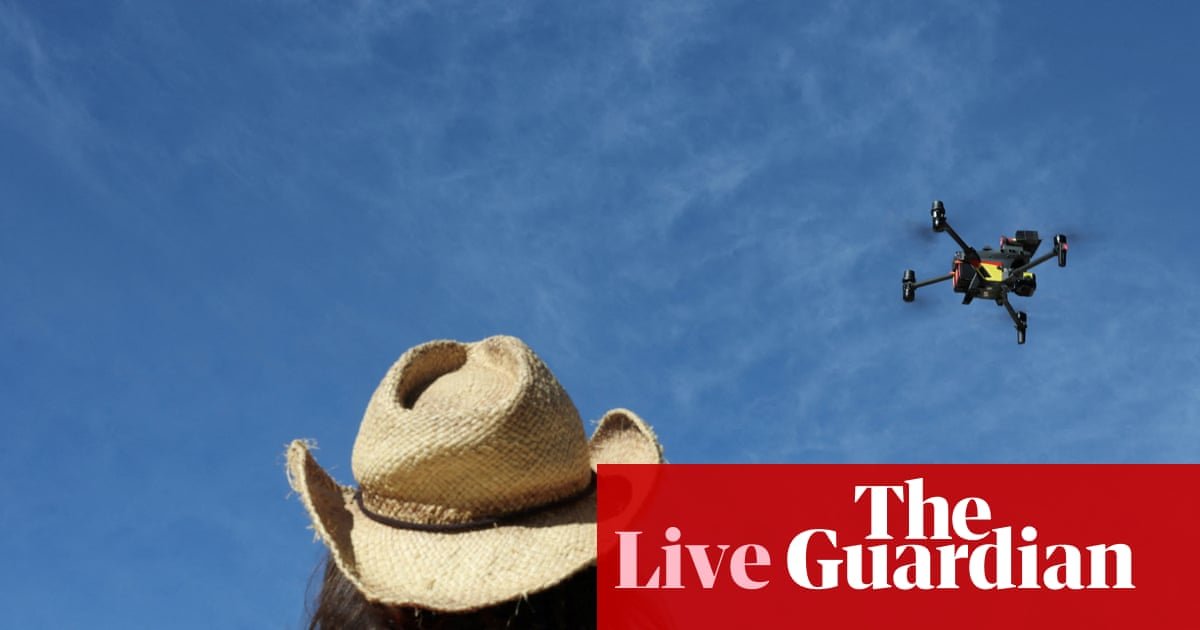
Chris Minns announces shark-spotting drone technology to patrol NSW beaches year-round
Shark-spotting drone technology will be deployed in New South Wales year-round under a state government investment that it says will be the largest expansion of aerial shark surveillance in the world.
On Sunday, the state government announced an additional $34m in drones, including using artificial intelligence, to scale up coverage across beaches in Sydney and along the state’s coast.
Around 70 beaches will be monitored 365 days of the year, prioritising areas with high numbers of users and where shark incidents have become more common.
This expanded monitoring will start 1 July and include year-round coverage across all Sydney beaches expanding from 26 to 38. There will also be two SharkSmart listening stations in Sydney harbour to alert swimmers to the presence of tagged sharks.
The premier, Chris Minns, said people should “feel confident” visiting the state’s beaches.
While no one can ever promise no shark interactions, this investment is about putting more eyes in the sky so we can spot sharks earlier and give people a clear heads-up when they’re in the water. More drones in the air means we’re getting a better picture of what’s happening offshore and it means we’ll get better at seeing them.
Welcome to Sunday 28 June
Good morning, readers.
It’s Caitlin Cassidy here with you this Sunday morning, and we’re kicking things off with a major New South Wales state government scale-up in shark-spotting drone technology after mounting concern over rising shark bites in Australia.
The state’s premier, Chris Minns, just appeared on Sky News where he spruiked the program, which follows a shock shark attack at Sydney’s popular Coogee beach.
Let’s get started.


