



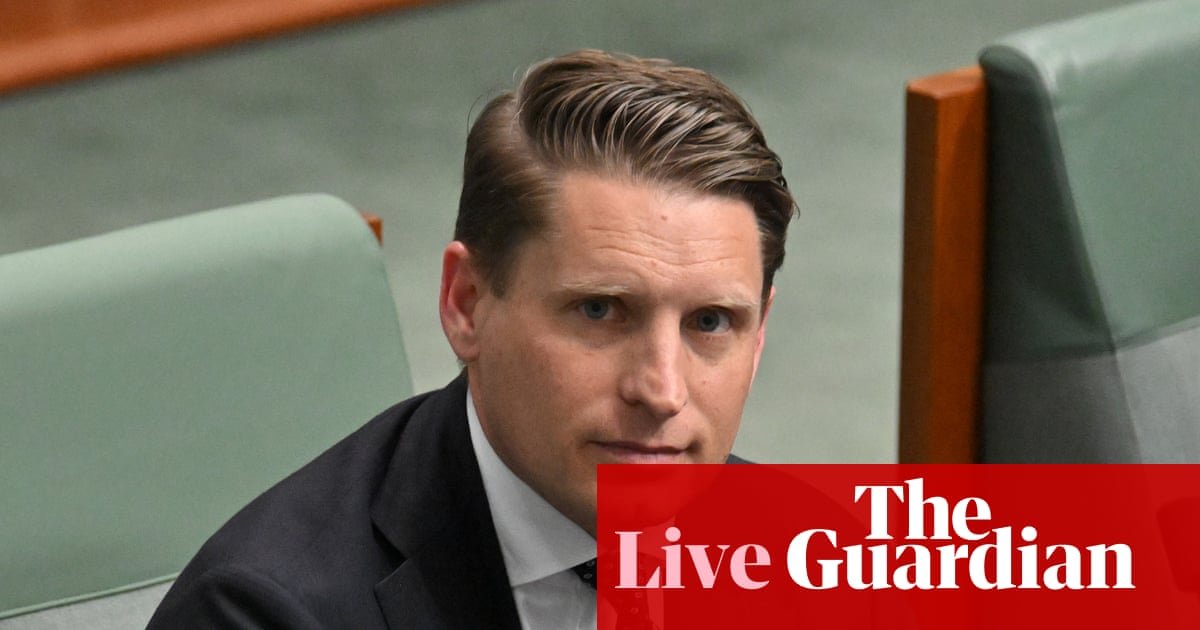
Hastie says US alliance has eroded Australia ‘sovereign capability’
Dan Jervis-Bardy
The Liberal frontbencher Andrew Hastie says doubling down on the US relationship has eroded Australia’s sovereign capability, including its defence industry, as he warns the country must “get serious” about national security to rebalance the alliance.
In a speech to the Robert Menzies Institute in Melbourne last night, the shadow minister for industry and sovereign capability said the reliance on the US meant “strategic trade-offs” that had hastened the deindustrialisation of Australia and “weakened our hard power”.
He said it had cost Australia “sovereign capabilities like a robust defence industry” and “strategic freedom of action” in ways that were now becoming clear amid the Middle East war.
Hastie said under Donald Trump the US “should not be expected to guarantee much except its own strategic interests”, which meant Australia must “get serious about our own national security” by rebuilding its industrial base and a defence force “with teeth”.
To put it bluntly, if Anzus is going to continue for another 75 years, we need to invest in our industrial base and our defence force.
The former soldier has been an outspoken critic of Trump and his war in Iran, striking a different tone to the opposition leader, Angus Taylor.
Key events
Good morning, Nick Visser here to take the reins and guide us through Friday. Let’s get to it.
Catie McLeod
Court hears Woolworths planned price hikes and subsequent drops
Under cross-examination by the ACCC’s barrister, Michael Hodge KC, Robinson conceded Woolworths had planned the elevated short-term price of $6.50 would become the product’s “was” price before it was even changed.
Robinson also acknowledged the supermarket negotiated profit margins with the supplier based on the third “Prices Dropped” price of $6.
The court was shown the proposed promotional plan for the baby rice from 2022 which said the number of weeks it would be at the new shelf price of $6.50 was “zero” whereas the number of weeks it would then be sold for $6 was 52.
Woolworths denies the ACCC’s allegation that in many cases it inflated prices solely to establish a higher “was” price so that it could make customers think they were getting a discount.
Sam Woodcock, who has worked in management roles across Woolworths for more than nine years, also appeared as a witness.
Woodock conceded Woolworths had planned price hikes and subsequent drops promoted as discounts in negotiation with the product suppliers.
“Essentially if a supplier proposes a cost price increase to be effective from a certain date and we don’t accept that as a retailer, there’s a risk that … that a supplier will choose not to supply us that product anymore,” he told the court.
The case continues.
Catie McLeod
Woolworths gives evidence about price changes in ACCC case
Woolworths planned to increase the shelf price of products in advance so it could later display desired “was/is” price comparisons on their promotional tickets, a court has heard.
The trial involving the Australian Competition and Consumer Commission (ACCC) and Woolworths continued yesterday in testing allegations the supermarket disguised price increases on hundreds of products between 2021 and 2023.
Stuart Robinson, Woolworths’ category manager for baby products, gave evidence in the federal court in Melbourne where he was asked about Nestlé Cerelac baby rice – one of 12 products the trial is scrutinising in detail.
Woolworths’ long-term shelf price was $5, according to court documents. It then lifted the price to $6.50, for 22 days, then reduced it to a new long-term price of $6.
The supermarket promoted the $6 price as a “Prices Dropped” discount on the item’s ticket, next to the higher “was” price of $6.50.
Robinson admitted in court that the agreed “was” price of $6.50 – to be advertised in store – was higher than Woolworths had ever charged for the product at the time.
Hackers steal US$2.5m owed to Australia from Sri Lankan finance ministry
Cybercriminals have hacked into the Sri Lankan finance ministry’s computer system and siphoned off US$2.5m, Agence France-Presse reports.
It is the most amount of cash ever stolen by hackers from a state institution in the debt-saddled country, which is recovering from a crippling economic crisis in 2022 after Colombo defaulted on its US$46bn external debt.
The money was destined as debt repayment to Australia, the finance ministry secretary, Harshana Suriyapperuma, told reporters in the capital.
Four senior officers at the Public Debt Management Office (PDMO) were suspended after the breach, he said.
Authorities were alerted to an attempt to break into the ministry’s email server and investigations showed that a US$2.5m payment owed to Australia had disappeared.
“Criminal investigators are looking into this and we are not in a position to give further details,” Suriyapperuma said, adding that Sri Lankan authorities were seeking help from foreign law enforcement agencies.
Australia’s high commissioner in Sri Lanka, Matthew Duckworth, said Canberra was aware of “irregularities” in payments owed to it.
“Sri Lankan authorities are investigating the matter and are coordinating with Australian officials, who are assisting the investigation,” Duckworth said on X.
“Australia remains committed to supporting Sri Lanka’s return to debt sustainability.”
Hastie says US alliance has eroded Australia ‘sovereign capability’
Dan Jervis-Bardy
The Liberal frontbencher Andrew Hastie says doubling down on the US relationship has eroded Australia’s sovereign capability, including its defence industry, as he warns the country must “get serious” about national security to rebalance the alliance.
In a speech to the Robert Menzies Institute in Melbourne last night, the shadow minister for industry and sovereign capability said the reliance on the US meant “strategic trade-offs” that had hastened the deindustrialisation of Australia and “weakened our hard power”.
He said it had cost Australia “sovereign capabilities like a robust defence industry” and “strategic freedom of action” in ways that were now becoming clear amid the Middle East war.
Hastie said under Donald Trump the US “should not be expected to guarantee much except its own strategic interests”, which meant Australia must “get serious about our own national security” by rebuilding its industrial base and a defence force “with teeth”.
To put it bluntly, if Anzus is going to continue for another 75 years, we need to invest in our industrial base and our defence force.
The former soldier has been an outspoken critic of Trump and his war in Iran, striking a different tone to the opposition leader, Angus Taylor.
Welcome
Good morning and welcome to our live news blog. I’m Martin Farrer with the top overnight stories before Nick Visser guides you through to the holiday weekend.
Andrew Hastie says doubling down on the US relationship has eroded Australia’s sovereign capability, including its defence industry, as he warns the country must “get serious” about national security to rebalance the alliance. More follows.
At least two children have been treated in hospital after dingo attacks in recent days at the same remote Western Australian campground. More details coming up.
And hackers have broken into the Sri Lankan finance ministry’s computer system and made off with $2.5m that was destined as a debt repayment to Australia. More on that, too, very soon


