



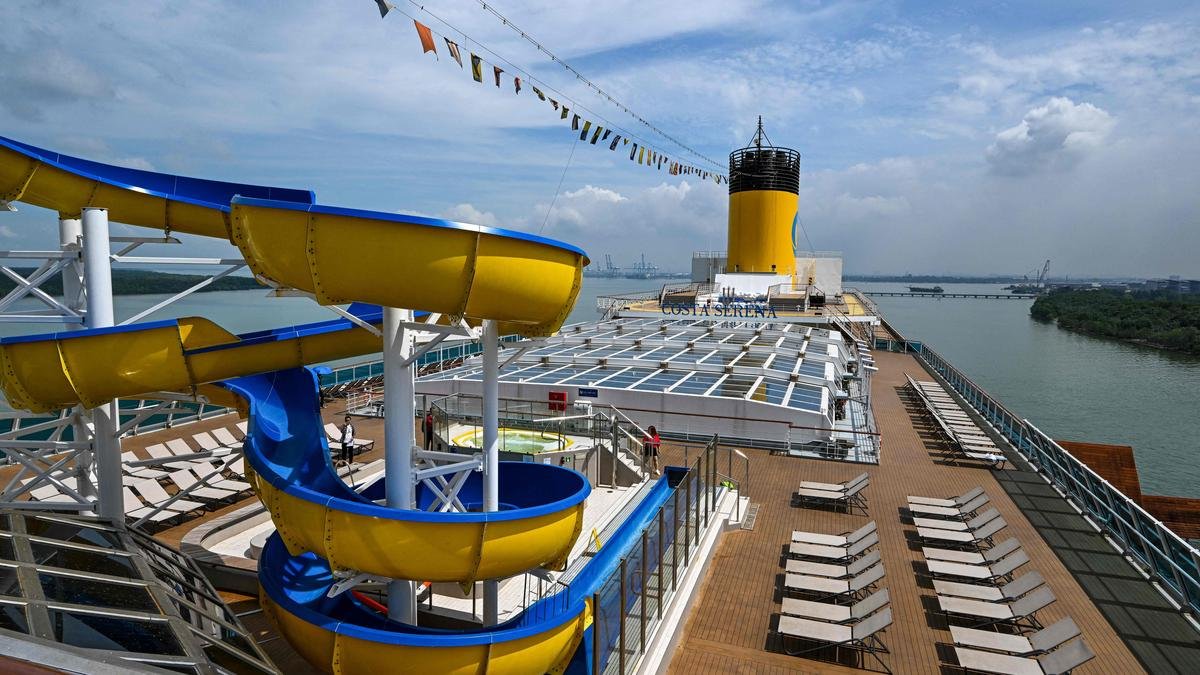
Athletes at the Asian Games in Japan will have “a unique experience” staying on a cruise ship and in wooden containers, an organising official told AFP six months out from the event, but acknowledged there were concerns about the plan.
About half of the expected 15,000 athletes and officials will live in the eye-catching temporary accommodation during the Games, which are in Nagoya and the wider Aichi area from September 19 to October 4 — coinciding with typhoon season in Japan.
The rest will stay in hotels, including in Tokyo, where swimming, diving and equestrian events are taking place.
Organisers say using the cruise ship and container units are cheaper than building a traditional athletes’ village, although they admit the unusual approach has raised eyebrows.
Kazuhiro Yagi, vice-secretary general of the Aichi-Nagoya Games organising committee, told AFP that the accommodation would offer “an experience that’s difficult to come by”.
“If people were going to live there long-term, that would be a different story,” he said.
“But in this case it’s a very limited period and athletes will spend much of their time training and then come back simply to rest.
“I would like them to go back home having had a unique experience,” he added.
Between 4,000 and 5,000 athletes and officials will stay on the Italian cruise ship Costa Serena, which will be docked at Nagoya Port during the Games.
The vessel, which features 571 cabins, seven swimming pools, eight restaurants and nine bars, is being chartered at a cost of about 4.5 billion yen ($28 million), said Yagi.
According to the official website, the ship has “an elegant, surprising, ironic and magnetic soul”.
It is a sister ship of the Costa Concordia, which sank off Tuscany in 2012, killing 32 people.
A further 2,000 athletes and officials will stay in wooden shipping container-style huts in Nagoya’s Garden Pier area.
Some of the units, which Yagi says are “essentially brand new”, have already been installed.
“I’ve heard some say the space is a bit tight, but from what I saw, they provide an adequately liveable environment,” he said.
Yagi says athletes will be assigned to a particular type of accommodation based on their sport, not by country.
Power of sport
He also says organisers will be ready to deal with Japan’s typhoon season.
“We don’t expect extremely large waves but we must be prepared for emergencies,” he said.
“Forecast accuracy has improved and we can generally see a typhoon’s path about a week in advance now.”
Yagi says preparations for the Games are on course, with the main athletics venue set to open next month.
He says there has been a “marked improvement” in public awareness in Japan of the event, and tickets started to go on sale for local residents last month.
Organisers hope to emulate the success of the world athletics championships, which were held in Tokyo last year in front of mostly sold-out crowds.
“It was incredible, I was there when (pole vaulter Armand) Duplantis set the world record,” said Yagi.
“It was close to 11:00 pm but no one was leaving, everyone was clapping along.
“The collective gasp when he broke the record was awe-inspiring, it really made me realise again how wonderful sport is.”
Japanese organisers are keeping a close eye on the situation in the Middle East, and say that at present the war there is not likely to have an impact on the Games.
Yagi says there are no special plans for the Iran team, or North Korea, which is reportedly preparing to send a delegation of more than 260 athletes and officials.
With just months to go, he says preparations are going “according to plan”.
“We are working to further reinforce coordination with the relevant organisations so that we can welcome the Games with everything in perfect order,” he said.
Published – March 20, 2026 01:36 am IST


