



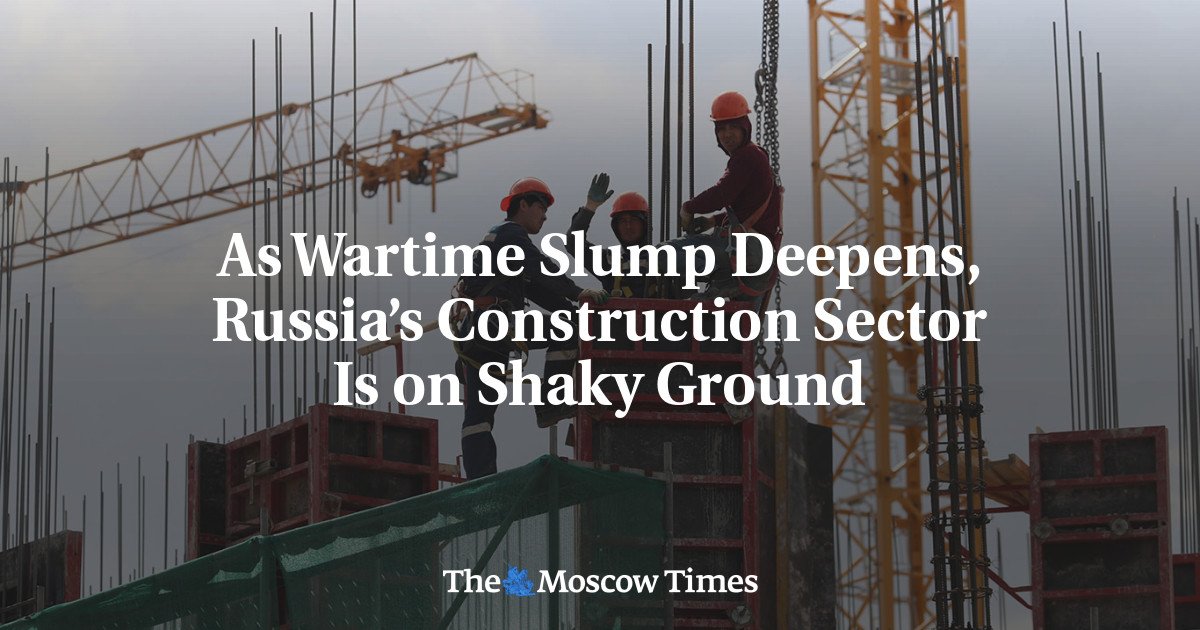
Russia’s construction industry boomed in the first years of the war in Ukraine as Russians sought refuge from sanctions, economic uncertainty and a weakening ruble by investing in property, while generous state-backed mortgages fueled demand.
But these days, the sector is running into trouble as the government scales back subsidies and reins in spending amid its own budget strains.
The latest round of restrictions targeted the subsidized 6% family mortgage program, limiting families to one mortgage between both spouses and banning the inclusion of third parties in mortgage agreements.
Those measures caused the value of subsidized mortgages issued by Russian banks to fall 62% year-on-year in February, 8% in March and 20% in April.
Total mortgage lending declined by between 9% and 21% in 2025, depending on the estimate, marking a second consecutive annual drop after the record-breaking year of 2023.
“We’ve already used up the safety margin we had, both builders and developers, since 2024,” Deputy Prime Minister Marat Khusnullin complained in May.
“You can’t keep putting more pressure on us. Beyond this point, it creates risks for the industry,” he added, warning against further tightening of subsidized mortgage lending.
As top officials grow increasingly concerned, signs of a broader slowdown are becoming increasingly visible.
The total value of construction work completed in the first quarter of 2026 — including residential housing, commercial property and industrial facilities — fell 10% from a year earlier to 2.91 trillion rubles ($40.2 billion), according to official data.
Both residential and commercial real estate are showing signs of weakness.
Housing completions fell to 23 million square meters (247 million square feet) in the first quarter of 2026 from nearly 32 million square meters (344 million square feet) a year earlier.
Sovcombank now forecasts developers will complete 35 million square meters (377 million square feet) of new housing this year, down 15% from 41.3 million square meters (445 million square feet) in 2025.
Commercial property has so far proven more resilient. Completions totaled about 7 million square meters (75 million square feet) in January-March, roughly unchanged from a year earlier. But cracks are starting to show in places like Moscow, where just 76,000 square meters (818,000 square feet) of new retail space is expected to be completed by the end of 2026, down 70% from 2025 levels.
Investment is being cut back as a result.
Spending on residential and commercial real estate fell 30% year-on-year to 99 billion rubles ($1.37 billion) in the first quarter. Analysts expect investment to decline by as much as 27% over the full year.
Vasily Kuzmichenok / Moskva News Agency
As weakness in the sector spills over into related industries, the downturn risks affecting the broader economy.
Domestic shipments of road construction machinery dropped by half in the first quarter from a year earlier, falling to 5.8 billion rubles ($80 million).
Construction accounted for around 6% of gross domestic product in 2025 and 13% when related industries are included, while up to 7 million workers are employed in the sector.
This means that, by rough estimates, every 1% decrease in construction shaves about 0.13 percentage points off Russia’s GDP. That might seem modest — but with authorities forecasting growth at just 0.4% in 2026, every fraction of a percentage point counts.
Industry participants say the downturn has been building for some time.
A Russian businessman involved in the production of chemicals for concrete said the downturn in the industry began in 2024.
“The housing market effectively stalled once banks stopped lending to households,” he told The Moscow Times, speaking on condition of anonymity because of the sensitivity of the issue.
Because cement is used at the start of the construction process, suppliers of construction materials felt the slowdown before many other parts of the industry, he said.
Cement demand fell 9% last year and is projected to drop by another 25% in 2026, forcing major producers to suspend operations at some plants.
The businessman said the downturn has since spread beyond housing construction as banks became increasingly reluctant to lend to businesses.
“Large companies are still surviving on reserves, but many are under pressure,” he said.
He added that some manufacturers serving the construction sector have already curtailed operations, while others are struggling with high borrowing costs and weakening demand.
Additional pressure has come from disruptions to supplies of construction materials following Ukrainian strikes on industrial facilities, he said.
Imports from China can take months to arrive and logistics chains remain unreliable, forcing some producers to seek cheaper alternatives in an effort to cut costs.
At the same time, state-backed construction projects have been scaled back, delayed or canceled, reducing another important source of demand.
Vasily Kuzmichenok / Moskva News Agency
Moscow-based analyst Pavel Ryabov described the slowdown as the industry’s “most serious stress test since the 2009 crisis.”
The influential government-linked Center for Macroeconomic Analysis and Short-Term Forecasting (CMASF) said the construction sector faces a downturn lasting two to three years.
It warned that high interest rates and lower government orders are raising questions about the financial solvency of some companies.
According to CMASF, developers’ net debt has reached 481% of EBITDA, meaning total debt is nearly five times larger than earnings before interest, taxes, depreciation and amortization.
Cash-flow problems are also growing.
The Vedomosti business daily reported that contractors building roads and bridges are waiting longer to receive government payments.
The amount owed to contractors rose 150% year-on-year in the first quarter to 500.7 billion rubles ($6.91 billion), which the newspaper attributed to bureaucratic delays and growing paperwork backlogs.
“As a result, construction companies are being left short of cash and are being forced to take on more debt — effectively providing interest-free financing to the state out of their own pockets,” Vedomosti wrote.
The industry source said rising borrowing costs and restricted access to credit have left some firms struggling to meet leasing obligations, leading to an increase in construction vehicle returns and lease defaults. That, in turn, is pushing up transportation costs across the industry.
The downturn could last several years as the sector adjusts to a lower level of activity with no clear catalyst for recovery, he said.
“The construction industry has never faced pressures on so many fronts simultaneously,” he said. “For now, the outlook remains bleak.”
A Message from The Moscow Times:
Dear readers,
We are facing unprecedented challenges. Russia’s Prosecutor General’s Office has designated The Moscow Times as an “undesirable” organization, criminalizing our work and putting our staff at risk of prosecution. This follows our earlier unjust labeling as a “foreign agent.”
These actions are direct attempts to silence independent journalism in Russia. The authorities claim our work “discredits the decisions of the Russian leadership.” We see things differently: we strive to provide accurate, unbiased reporting on Russia.
We, the journalists of The Moscow Times, refuse to be silenced. But to continue our work, we need your help.
Your support, no matter how small, makes a world of difference. If you can, please support us monthly starting from just $2. It’s quick to set up, and every contribution makes a significant impact.
By supporting The Moscow Times, you’re defending open, independent journalism in the face of repression. Thank you for standing with us.
Continue
Not ready to support today?
Remind me later.
×
Remind me next month
Thank you! Your reminder is set.


