



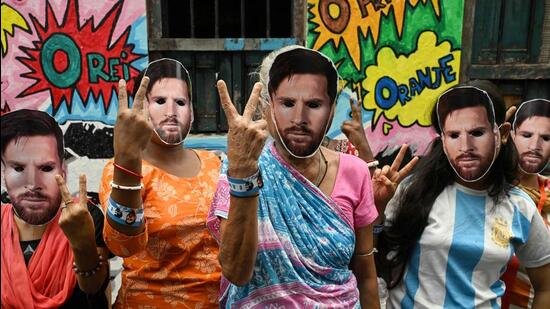
New Delhi: Every time the FIFA World Cup comes around, Indian football fans find themselves asking the same question: why not India? Perhaps it is a question that should not be reserved for once every four years. Perhaps it is a question Indian football needs to ask itself every day.


As the 2026 World Cup unfolds across North America, the gap between India’s footballing ambitions and reality feels starker than ever. Across Asia, nations once considered peers have turned dreams into milestones.
Japan and South Korea have become World Cup regulars, qualifying for eight and eleven consecutive editions respectively, while first-time qualifiers Jordan and Uzbekistan have broken new ground and earned their place on football’s biggest stage. Asia will have a record representation at the 2026 tournament, reflecting decades of investment in youth development, coaching pathways and long-term planning.
For Indian fans, those success stories are both inspiring and painful. Uzbekistan, a nation of around 37 million people, is playing at its first World Cup after years of steady progress, while Jordan has achieved a historic breakthrough of its own. Their journeys stand as reminders that population size alone does not guarantee footballing success.
India, meanwhile, remains on the outside looking in. Despite a population of more than 1.4 billion and one of the world’s largest sports audiences, the national team’s 2026 World Cup campaign ended before reaching the final stages of Asian qualifying.
To understand where Indian football stands today, we spoke to fans, academy players and grassroots followers of the game. Their frustrations were varied, but the themes remained remarkably consistent: a lack of structure, a lack of planning and, perhaps most importantly, a lack of pathways.
“Whenever people say India doesn’t have talent, I disagree. The real issue is that thousands of talented kids never get seen. If you’re born outside a football hotspot, your journey often ends before it starts,” said Apoorv, a 19-year-old fan from Dehradun.
It is a sentiment that echoes across Indian football. While countries such as Japan and South Korea spent decades building academy networks, coaching systems and competitive youth structures, India’s football map remains concentrated in pockets. Kerala, Goa, West Bengal and parts of the Northeast continue to produce players and passionate supporters, but large parts of the country remain disconnected from a meaningful football ecosystem.
The result is a paradox. India has one of the largest football audiences in the world, yet many aspiring footballers still struggle to identify a clear pathway from school grounds to professional football.
As Shrey (17) from Gurgram put it, “A talented kid in India still doesn’t know what the pathway to the national team looks like. Until young players can see a clear route from school football to professional football, we will keep falling behind.”
That sense of uncertainty extends beyond the grassroots level. Over the past year, discussions around Indian football have often focused as much on governance and the future of domestic competitions as on performances on the pitch.
One academy player who follows both Indian and international football closely pointed to the contrast with countries that have recently qualified for the World Cup. He argued that Jordan and Uzbekistan did not arrive on the global stage overnight.
“Every World Cup, we compare ourselves with countries that have qualified. The difference is that they spent years following a roadmap. In India, it feels like we are still debating where the road should begin,” said Aarnav Osahan, a 20-year-old staunch follower of the sport from Amritsar said.
His frustration was not directed at the players. If anything, he believes Indian football asks too much of them. He argued that players and coaches can only take the game so far before governance, funding and long-term planning begin to matter.
There is also a broader cultural challenge. Football’s popularity in India has never been in doubt. Premier League shirts are common sights in school corridors and college campuses, and European football dominates television screens late into the night. Yet that passion rarely translates into the same attention for domestic football. One fan described it as a country that loves football but remains detached from its own footballing reality.
For Indian fans, that may be the hardest reality to confront. The World Cup dream itself has not faded. If anything, it remains one of the most powerful aspirations in Indian sport. But many now believe the conversation should shift from qualifying for a World Cup to first building the foundations required to compete consistently in Asia.
Until then, every World Cup may continue to begin with the same question — why not India?
So, why not India? The answer, at least for now, lies less in a lack of dreams and more in a lack of direction.
The warning signs have been impossible to ignore. India’s failure to qualify for the 2027 AFC Asian Cup, after dropping crucial points against teams it was once expected to compete with, served as another reminder that the gap between aspiration and reality is widening.
The problems are neither new nor hidden. Inconsistent grassroots structures, the absence of a robust football pyramid, governance concerns and inadequate talent identification have all been part of the conversation for years.
Yet roadmaps are only as good as the roads they are built on. Fans have heard promises before. What they crave now is continuity, accountability and visible progress.
Perhaps that is why even Arsène Wenger, during his visit to India in 2023 as FIFA’s Chief of Global Football Development, resisted the temptation to speak in grand terms about World Cups. “It is impossible that a country like India, 1.4 billion, is not on the football world map,” he said, calling the country a “gold mine” of talent.
But his emphasis was elsewhere. Having seen Japan transform into a footballing nation, Wenger spoke of starting early, investing in development and building foundations.
As Aarnav put it, “Others had a roadmap. India had hope.”
For now, as Japan, South Korea, Jordan and Uzbekistan carry Asia’s hopes onto football’s biggest stage, Indian supporters are left with a familiar feeling and an even more familiar question. The dream remains but everything else is still under construction.


