



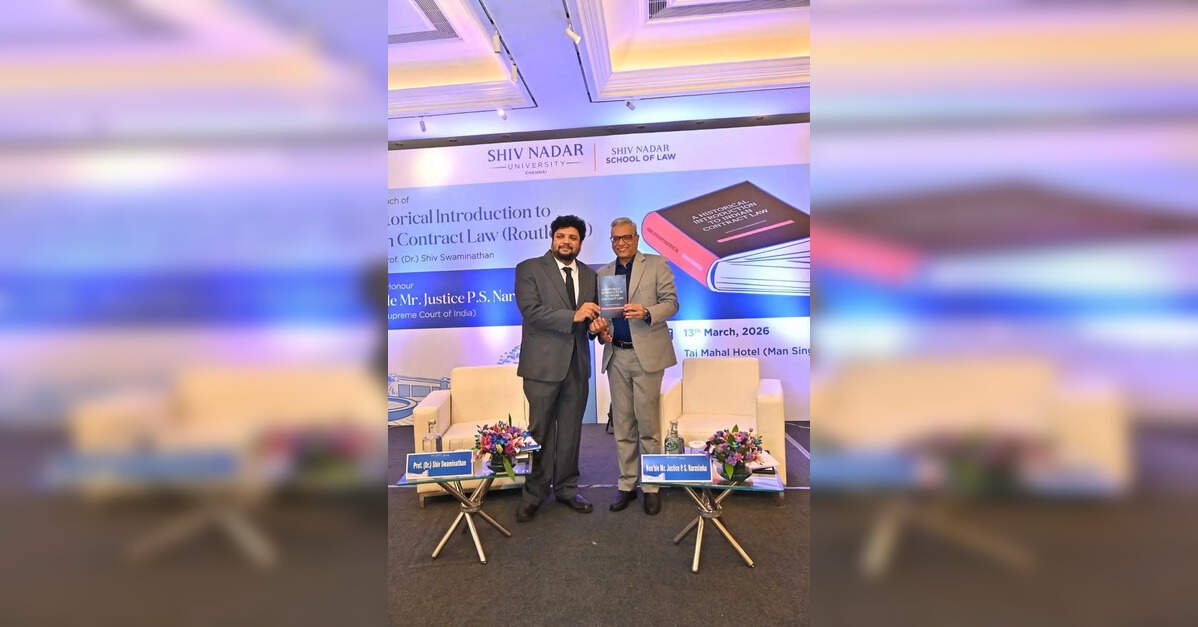
A gathering of scholars and members of the legal fraternity convened in Delhi on 14 March 2026 for the launch of, ‘A Historical Introduction to Indian Contract Law (Routledge)’, a book examining the historical foundations and evolution of Indian contract law. The event was organised by the Shiv Nadar School of Law, Shiv Nadar University Chennai.The book titled, A Historical Introduction to Indian Contract Law (Routledge), by Prof (Dr.) Shivprasad Swaminathan, Professor and Dean at the Shiv Nadar School of Law is based on original archival research.
“The book traces how core concepts from nineteenth-century English jurisprudence were incorporated into the Indian Contract Act, 1872, and interpreted by Indian courts over the decades. It presents a novel insight: the drafters did not intend a faithful codification of English law, yet over time, courts and scholars often projected English law onto the Act,” said Prof. Swaminathan.
The book’s central argument is that the drafters of the Act deliberately deviated from english law in key respects, yet over time, Indian courts and commentators often read the Act through the lens of english precedents, thereby eclipsing its reformist and Indian‑specific potential.
Aligning modern practice with the Act’s original intent
In an interaction with ETLegalWorld, Prof. Shivprasad Swaminathan highlighted the need for greater doctrinal and historical sensitivity.
When asked how Indian courts could better align the interpretation of the Indian Contract Act, 1872, with its original, India‑specific design while addressing contemporary business realities, Prof. Swaminathan described the Act as a “revolutionary piece of draftsmanship” that anticipated many reforms that took decades to reach English law. However, he noted, Indian scholars and courts have often projected english law onto the Act, overshadowing its reformative character.
“The piece of legislation that was meant to be decades ahead of the curve has somehow ended up falling short of the state‑of‑art,” he said. Prof. Swaminathan recommended that courts develop a sharper awareness of the drafting history of the Act and the “genealogy” of its core concepts.
Reforming contract‑law pedagogy
When asked about how law schools could better prepare students for company disputes in a rapidly changing, technology‑driven world, Prof. Swaminathan identified two complementary tasks. First, he emphasised a renewed focus on the first principles of contract law, which would equip students to handle both “known unknowns” and “unknown unknowns” that arise in practice. Second, he advocated for forward‑looking teaching that trains students to anticipate problems arising from new technologies and to resolve them through analogical reasoning and comparative law.
He argued that before any legislative amendment to the Contract Act, universities should strengthen doctrinal teaching in a way that balances historical depth with future‑oriented problem solving. This dual orientation, he maintained, would better prepare future lawyers to navigate complex commercial disputes, particularly those involving digital platforms, AI‑driven agreements, and evolving regulatory frameworks.
“Prof. Shivprasad Swaminathan’s work is significant because it brings serious doctrinal and historical scholarship to an area where such writing has been limited. By carefully tracing the development of key concepts and examining landmark cases in detail, the book encourages teachers, scholars and students to engage more deeply with contract law and to rethink how the subject is studied and taught in India,” said Dr. Nilima Bhadbhade, Scholar and Author.
During his address, Justice Narasimha said that the Indian Contract Act, 1872, was initially conceived as a transformative instrument. “This book traces how the Indian Contract Law was originally conceived to be transformative, yet over time its interpretation often followed established habits and inherited perspectives.” He noted that while the text of the Act has remained largely unchanged for decades, its interpretation has evolved through judicial decisions and commentary.


