



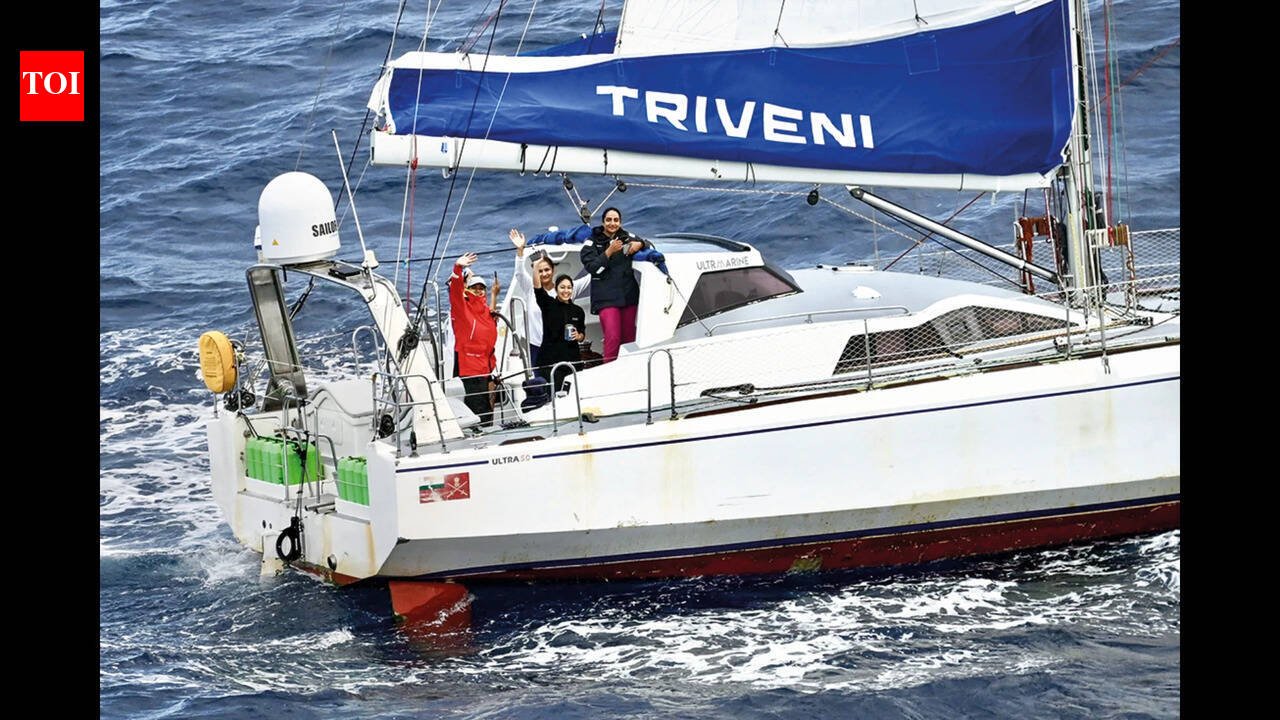
A historic tri-service, all-woman crew set out on a 25,500 nautical-mile circumnavigation expedition aboard the Indian Army Sailing Vessel Triveni. The crew of nine members, after sailing across five continents and overcoming extreme oceanic challenges, returned to Indian shores in Mumbai on Wednesday
The crack of the largest sail tearing loose in a 60-knot gust, with four-to-five-metre swells hammering the hull somewhere between Australia and New Zealand, is not the sound that any yacht skipper wants to hear. That is exactly what Lt Col Anuja Varudkar, skipper of the Indian Army Sailing Vessel (IASV) Triveni heard at 8.30 in the night. That sound is the one that still visits her in quiet moments.The IASV Triveni and her crew bashed on, through the Southern Ocean’s treacherous waves and Cape Horn’s fury, all the way through the Drake Passage to a triumphant return at the Gateway of India on Wednesday. The vessel returned to Mumbai on July 4, but was officially flagged in on Wednesday.
The crew of IASV Triveni with female officers at one of the ports they halted at
After 314 days and nearly 25,500 nautical miles, the first tri-service circumnavigation by Indian women had come full circle, back to the very slipway from which it had cast off on Sep 11 last year.Thrown into the deep endFew of the crew arrived as sailors. Major Karamjeet Kaur, of the Military Nursing Services from Sirsa in Haryana, had no sailing history whatsoever. Neither did Squadron Leader Vaishali Bhandari of the Air Force’s accounts branch, who learned everything from knots, navigation, and nerves onboard. When the women officers sailed out on the Triveni, they had logged barely 3,000 nautical miles between them.
It showed, briefly, on the very first leg. “The boat was new to us and we were new to each other,” Varudkar admits of the run from Mumbai to Australia, when persistent equipment troubles turned the passage into an unplanned crash course. “We found out who is good at what, who has a keen eye, who can understand the change in noise of the engine, the change in the sails.”It is the oldest lesson in sailing. The sea does not care about resume or gender, only about how fast you learn.Varudkar is a self-described “land lugger” who admits she is afraid of swimming pools where she cannot see the bottom, let alone an ocean where the depth is measured in kilometres. “I had to challenge myself. I wanted to find myself,” she says. “The Army motto when I joined was ‘Do you have it in you,’ and through this expedition, I have proved to myself that I still have it in me.”Her deputy, Squadron Leader Shraddha Raju of the IAF, had never so much as stepped onto a sailboat before training began. A scuba diver by inclination, she found herself, three years later, responsible for Triveni’s most temperamental systems such as generator, sails, pumps, navigation gear, and mast.
Heart in the mouthIt was Raju who, alongside Kaur, crawled to the bow in the dead of a Tasmanian night to lash down a wayward genoa while angry waves washed over the yacht determined to pummel the crew into submitting to the Southern Ocean.Varudkar watched as two of her crew wrested a shredded sail in the ghoulish light of a headlamp when a rogue wave swept the boat sideways and sent them swinging out over black water. “For a moment, I could not see the light of their headlamp, and I was scared they had fallen overboard,” she recalls. “As the skipper, I was wondering if I would have to face their organisations, their parents, and explain what happened.”Albatrosses and a Jain diet in the roaring fortiesFor all its danger, the voyage kept faith with the sea’s older superstitions and stranger comedies. Sighting an albatross in the Southern Ocean, sailors have long believed, is a stroke of luck, and Triveni’s crew took every one they could get, alongside penguins off Argentina, playful dolphins and seals, and bioluminescent jellyfish lighting the wake at night.Provisioning six people across every ocean on Earth produced its own small sagas. Fresh food lasted 10-15 days out of any port before the real culinary improvisation began, with a rotating “mother of the day” conjuring meals from whatever remained. A forgotten crate of onions left the crew on an inadvertent Jain diet all the way to Argentina. DRDO-issued ready-to-eat meals filled the gaps, but as Raju puts it simply, “We missed Indian food everywhere.”Not every trial announced itself with a gale. Lt Cdr Priyanka Gusain, the Navy’s naval architect aboard, found the expedition as much an inward voyage as an outward one. “Most of our lives are spent focused on ourselves, our goals, our routines,” she reflects. “But out at sea, surrounded by the vastness of the ocean, all of that seemed insignificant.”
For Raju, the memory that lingers is a humpback whale that circled the boat off Australia as she was underwater repairing the propeller.Kaur, distilling nearly 10 months into a single phrase, settles on “magnum opus”. Gusain calls it “life-defining”. For Raju, it’s simply “epic” — though she is already, by her own admission, “waiting to get back to the seas… but this time for shorter durations”.Bhandari, “a pahadi” at heart, is craving a trek through the hills of Uttarakhand. Gusain plans to return to her parent cadre in Naval Construction, hoping to feed the voyage’s hard-won lessons about seaworthiness back into the design of future Indian naval vessels. And Varudkar, ever restless for the horizon, says plainly, “When I find a desk job waiting for me, I feel the urge to run back to the sea.”


