



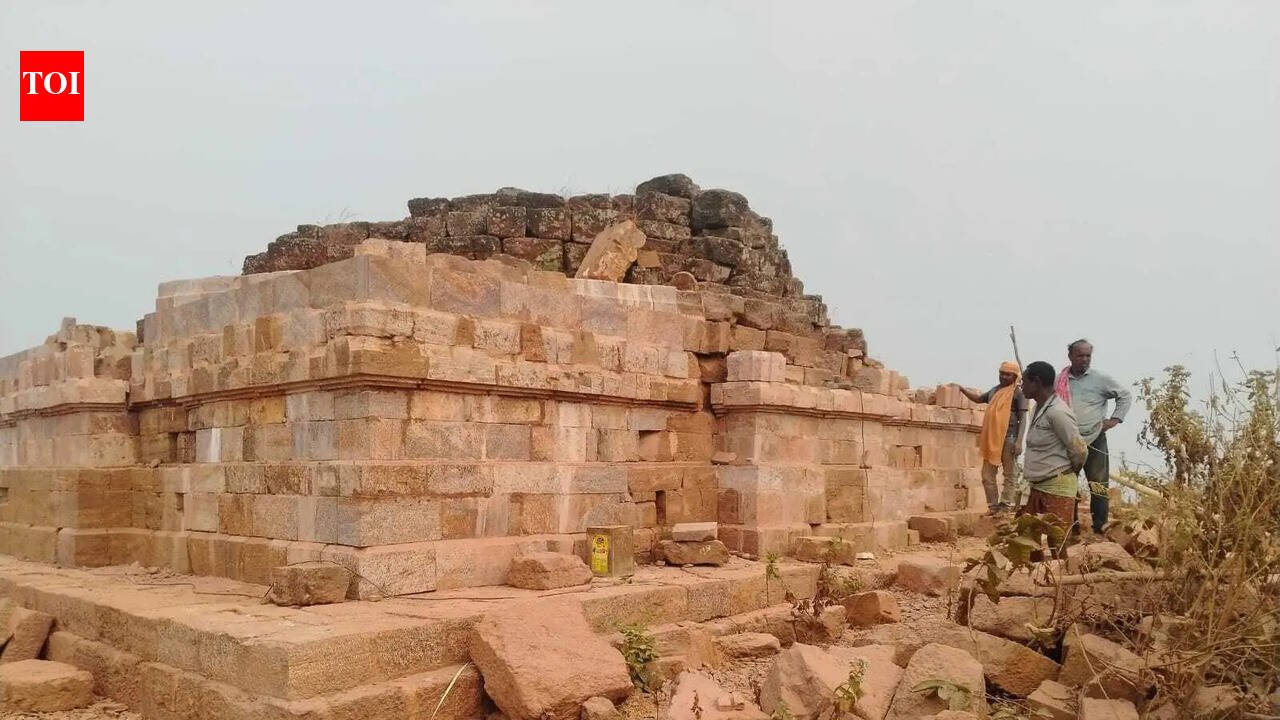
Kendrapada: To protect Odisha’s Buddhist heritage, the Archaeological Survey of India (ASI) has completed conservation work on the state’s highest Buddha stupa at Parabhadi hillock in Jajpur district.“The 8th-century stupa, measuring about 15 ft in length, stands at an elevation of 138 m above sea level. ASI had unearthed the remains of a 4m-long Buddha stupa at the site in 2023,” said Chittaranjan Dash, deputy superintending archaeological engineer of ASI, Puri circle.“Conservation and renovation work took nearly three years to be completed at Rs 20 lakh. The stupa is believed to have been built around 1,300 years ago and had suffered extensive damage over time,” Dash said. He added that Parabhadi hillock was once a prominent Buddhist complex, known for its Great Stupa, brick monasteries and rock-cut caves.“Buddhism left a deep imprint in this region, particularly through its architecture, monasteries and stupas,” Dash said.After the discovery, ASI sought a halt to quarrying on the hillock, including extraction of khondalite stones by Odisha Mining Corporation and others. “After our request, quarrying was stopped, which allowed us to begin conservation work,” Dash added. Parabhadi hillock is located barely a kilometre from Lalitgiri, one of Odisha’s most prominent Buddhist sites.Along with Ratnagiri and Udayagiri, these sites form the famed ‘Diamond Triangle’, highlighting the region’s rich Buddhist past.“ASI carried out excavations at Lalitgiri between 1985 and 1991, uncovering a massive hilltop stupa and the remains of an apsidal chaitya griha,” Dash said, adding that Parabhadi was not excavated during that phase.Welcoming the restoration, Buddhist scholar Suvendu Bhuyan said the site had been deteriorating due to official neglect. “Many Buddhist scholars across the world remain unaware of Parabhadi’s significance. The site lacks basic infrastructure such as lighting and proper pathways,” he said.Bhuyan also urged ASI and the state govt to take up further excavation and development, claiming several rare Buddha images remain buried in the hillock and the site has strong potential to emerge as a major centre for heritage tourism.


