


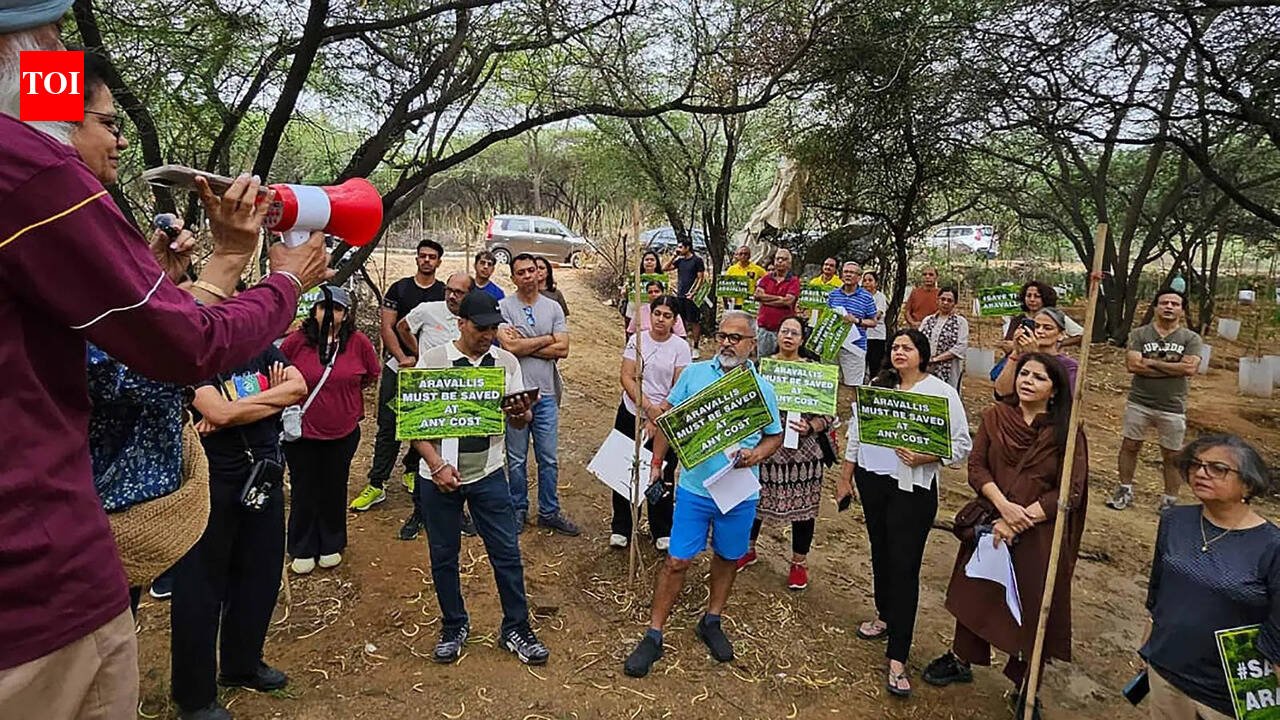
Gurgaon: Citizens and greens are up in arms against the “ecological and legal implications” of Haryana govt’s 750-acre afforestation initiative in the Aravalis.On World Environment Day, over 100 residents, environmentalists and wildlife enthusiasts — who held placards reading ‘Aravalis Must Be Saved At Any Cost’ — gathered at the Matri Van project site in Sector 55 and dwelt on “violations” of environmental laws, destruction of wildlife habitat and unscientific plantation practices within the project area. Participants raised concerns about the impact of the project on wildlife.“The Aravalis do not need to be converted into a curated urban park,” trustee of Aravali Bachao Citizens Movement (ABCM), a citizens’ group, S Oberoi said during a discussion organised by ABCM. “What existed here was a naturally regenerating ecosystem supporting wildlife, biodiversity and groundwater recharge. Our concern is that a functioning forest landscape is being altered in the name of restoration without adequate ecological studies and wildlife mitigation measures,” Oberoi added.Activists — who assembled under the existing tree canopy on Friday between 7am and 8.30am near Kholi-Wale Baba Temple — claimed the site forms part of a wildlife movement corridor connecting forest patches in the Aravalis and supports species such as leopards, striped hyenas, reptiles and other fauna. Members of the group alleged that natural hillocks were flattened and claimed the works violated provisions of the Forest (Conservation) Act and protections available under Sections 4 and 5 of the Punjab Land Preservation Act (PLPA).The Matri Van project, part of the Centre’s ‘Ek Ped Maa Ke Naam’ campaign, has been planned as an urban forest along Gurgaon-Faridabad Road. Spread across five villages — Chakkarpur, Haiderpur Viran, Wazirabad, Ghata and Nathupur — the project aims to create a green corridor linking the Aravali Biodiversity Park and Nagar Van along the Chakkarpur hill belt.According to activists, large-scale earthmoving activities undertaken since Aug last year altered the natural Aravali terrain through the use of heavy machinery. Wildlife rescuer Jyoti Raghavan spoke about wildlife presence in the area and questioned the absence of wildlife mitigation measures. Members of the group alleged that habitat used by wildlife was disturbed without detailed ecological studies or mitigation plans.Another issue highlighted during the event was the plantation methodology being adopted at the site. Vaishali Rana, trustee of ABCM, said, “Native species such as neem, peepal, banyan, amaltas and sheesham have been planted barely 3-4 feet apart, including under dense canopy areas. Trees are being planted almost like herbs. There is no scientific spacing and plantation is being carried out inside an existing forest ecosystem. We believe this is contrary to established ecological restoration principles.”Environmentalists argued that portions of a naturally regenerated forest ecosystem were being modified to create a curated urban landscape featuring walking trails, gazebos and other public-use infrastructure. They questioned the need for fresh plantation in areas where natural vegetation already existed.The initiative was inaugurated last year by Union environment minister Bhupender Yadav and Union minister for housing and urban affairs Manohar Lal Khattar. Haryana govt has maintained that the project is intended to enhance green cover, improve biodiversity and restore degraded landscapes in the Aravallis.Meanwhile, a senior forest department official said ownership of land does not determine whether an area is treated as forest under law. “The question of land ownership was never a factor. Any area classified as forest is treated as forest irrespective of who owns it and is governed under provisions of the Punjab Land Preservation Act, including Sections 3, 4 and 5,” the official said.
