


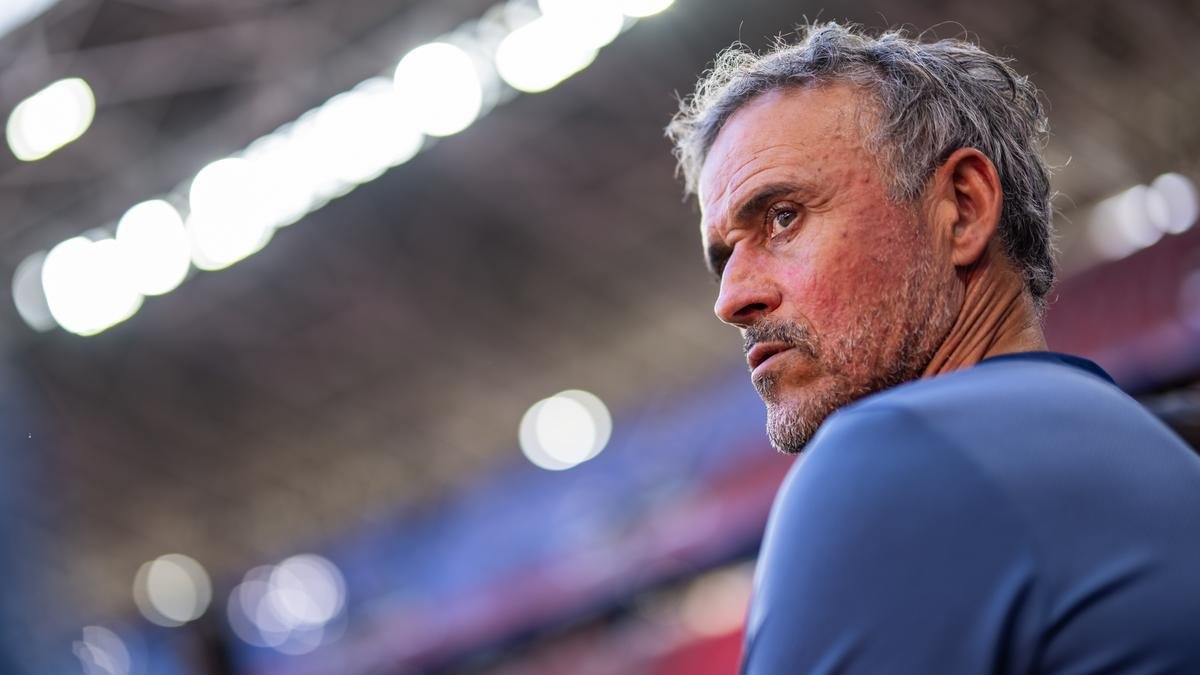
After presiding over PSG’s successful Champions League title defence, Luis Enrique put his name up in lights in the hall of fame for football’s greatest-ever managers.
Having previously guided Barcelona to Champions League glory in 2014-15, the Spaniard secured his third European Cup triumph as a coach. He joined an elite group of managers with three or more European Cup titles, alongside Carlo Ancelotti, who won a record five, and Bob Paisley, Zinedine Zidane and Pep Guardiola, who have each lifted the trophy three times.
Getting one over Guardiola
By going back to back, Enrique achieved what even his good friend Guardiola — who has a case for being considered the greatest ever — could not. And he did it in some style, with his PSG team being feted for its silky interplay and bewildering movement.
Enrique’s insistence on high-intensity, high-pressure football with electrifying forwards who dribble through defences has created a rare blend — arguably even improving on Guardiola’s iconic Barcelona side which won the Champions League twice. He has expanded on the possession-based ideas of Spain’s best teams, adding risk-taking and transitional threat.
Enrique’s PSG plays structured positional football, typically a 3-1-6 in possession. But there is fluidity within this formation — it’s not the same players in the same positions at all times. The side can pull apart most defences with its clever positional interchanges.
While PSG couldn’t break Arsenal down in the final, which went to penalties, it still created several headaches for the English champion, which Enrique said was the best team in the world out of possession. Arsenal manager Mikel Arteta said after the game that his plan wasn’t to have just 25% of the ball, but PSG’s dominance had precipitated the situation.
“It’s not a plan to play in certain scenarios when you don’t have the ball but they force you to do that,” Arteta, who admitted to being inspired by Enrique and PSG, said. “What they are able to do with the ball, individual actions, I haven’t seen it [before]. And so even more praise to them.”
In many ways Enrique is the defining figure of this PSG project, after the megastars, Lionel Messi, Neymar, and Kylian Mbappe, departed. As Arteta said, “His fingerprints are all over this team.” Enrique arrived in Paris in 2023 promising a cultural shift rather than instant glamour. The Spaniard wanted a team in which collective sacrifice outweighed individual status, where the biggest names defended, pressed and suffered together. It’s fair to say he has succeeded.
Un, dos, tres: Enrique’s next target is the Champions League three-peat. ‘We can talk about going back-to-back-to-back, our club is worthy of it, as are our supporters,’ he says.
| Photo Credit:
Getty Images
After Mbappe left in 2024, Lucho, as he is nicknamed, said his team would become even stronger. “Having a player who moved wherever he wanted meant there were parts of the game I couldn’t control… next year, I’ll control everything. Everything,” he said. And he did.
The club still invested heavily in players, but players tailored to their manager’s plans, willing to run endlessly for the collective, and keep egos in check. “I arrived at the club thinking, ‘My objective is to make history,’ and we have indeed made history,” Enrique said. “We want to keep writing the story because we believe there’s still more there for us to achieve.”
Trophy-winning dynasty
Enrique has won 12 trophies, including three Ligue 1 titles, during his time at PSG. It is clear, from inside and outside, the effect the Asturian has had on a club built in his image, capable of creating a modern football dynasty. But while there is no doubt about Enrique’s quality, the question of his legacy, specifically the PSG chapter, is less straightforward.
The French team, built with Qatari riches, continues to face questions about ‘sportswashing’, which global campaigning network Greenpeace defines as “the act of sponsoring a sports team or event in order to distract from bad practices elsewhere. This tactic is often used by companies and governments with poor environmental or human rights records, exploiting people’s love of sports to ‘wash’ their image clean”.
Qatar Sports Investments acquired a controlling stake in PSG in 2011, just under a year after Qatar was named host for the 2022 World Cup. Critics saw both moves as a means to “mute criticism of an autocratic regime”, to take attention away from its “appalling treatment of migrant workers”, “suppression of human rights”, and “imprisonment of whistleblower Abdullah Ibhais”.
Critics also cite the financial imbalance enjoyed by state-owned teams such as PSG, Manchester City and Newcastle, arguing that it undermines fair competition. They point to the influence of PSG president Nasser al-Khelaifi, the chairman of both European Football Clubs (EFC) and broadcasting company beIN, on the administration of European club football. This, they say, is the “the deeper effect of state money”.
The questions and criticism have reduced with PSG’s success on the biggest stage — critics contend that this is precisely the point of ‘sportswashing’.
Sticking point: Enrique’s tenure at PSG doesn’t lend itself to easy analysis. Critics say the financial imbalance enjoyed by the Qatar-owned club and the influence of PSG president Nasser al-Khelaifi on European football undermines fair competition.
| Photo Credit:
Getty Images
Enrique’s tenure at PSG — much like Guardiola’s at City, which was marked by incredible trophy success but marred by 115 alleged breaches of the Premier League’s financial regulations — will be accompanied by a knotty question: Can legacy be separated from the context of the circumstances in which it is built?
Fans of Enrique will hope that the answer doesn’t define him entirely. The 56-year-old has enriched the game with his progressive ideas of play, extending the limits of modern tactical thinking. While mastering his craft, he has endured a great personal tragedy and borne the loss of his young daughter with resilience and grace. Some will also highlight the fact that other managers have enjoyed Enrique’s resources at PSG but failed to produce the results he has.
Target three-peat
For his part, Enrique isn’t overly concerned about his legacy, at least publicly. After the final, he said he was “not interested” in whether he was becoming a legend or not. His next target is the Champions League three-peat. “The first one was incredible, but more than anything we had that desire to get the second,” he told broadcaster M6. “I love this club so much, and it’s not over! We’ve got the second, we’ll keep working and go get the third.”
Record 15-time winner Real Madrid won the Champions League three times (2016-2018). Before that, the last teams to complete a hat-trick were Bayern Munich and Ajax in the 1970s. Real also won it five years running, back at the competition’s inception. “We can talk about the back-to-back-to-back,” said Enrique. “We can talk about these types of objectives, our club is worthy of it, as are our supporters. We do need new players to refresh certain positions, but we’ve been champions of Europe for two years… piano piano [slowly, slowly].”
