






Lok Sabha Speaker Om Birla on Thursday said any fresh impeachment motion against Chief Election Commissioner (CEC) Gyanesh Kumar would be examined in accordance with the laid-down procedures, amid Opposition protests demanding his removal over alleged irregularities in the Special Intensive Revision (SIR) of electoral rolls.

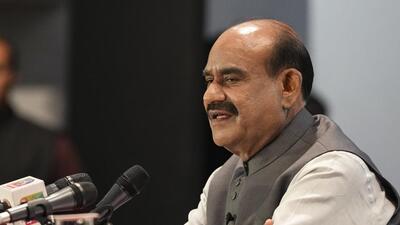
“We will follow the process when the motion is moved. Just as there is a procedure for the impeachment of judges, there is a process laid down for the CEC too… It will be followed if the opposition moves a motion,” Birla said at a press conference ahead of the 12th BRICS Parliamentary Forum, which India is hosting.
The Opposition has been leading protests against Kumar and has met President Droupadi Murmu, demanding his removal and the repeal of the 2023 law that provides immunity to the CEC and Election Commissioners. It has accused the CEC of the “unilateral and arbitrary exercise of the collective powers” during the ongoing revision of electoral rolls.
The Opposition has made two attempts to remove Kumar. The notices submitted in the first attempt were rejected by both the Lok Sabha and the Rajya Sabha, while those submitted in the second attempt are pending in the Upper House.
Under the law, the CEC can be removed by Parliament through a process similar to the impeachment of a Supreme Court judge. The CEC or an Election Commissioner may also resign by submitting a written resignation to the President.
Responding to speculation that the government may convene a special session of Parliament to introduce and pass the Constitution (131st Amendment) Bill and the Delimitation Bill to implement 33% reservation for women in legislatures, Birla declined to comment on whether such a session was planned.
He said the process of proroguing Parliament was explicitly laid down in the Constitution and that there had been instances of long intervals between the adjournment of a session and the proroguing of the House.
“This is not the longest duration (between the adjournment and proroguing)… Article 85 of the Constitution clearly states the rules for proroguing the House,” he said.
The Monsoon session was adjourned sine die on August 13 but has not yet been prorogued. Article 85 empowers the President to summon and prorogue either House of Parliament, or dissolve the Lok Sabha, on the aid and advice of the Council of Ministers. While it requires that no more than six months elapse between two sessions, it does not specify a deadline for proroguing a House.
According to a person aware of the details, the government needs to give 15 days’ notice before convening a full session and at least three days’ notice for a special session. Union parliamentary affairs minister Kiren Rijiju said earlier this week that there had been several instances in the past when both Houses had not been prorogued for extended periods, including for periods of up to 87 days.
On the petitions seeking the disqualification of rebel Trinamool Congress (TMC) MPs who broke away and merged with the Nationalist Citizens Party of India (NCPI), a registered, unrecognised regional party, Birla said the matter was being examined.
“The petitions are being heard in the (Supreme) Court and they are also being heard in my court… Both sides are being heard and the proceedings are underway. As soon as we receive their response, we will expedite the process,” he said.
A TMC faction led by its national general secretary, Abhishek Banerjee, had petitioned Birla seeking the immediate disqualification of the rebel lawmakers, arguing that their merger amounted to “voluntarily giving up party membership”.
Birla also expressed hope that the two-day BRICS Parliamentary Forum, beginning October 26, would adopt a joint declaration by consensus and discuss issues of global concern, including terrorism and climate change.
“India’s position has consistently been against terrorism, and we have always condemned it at every level. I hope there will be a detailed discussion on this issue within BRICS as well. Terrorism must end in every country,” he said.
Prime Minister Narendra Modi is scheduled to attend the event and meet leaders of visiting delegations, Birla said. While Saudi Arabia and Ethiopia are yet to confirm their participation, 18 countries have submitted suggestions for the forum, which will be taken up during the deliberations.


