



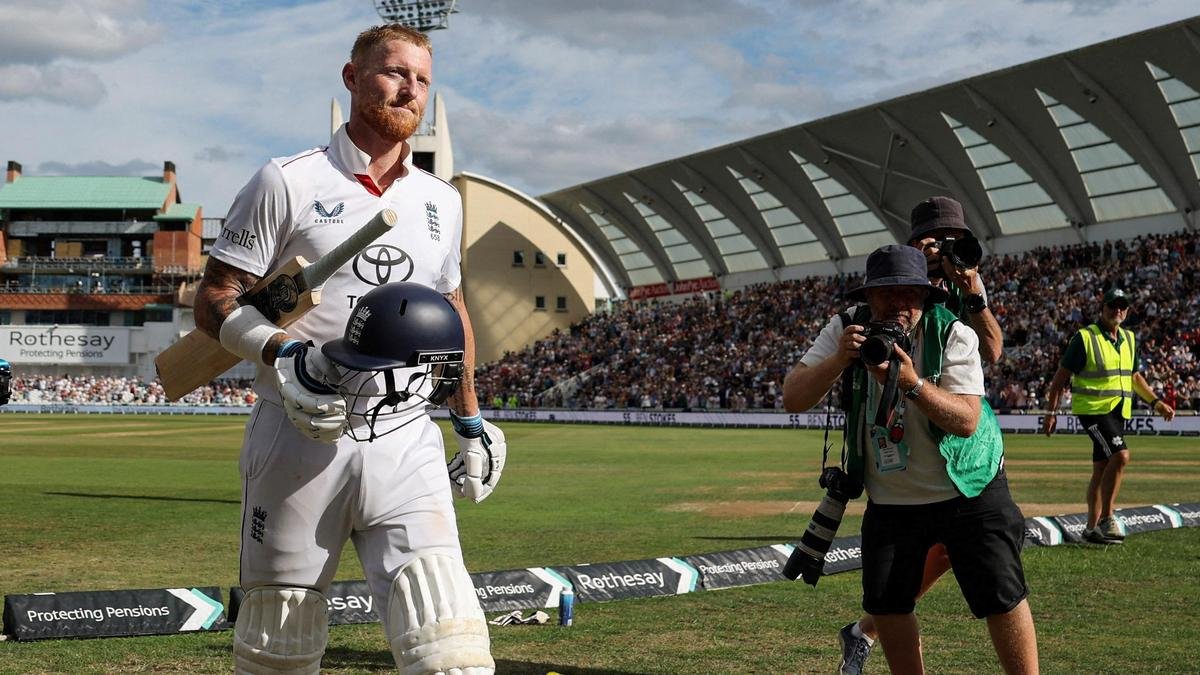
Anonymity is a very strange state of being, depending on which side of the fence one is on. Most of us go through life craving it, maybe because we aren’t confident enough in ourselves, in our abilities and skills. Many of us willingly embrace it, because hey, isn’t life easier that way? Some of us absolutely abhor it – who doesn’t want to be known and recognised and celebrated and feted? And then there are the uber achievers, who enjoy the adulation and the attention but occasionally, very occasionally, covet it anonymity for the simple reason that being a celebrity doesn’t allow them the ‘luxury’ of doing the simple, mundane, unglamorous everyday things.
Anonymity and Ben Stokes have never been intimate bedfellows. How could they be? Stokes isn’t just a run-of-the-mill cricketer – he is not a right-arm trundler who relies on conditions to prise out the occasional wicket, he is not a left-handed plodder who nudges and nurdles and quietly moves to 30 or 40. He isn’t a ‘safe’ fielder who is a bank when the ball comes directly to him but is otherwise inconspicuous on the park. He isn’t hiding in the outfield, at fine-leg or third-man, trying to stay away from the ‘action areas’. No sir, Ben Stokes is none of these things.
Never would Stokes have yearned for anonymity more than on that one dramatic April night in 2016, when the theatre of dreams which is the majestic Eden Gardens became his stage of nightmares. Oh wait, maybe that’s not correct; Kolkata was potentially the first time in his international career that Stokes would have wished the spotlight were not trained on him, for all the wrong reasons.
For almost the entire length of England’s T20 World Cup final against West Indies, Stokes had been a fringe entity, bordering on the anonymous. An unremarkable eight-ball 13 in his team’s tally of 155 for nine, then modest figures of none for 17 from two overs as the Caribbeans got down to business. Until Eoin Morgan tossed him the ball for the final over of the tournament, with the game wide open, West Indies needing 19 to become the first two-time champions.
Marlon Samuels, the tempestuous but exceptionally gifted right-hander, had spearheaded a stuttering West Indian riposte with a glorious 85, but as Stokes marked his run-up, he was off strike, having failed to lay bat to Chris Jordan’s last ball of the tournament. Instead, the towering figure of Carlos Brathwaite – ‘Remember the name?’, to quote Ian Bishop slightly out of context – stood nearly 40 yards away, deceptively lying in wait. Perhaps, the big right-hander would scamper a single and bring Samuels back on strike? After all, you’d back someone on 85 to knock off the remaining 18 off five deliveries, right?
Admiring spectator
Wrong. Brathwaite decided instead that he would flex his muscles. That Samuels, who had provided all the batting entertainment in the second half of the title clash, could now just be an admiring spectator, not the headline act. And so he went 6. Then 6. And 6 and 6 again. Four balls, four sixes, all over, thank you very much.
Eden Gardens erupted in ecstasy, matching the mood in the Caribbean camp which reflected on a glorious double. Just hours previously, West Indies Women had crowned themselves T20 World Cup champs for the first time, and watched proudly as their male counterparts too kept up their end of the bargain. The last of Brathwaite’s four sixes was the spark for a party that didn’t end for several hours.
As the Caribbeans swarmed Brathwaite and Samuels, Stokes cut a lonely figure. First hands on his knees, looking vacantly in front of him, then finding himself sucked in by the power of gravity, he would have so wished for the ground beneath him to cave him and gobble him up. His colleagues, with Morgan in the lead, swooped on him in consolation and commiseration, trying to convince him that defeat was collective, that Stokes mustn’t be too harsh on himself. As if those words ever registered.
Could that passage of play could have ‘broken’ Stokes? Does the sun rise in the west? Is there no sand in the desert?
When India were shot out for their lowest Test tally of 36 in Adelaide in late 2020, Ravi Shastri exhorted his wards to wear it ‘like a badge on your sleeves’. “And you will be a great team,” the head coach thundered. Prophetic words, as India bounced back from that debilitating low to pull off one of the great miracles in modern-day cricket, clinching the series 2-1 despite key personnel dropping off like autumn leaves. One isn’t sure if, four and a half years previously, anyone had suggested the same to Stokes or whether he wore four sixes in the last over to lose a T20 World Cup final ‘like a badge on his sleeve’, but he did finish as a ‘great’ player. Great, in every sense of the term.
In this day of hyperbole and the need to affix adjectives and superlatives as if there is no tomorrow, everything is ‘great’. How many times have we watched even a T20 game on the telly and come away not having heard ‘great’ at all? A reverse sweep is great, a dot ball in the 19th over is great, a dramatic tumbling stop in the infield even though there is a fielder patrolling the boundary ropes is great. And that won’t change, because apparently words like these are what keep the audience hooked when there are so many other avenues of entertainment available.
But even against this backdrop, but maybe more appropriately, independent of it, history will regard Stokes as a great cricketer. With great being used in its purest, most unadulterated form. A great cricketer, sure, but also a great competitor, a great motivator, a great entertainer. Great at making news too, for sure, but there are few sights in cricket of a recent vintage to match Ben Stokes on a cricket field.
Just the other day, Geoffrey Boycott, that wonderfully obdurate England opener whose cricket was as diametrically opposite to the Stokes brand as imaginable, wrote in his column in an English newspaper that while he considered Stokes the more dangerous bowler, in his estimation, Ian Botham was the greater all-rounder. Boycott knows what he is saying – needless to mention; Botham was truly a fabulous showman who turned matches as much through his sheer magnetic presence as his bag of tricks that ranged from the innocuous to the outrageous. He would have been a perfect fit when it came to T20 cricket which, strangely enough, isn’t Stokes’ strongest suit. But who can argue that Stokes isn’t at least in the same league as the older maverick who also had his fair share of misadventures off the park?
Any mention of Stokes going forward will always be accompanied by a footnote, an asterisk, recalling his off-field dalliances, one of which potentially pushed him into international retirement earlier this week. Stokes has been involved in numerous controversies, most of them in or outside watering holes including a charge of affray in September 2017 of which he was cleared a year later. It was his bending of a curfew last month that was introduced to the English setup — Stokes himself was among those who framed the rules — which precipitated his premature departure from the sport at the highest level. Despite being 35, despite battling a ravaged and creaking and protesting body and despite having spent a decade and a half fashioning and pulling off miracles with stunning regularity, he still has so much cricket left in him.
The Stokes miracles are too many to be condensed into a few hundred words, though there are a couple that continue to astonish and exhilarate, nearly seven years after the acts and within a few weeks of each other. The first of those came at the 50-over World Cup final at Lord’s, against an indomitable New Zealand side led by one of the other stellar champions of modern times, Kane Williamson. Chasing 242 for a maiden title – not even the magic of Botham had facilitated victory against Pakistan in the 1992 final at the gigantic MCG – England played themselves into a hole at 203 for six with only 23 deliveries remaining. But Stokes accounted for most of the next 38 runs as the match ended in a tie with Mark Wood run out off the last ball in looking for the winning run. Stokes finished unbeaten on a marvellous 84 as the match ended in a sensational tie. He then swiped eight off three in the Super Over, which too ended indecisively, but England were declared triumphant on the quirky boundary countback rule that has since been banished into oblivion.
The events of July 14, which helped England finally break their 50-over World Cup duck and slay the ghosts of 2015, when they failed to advance beyond the first stage, propelled the legend of Stokes to stratospheric proportions. Already a hero of the masses, he won over the tight upper-lipped too; Lord’s went nuts (really, no exaggeration) and Stokes became a national hero, having fashioned the impossible.
Mere mortals would find it impossible to top those heroics, but Stokes hasn’t always conformed to norm. And so there he was, a month later, pulling off another otherworldly rabbit out of the hat, in a Test match but not in just any Test match. It was against the old foe, the one who must not win. But it was old foe that led 1-0, with three to play, when England and Australia lined up at Headingley for the middle fixture of what unspooled into one of the great Ashes showdowns.
Australia were well on course to establish an unbeatable 2-0 lead after setting the hosts a target of 359. The highest total in the first three innings was 246, England had been shot out for 67 in their first dig. How do you even think of making more than five times that many, in the final innings?
How do you, Ben? England were 286 for nine when Jack Leach, the uncelebrated No. 11, joined Stokes.
Incredible climax
In a fairytale passage lasting 62 deliveries of which Leach faced only 17, Stokes cut loose with an unbeaten 135 that hauled his team over past the winning post. Stokes for PM in the summer of 2019? Well, England would certainly not have had four Prime Ministers in the last seven years.


