






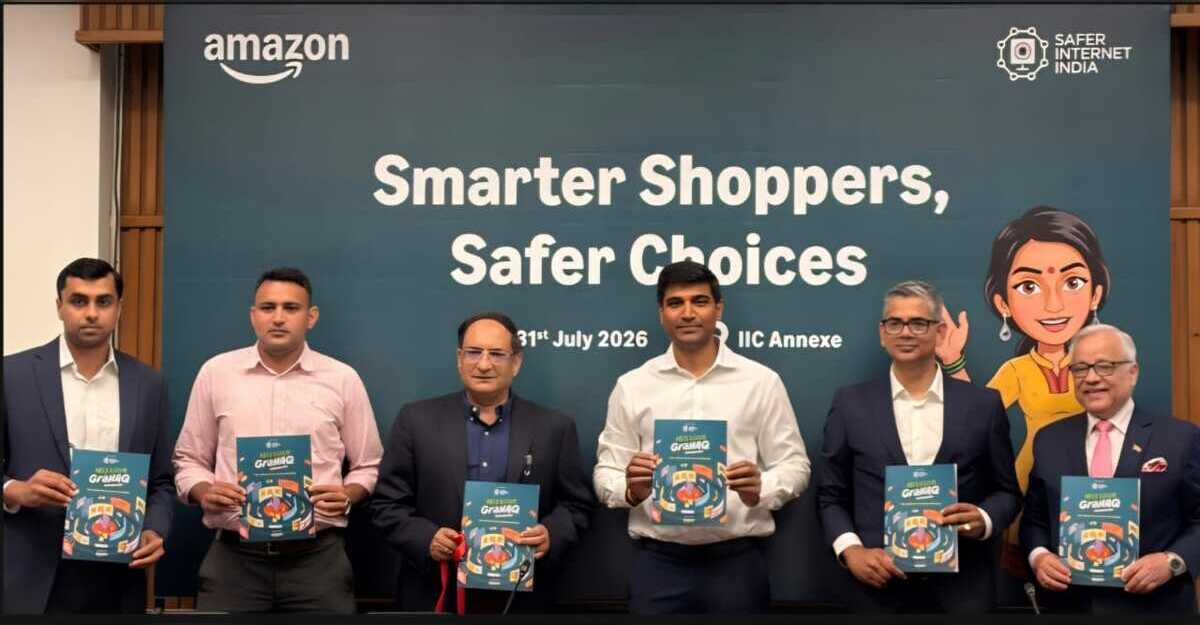
In an exclusive conversation with ETLegalWorld, Rakesh Mohan Bakshi, Head of Legal at Amazon India and Vice President (Legal) for India, MENA, and Turkey, spoke about Amazon’s three-pillar strategy of enforcement, education, and technology, to tackle counterfeiting and online fraud, as the company unveiled its new consumer awareness handbook, “Mission GraHAQ,” on July 31, 2026.
Developed in partnership with the Safer Internet India coalition and Koan Advisory Group, the “Mission GraHAQ Handbook: Your Guide to Safe Online Shopping” comes at a time when India’s e-commerce market, is projected to grow to USD 250 billion by 2030, driven by rapid expansion into tier-2 and tier-3 cities.
Speaking on the sidelines of the handbook launch Bakshi, said “customer obsession” remains the company’s foundational leadership principle, driving its approach to seller verification, product safety, and its no-questions-asked return policy.
Bakshi described Amazon’s model as a “house” with customer trust and delight at the top priority. Bakshi noted that Amazon vets India’s roughly 1.5 million third-party sellers through GST numbers, tax filings, contact details and bank verification before onboarding, and that customer complaints trigger investigations that, according to him, result in 99 percent of flagged counterfeit products being removed from the marketplace.
Bakshi confirmed that Amazon has finally set up its Counterfeit Crimes Unit (CCU) in India, a team of lawyers and former law-enforcement personnel tasked with proactively identifying counterfeiters and scam networks and building evidentiary cases for police action.
This aligns with Amazon’s public announcement in April 2026 that it was expanding the CCU to India as part of a broader push to strengthen consumer protection and intellectual property enforcement, backed by its commitment to invest tens of billions of dollars in the country through 2030. Bakshi clarified that the India unit is only weeks old, with “nothing to report” yet on enforcement outcomes, though the company expects to share updates as cases progress.
Globally, Bakshi said, the CCU model has driven results at scale, citing figures of roughly 50 million counterfeit products intercepted, more than 300 arrests, and around 30,000 police actions in a single year outside India, and Amazon separately disclosed that since 2020 the unit has driven over 200 civil actions and secured more than USD 180 million in restitution worldwide.
The handbook frames consumer education as a journey from a “Shikshit GraHAQ” (informed consumer) to “Satark GraHAQ” (vigilant consumer) to “Sashakt GraHAQ” (empowered consumer), and catalogues nine common scam types, including phishing, fake delivery and cash-on-delivery scams, empty-box scams, payment scams, fake urgency tactics, delivery-box data misuse, fake customer-support handles, and membership-renewal fraud.
It also sets out consumers’ legal recourse under the Consumer Protection Act, 2019, and outlines criminal remedies under the Bharatiya Nyaya Sanhita, 2023 and IT Act, 2000.
On outreach in smaller cities, Bakshi pointed to Amazon’s use of the communication that best resonates with the audience to make safety messaging resonate with tier-2 and tier-3 cities based customers.


